
Capture demographics and contact
Required: full legal name, date of birth, address, phone, email, preferred contact method, emergency contact. Demographics feed insurance eligibility and EHR chart creation.
Form template · Doctor appointment
New-patient registration is paperwork the patient can do at home instead of in your waiting room. Capture demographics, insurance, and history basics on the form — chair time becomes treatment, not admin.
Every template is free and fully editable in the drag-drop builder — swap fields, colors, and the button label before you publish.
No server, API route, or SDK — your Patient Registration Form posts straight to one endpoint.
Every submission is emailed to you and saved to a searchable dashboard — spam filtered before it reaches you.
It's plain HTML you own — paste the Patient Registration Form snippet, swap in your access key, and ship.
Copy and ship
HTML by default — the same field set also renders as React, Next.js, PHP, and cURL in your dashboard. Every variant posts to the same /api/submit endpoint. Replace YOUR_ACCESS_KEY with the key from your dashboard; that's the only edit.
<form action="https://splitforms.com/api/submit" method="POST">
  <input type="hidden" name="access_key" value="YOUR_ACCESS_KEY">
  <input type="hidden" name="subject" value="New appointment request">

  <label for="patient_name">Patient name *</label>
  <input id="patient_name" type="text" name="patient_name" placeholder="Daniel Chen" required>
  <label for="email">Email *</label>
  <input id="email" type="email" name="email" placeholder="patient@example.com" required>
  <label for="phone">Phone *</label>
  <input id="phone" type="tel" name="phone" placeholder="+1 415 555 0142" required>
  <label for="reason">Reason for visit *</label>
  <select id="reason" name="reason" required>
    <option value="">Choose…</option>
    <option>Routine checkup</option>
    <option>Follow-up</option>
    <option>New symptoms</option>
    <option>Prescription refill</option>
    <option>Other</option>
  </select>
  <label for="preferred_date">Preferred date *</label>
  <input id="preferred_date" type="date" name="preferred_date" required>
  <label for="symptoms">Symptoms or notes (optional)</label>
  <textarea id="symptoms" name="symptoms" placeholder="Briefly describe what brings you in."></textarea>
  <label for="insurance">Insurance provider (optional)</label>
  <input id="insurance" type="text" name="insurance" placeholder="Blue Cross / Aetna / N/A">

  <!-- honeypot — bots fill every field -->
  <input type="checkbox" name="botcheck" style="display:none" tabindex="-1" autocomplete="off">

  <button type="submit">Send</button>
</form><p class="splitforms-attribution" style="margin-top:12px;font-size:11px;color:#888;text-align:right">
  Powered by <a href="https://splitforms.com" style="color:#888;text-decoration:none" target="_blank" rel="sponsored noopener">splitforms</a>
</p>
How to add it
To add a Patient Registration Form to your site you need three things: a free splitforms access key, the HTML snippet above, and your key pasted into it. No backend, database, or CAPTCHA library — the form posts to one URL and every submission lands in your inbox and dashboard.
Required: full legal name, date of birth, address, phone, email, preferred contact method, emergency contact. Demographics feed insurance eligibility and EHR chart creation.
Insurance carrier, member ID, group number, policyholder (self / spouse / parent), and primary care physician (with referral if applicable). Front desk verifies eligibility before the visit; surprise denials disappear.
Webhook the registration into your EHR's intake API (Athena, DrChrono, eClinicalWorks all accept inbound). New-patient chart is created and pre-populated; the front desk reviews rather than re-types.
What's included
Front desks spend 10-15 minutes per new patient on registration paperwork — printing forms, handing over clipboards, retyping into the EHR. A web form completed ahead of the visit shaves that whole cycle. The form captures demographics, insurance carrier and member ID, pharmacy preference, emergency contact, and a brief history summary. Front desk imports the data into Epic / Athena / eClinicalWorks before the patient arrives; the visit starts on time. For sensitive history, redirect patients to your HIPAA-compliant portal after the basic registration — the public form captures scheduling data only. Capture scheduling data on the public form; route sensitive history to your HIPAA-compliant portal.

Where submissions go
Reply-to is wired to the visitor's email, so one tap on Reply answers them directly — while the built-in honeypot and spam classifier filter out bots before they reach you. Every submission is emailed to your inbox and can forward to a webhook or Slack the moment a visitor hits send.

How SplitForms works
Connect your form, collect every submission, and send data where it needs to go — without building backend infrastructure.

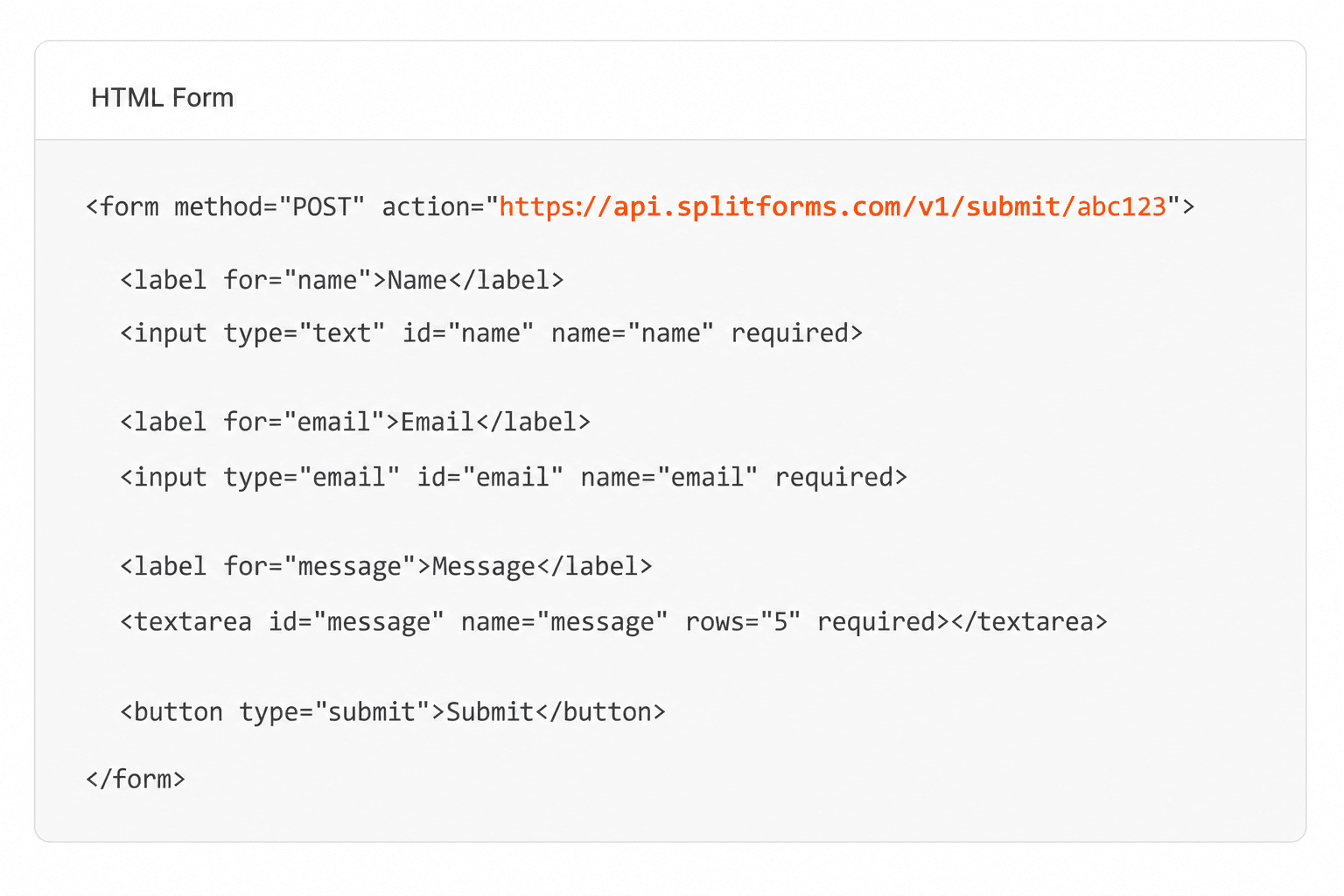
Point your form to your unique SplitForms endpoint. That's it.
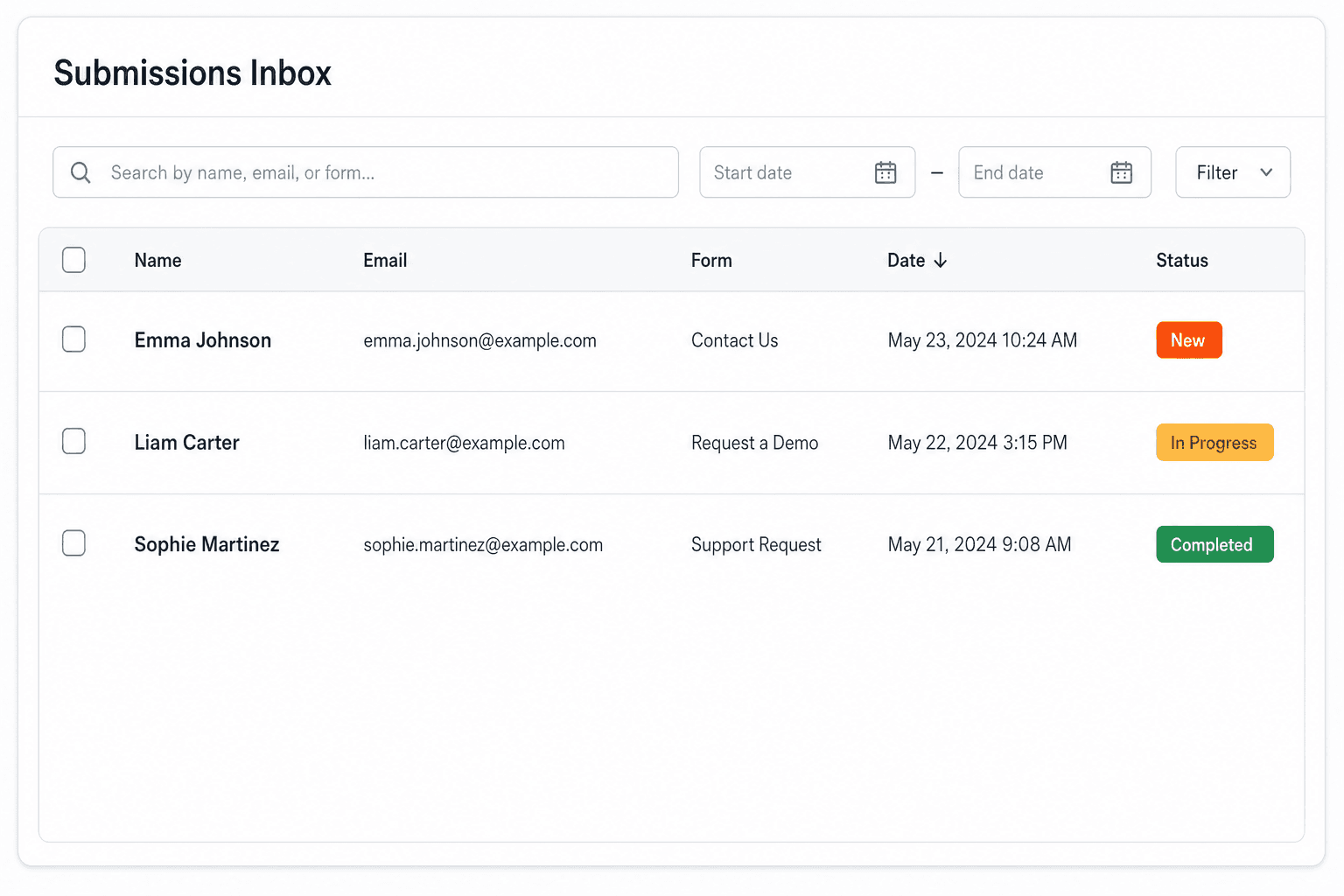
We instantly capture and organize every submission in your inbox.
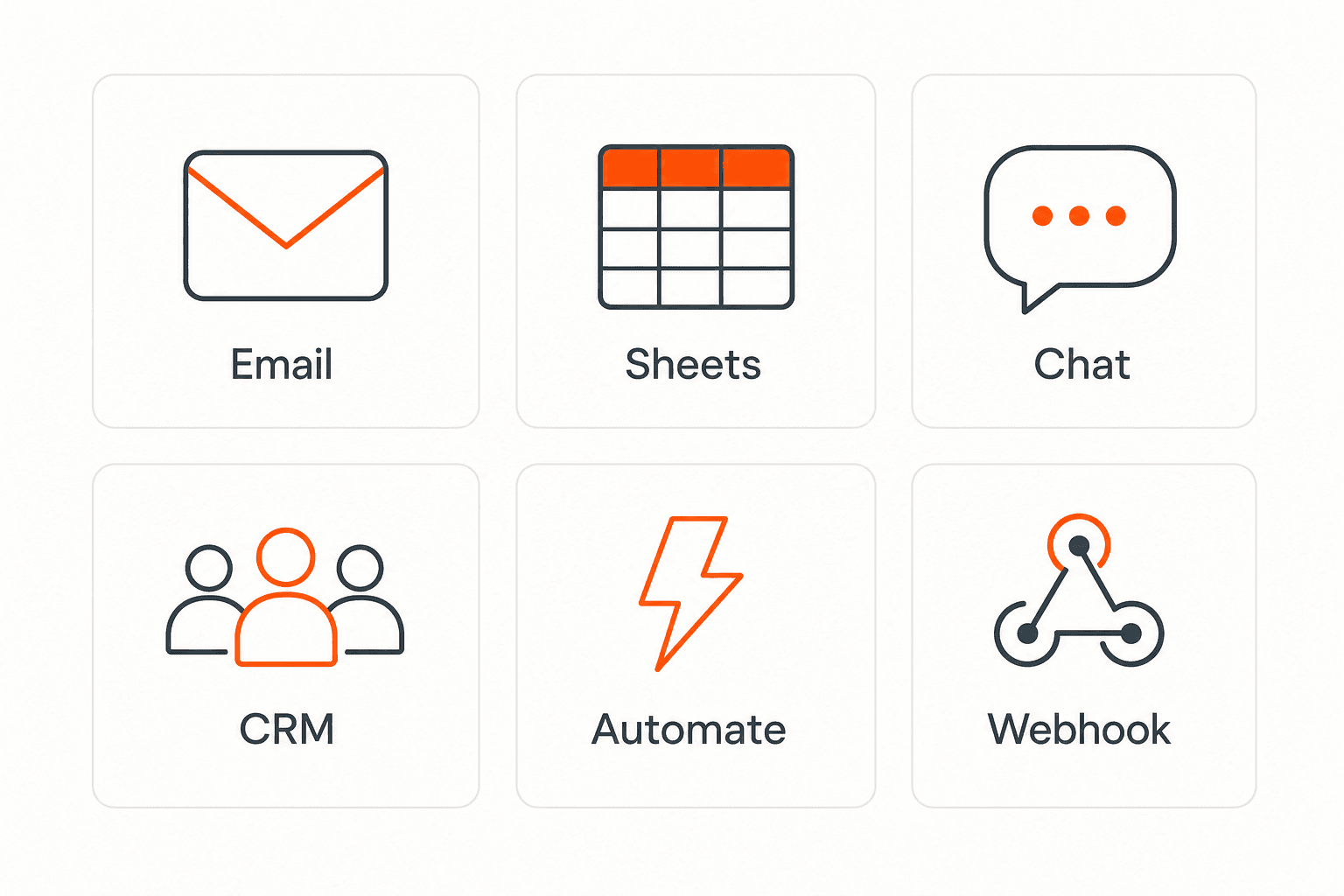
Send data to email, spreadsheets, CRMs, webhooks, and 7,000+ apps.
No credit card required. Set up in under 60 seconds.
Connect & automate
SplitForms works with the destinations you route to and the platforms you build on — from Slack and Sheets to WordPress, Shopify, and Next.js.

Trusted by indie teams and agencies shipping forms worldwide
Testimonials
40 quotes on record — from indie hacks to agency migrations.
“I replaced a Lambda + DynamoDB + SES contact form with six lines of HTML. It took eleven minutes, and the dashboard is better than what I was going to build.”
“We migrated 14 client sites off Formspree in a single weekend. The price is a third of what we paid, the API is more honest, and the spam filter actually works.”
“The webhook payload is signed, idempotent, and well-shaped. It reads like code from a competent team, not a CRUD app held together with duct tape.”
“I stopped reaching for Typeform on small marketing sites. splitforms covers 90% of the use case at none of the bloat.”
“I onboarded our whole agency in an afternoon. The MCP integration meant Cursor literally dropped the form straight into our client repos for us.”
“The free plan gave me 500 submissions before I paid a cent, and Pro is five dollars a month. I've spent more on coffee deciding which backend to use.”
“Spam went from forty junk entries a day to zero, with no reCAPTCHA puzzle ruining the form. The honeypot and time-trap just quietly do their job.”
“Point the form action at one endpoint and you're done. No SDK, no client library, no build step. This is how a form backend should feel.”
“Leads land in Slack the second someone submits, and a copy goes to Google Sheets for the sales team. I wired both up in under ten minutes.”
“I run a static Hugo site on a five-dollar VPS. splitforms gave it a real contact form without me standing up a single server.”
Questions
splitforms is not HIPAA-compliant out of the box on the standard plan — no BAA. The form is appropriate for non-sensitive registration data (demographics, insurance, contact). Detailed medical history, current medications, and diagnoses belong in your HIPAA-compliant patient portal, not on a public web form. For a fully compliant flow, capture basics here then redirect to the portal.
No — never on a public web form. SSN is only required for certain insurance or financial-assistance applications; collect it inside the secure patient portal or in person with proper safeguards. Public forms collecting SSN are a data-breach and regulatory liability.
The insurance carrier and member ID fields let the front desk run real-time eligibility through your EHR or clearinghouse (Availity, Change Healthcare). Verify benefits 2-3 days before the appointment so surprises surface in time to reschedule, not at the front desk.
Yes — most EHRs accept inbound registration data via their API or through HL7 / FHIR. Athena and DrChrono have direct API access; Epic typically needs vendor integration. Confirm with your EHR's integration team before deploying; the splitforms payload maps cleanly to standard patient-resource fields.
Capture both the patient (minor) name and the responsible-party / guardian name, plus their contact and the relationship. Insurance usually bills under the guardian's policy; the form should reflect that. Add a 'parent / guardian consenting to treatment' checkbox for legal cover.
Simple pricing
Choose a plan that fits your workflow — from a free form endpoint to full automations, exports, and higher submission limits.
Free forever
For side projects and indie devs.
For agencies and growing products.
Pay $59. 3 years sorted.
No credit card required on Free • Cancel anytime


