
Copy your MCP token
Sign in at splitforms.com, open Dashboard → MCP, and click Generate token. Copy the one-time token (it starts with lim_) now; it is only shown once.
MCP · Model Context Protocol
Ship an official MCP server so Claude Code, Cursor, Windsurf, and any agent can read your forms, list submissions, and generate HTML — no access keys pasted into a chat.

Twelve typed tools — list_forms, get_submission, generate_form, update_form — so the agent never scrapes docs or pastes keys into a chat.
Read, list, and generate calls through the MCP server are unlimited and uncharged on every tier, including Free.
Each MCP token is bound to your account, calls only the seven exposed tools, and can be revoked instantly.
Quick start
Connect to the hosted HTTP MCP endpoint by adding this block to your IDE settings, replacing the placeholder with your token, and restarting the client.
{
  "mcpServers": {
    "splitforms": {
      "url": "https://splitforms.com/api/mcp",
      "headers": { "Authorization": "Bearer YOUR_MCP_TOKEN" }
    }
  }
}
Install
Get a token, connect your client to the hosted HTTP endpoint, then restart the client. Claude Code also supports a single setup command.
Sign in at splitforms.com, open Dashboard → MCP, and click Generate token. Copy the one-time token (it starts with lim_) now; it is only shown once.
Paste the config block above into your IDE's MCP settings. For Claude Code run: claude mcp add --scope user --transport http splitforms https://splitforms.com/api/mcp --header "Authorization: Bearer YOUR_MCP_TOKEN".
Restart Claude Code, Cursor, Windsurf, or whatever host you're using. The splitforms tools appear in the tool list — try '@splitforms list submissions for my contact form' and you're done.
What is MCP
The Model Context Protocol is an open standard — introduced by Anthropic and adopted by every major AI IDE — that defines a typed tool layer between an LLM and your services. For a form backend it means the agent never sees your raw access key, never memorizes endpoint URLs, and never parses docs — it calls list_submissions(form_id, limit, since) like a local function. See the MCP docs for the full reference.

Supported clients
One MCP server, every host. Claude Code, Cursor, Windsurf, Cline, Continue, and Zed are officially supported and tested — and any other client that implements the Model Context Protocol works automatically the moment you paste in the install command.

Security
What the token can do, what it can't, and how to undo it. Each MCP token is bound to the account that generated it and can only call the seven exposed tools — never billing, passwords, team seats, or any account other than yours.

How SplitForms works
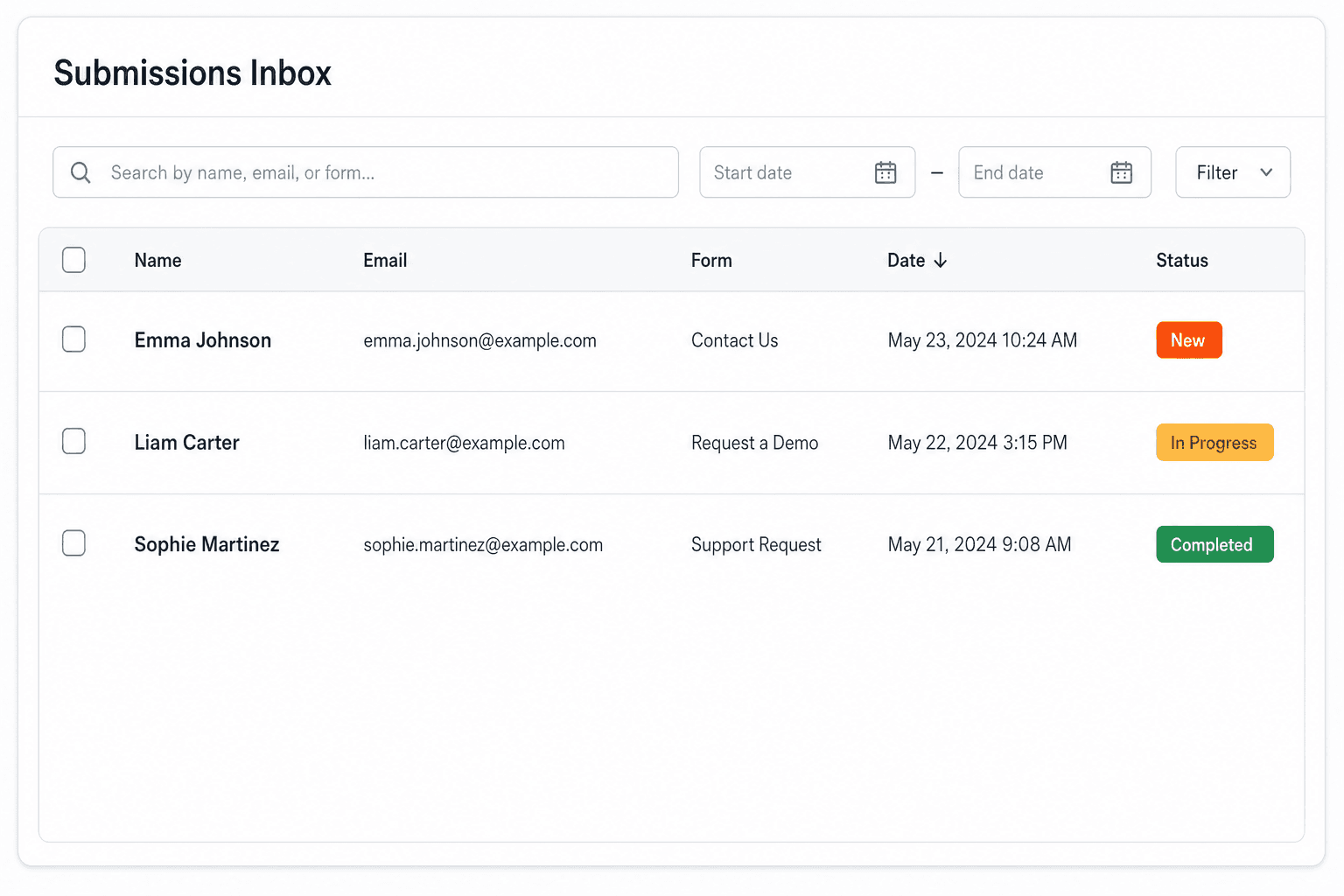
splitforms receives the submission, filters spam, saves it to your dashboard and emails you — then, on paid plans, sends it on to your webhooks and integrations. No backend infrastructure to build.

Point your form to your unique SplitForms endpoint. That's it.
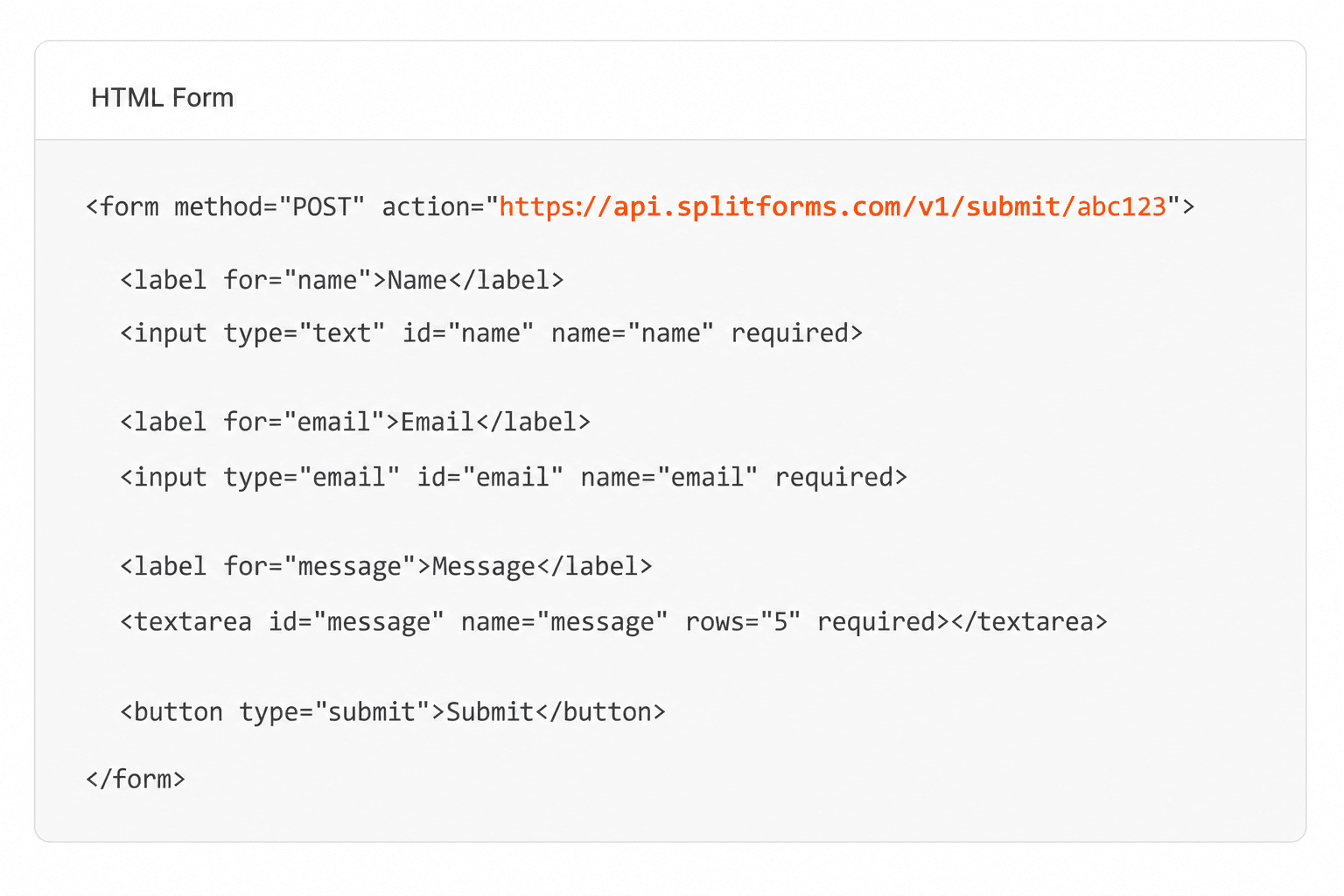
We instantly capture and organize every submission in your inbox.
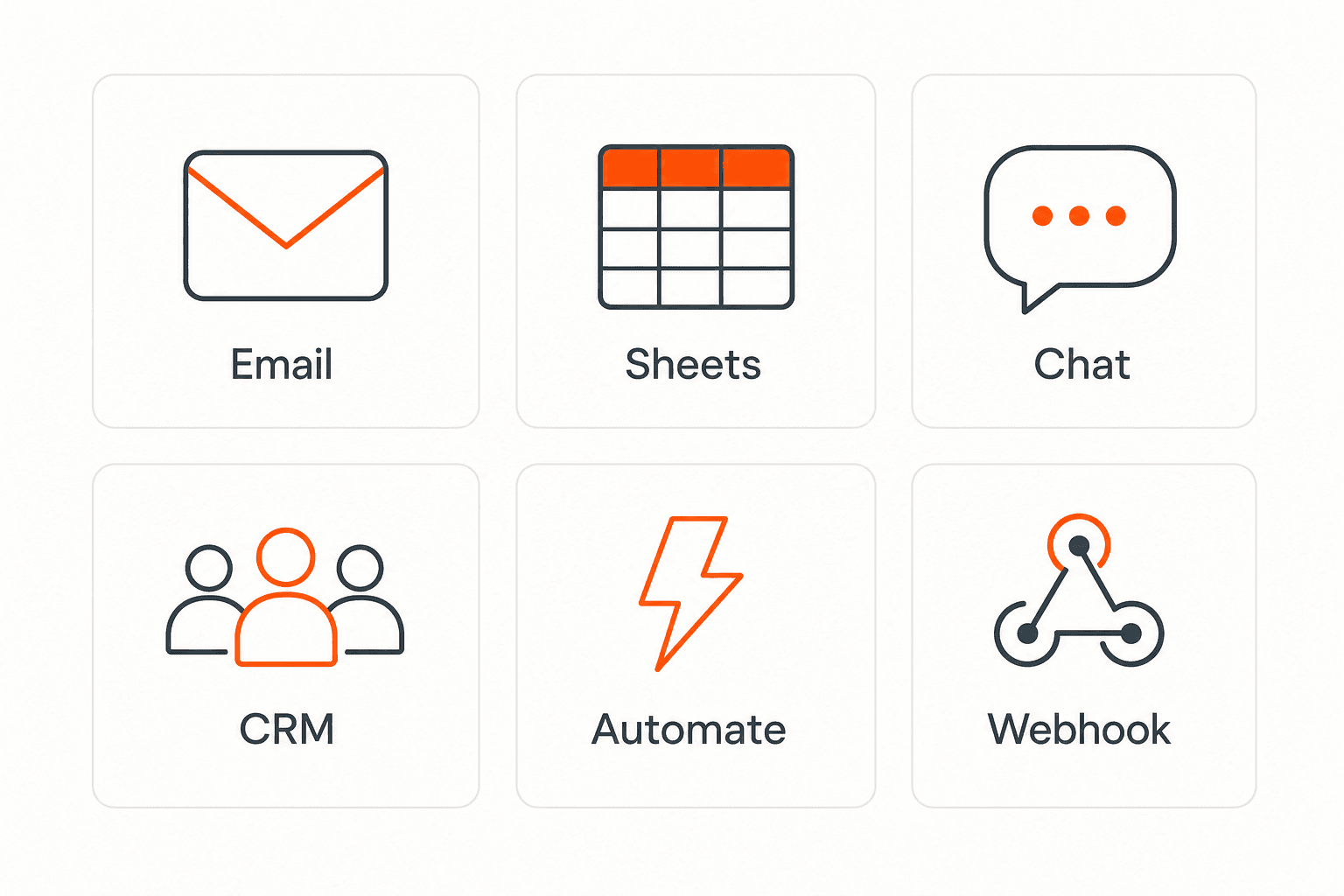
Send data to email, spreadsheets, CRMs, webhooks, and 7,000+ apps.
No credit card required. Set up in under 60 seconds.
Connect & automate
On paid plans, submissions can also go to Slack, Discord, Google Sheets, Notion, Airtable, Zapier or any signed webhook — and splitforms works on the platforms you build on, from WordPress and Shopify to Next.js. With Stripe connected, your forms can take payments too.
 NewTake payments on your formsDeposits, bookings, order forms — submitters check out through Stripe and the money goes straight to your Stripe account. Included on every paid plan.See plans →
Questions
It's a Model Context Protocol server that exposes splitforms as a typed toolset to AI coding agents. Instead of pasting your access key into Cursor or Claude Code and asking it to remember API docs, the agent calls structured tools like list_forms, get_submission, and generate_form directly. The server is free on every plan including Free.
Any MCP-compatible host: Claude Code (Anthropic's CLI), Cursor, Windsurf, Cline, Continue, and Zed are all officially supported and tested. Any other client that implements the Model Context Protocol spec works automatically — that's the whole point of the standard.
Free on every tier including the Free plan. We don't charge for AI access — submissions are still counted against your plan's monthly limit, but read/list/generate calls through MCP are unlimited and uncharged. The Pro and 3-Year plans subsidize the Free tier; AI access is a feature, not an upsell.
Sign in at splitforms.com, open Dashboard → MCP, and click 'Generate token'. The token starts with lim_ and is shown once. Copy it into your IDE's MCP config or use the Claude Code HTTP command on this page. Tokens are scoped to your account and can be revoked from the dashboard.
It's read and write. The MCP can list forms, read submissions, generate HTML, and call create_form to provision a new form on your account. All writes are scoped to the token's account — the agent cannot touch other accounts, billing, or your password. Destructive operations (delete) are intentionally not exposed.
Yes — MCP is host-agnostic. If you run a local model through Ollama, LM Studio, or vLLM and pair it with an MCP-aware harness (Claude Code, Continue, Cline all support local models), the splitforms MCP works identically. No data ever leaves the path between your IDE and our API.
The REST API is what you call from a browser or backend with fetch(). MCP is what an AI agent calls — it's a structured, typed tool layer on top of the same backend, with introspectable schemas the LLM uses to plan multi-step actions. You can use either or both. MCP exists so agents don't have to scrape your docs.
Yes, instantly. Open Dashboard → MCP, click 'Revoke' next to the token, and every future request from that token returns 401. Token usage is logged with timestamp, IP, and the tool called, so you can audit exactly what an agent did before revocation. Generate a fresh token whenever you want.
Twelve typed tools, all scoped to your token's account: list_forms and get_form read your forms and their schema; list_submissions and get_submission read submission data; generate_form and list_templates return ready-to-paste code from templates; get_access_key wires the public key into a generated form; create_form provisions a new form; update_form changes safe settings (name, subject, auto-responder, pause/resume); get_usage reports quota and storage; and create_webhook plus test_webhook wire submissions into Slack, a CRM, or Make/Zapier. There are also guided prompts (build_form, triage_inbox, connect_webhook, add_form_to_site). Destructive operations like delete a form or submission are intentionally not exposed over MCP — use the dashboard.
Anything the twelve tools cover. For example: 'Generate a Tailwind contact form for a Next.js server action that posts to splitforms', 'List the last 20 submissions to form_xxx and group them by source URL', 'Create a new form called Newsletter with fields email and consent_marketing', or 'Show me which submissions were flagged as spam this week and summarize the patterns.' The agent calls the tools directly to answer.
Because AI agents are first-class users now — in 2026 a meaningful fraction of new contact forms are written end-to-end by an agent, and making them scrape docs and copy keys is the same mistake as ignoring mobile in 2010. Copy-pasting an access key into an IDE chat leaves it in conversation history and screen recordings; an MCP token stays in a config file the agent reads but never quotes back. And an agent that can call generate_form and verify it against a real schema ships working code on the first try — docs go stale, a typed toolset can't.
Simple pricing
Free is $0 for 500 submissions in total (a one-time allowance). Paid plans are metered monthly: Starter is $1/month for 1,000, Pro is $5/month for 5,000, and the 3-Year plan is $59 for the first three years, then $59/year, for 15,000 a month.
For side projects and indie devs.
For builders who want every paid feature for $1/month.
For agencies and growing products.
Pay $59. 3 years sorted.
No credit card required on Free • Cancel anytime


