
Get a free access key
Sign up at splitforms.com — no credit card. Copy your key from the dashboard.
SplitForms vs Google Forms
500 free submissions each month, a modern developer API, and pricing that stays simple as you grow.
Get started in minutes
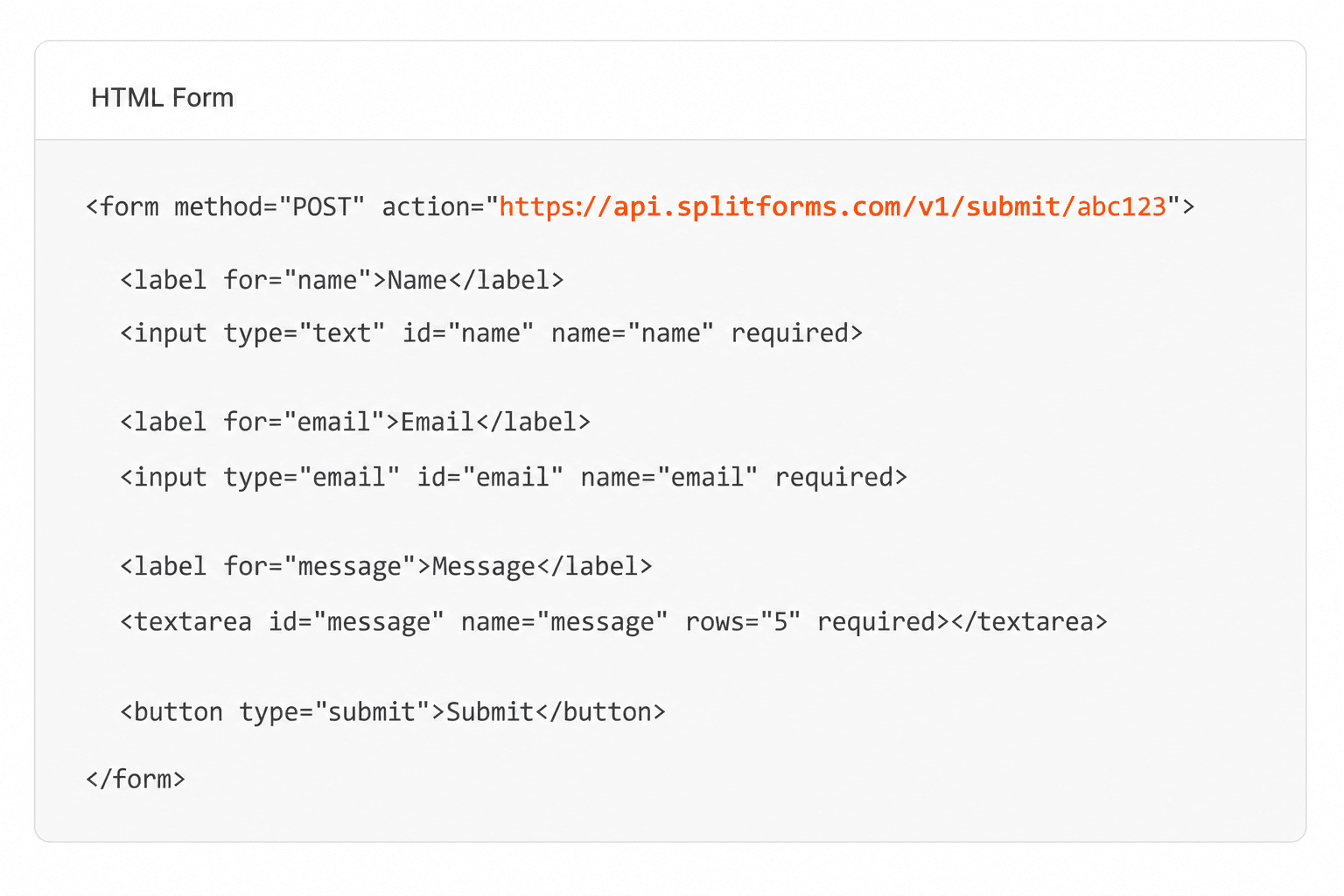
Drop one endpoint into the HTML you already have and submissions start flowing — no backend to host, no SDK to install, no lengthy onboarding. Point your form, hit submit, and watch the entries land.

Feature-by-feature comparison
A side-by-side look at the details developers actually care about when comparing splitforms and Google Forms.
| Feature | splitforms | Google Forms |
|---|---|---|
| Free tier | 500 submissions/mo, unlimited forms | Unlimited submissions, free with any Google account |
| Cheapest paid plan | $5/mo Pro (5,000 submissions) | Free (bundled with Google Workspace) |
| Long-term plan | $59 every 3 years (15,000/mo, 36 months) | Not offered |
| Submission dashboard | Yes, with search & export | Yes |
| Webhook delivery | Starter and higher plans, signed; one 8-second attempt | Yes |
| File uploads | Storage-backed, 5 files at 5 MB each | Yes (often paid) |
| Spam protection | AI classifier + honeypot | Honeypot / CAPTCHA |
| Host requirement | None — works anywhere | None |
The short answer
Google Forms is free with unlimited submissions and the right tool for internal surveys, quizzes, and RSVPs that end in a Google Sheet. splitforms is the right tool for public forms on your own domain: standard HTML with no iframe, AI spam filtering, signed webhooks from $1/month, and a real REST API.

See everything
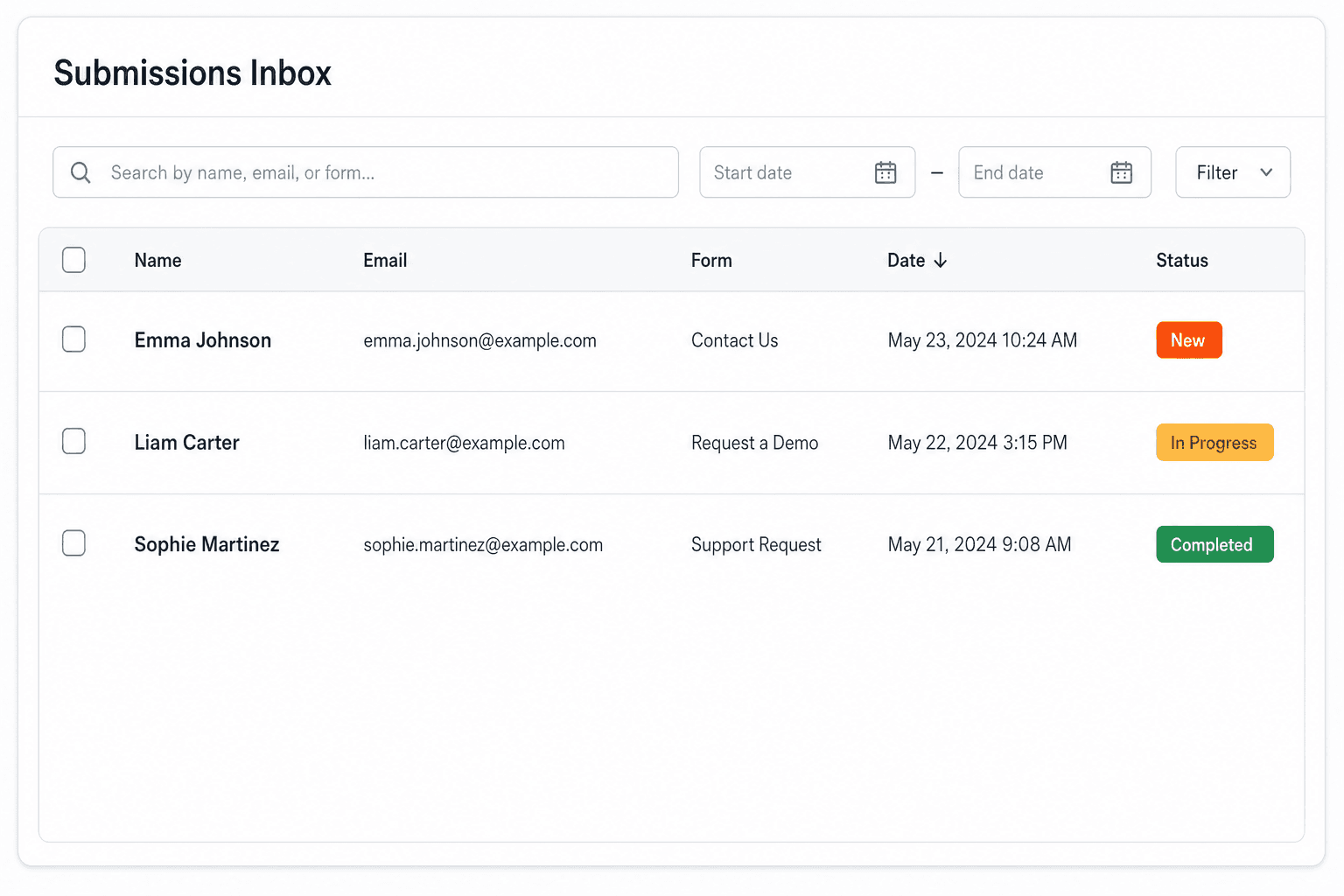
Search, filter, and export every entry, watch your analytics update live, and let the built-in spam shield drop junk before it ever reaches your inbox — all in one clean control room.
Where your leads go
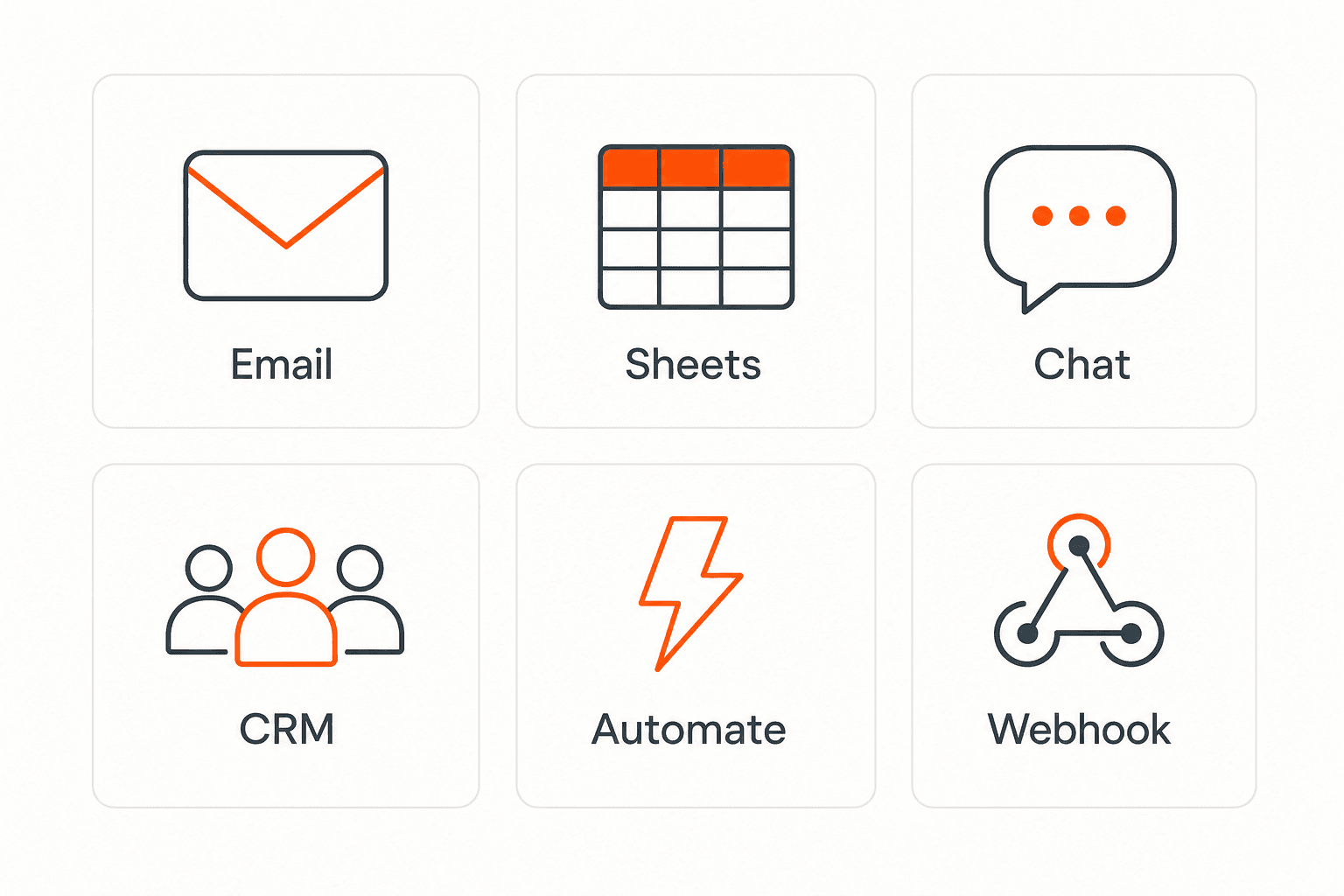
Forward submissions to email, Google Sheets, your CRM, or any webhook the moment they arrive. When you move off Google Forms, your leads keep landing exactly where your team expects them — nothing to re-wire.
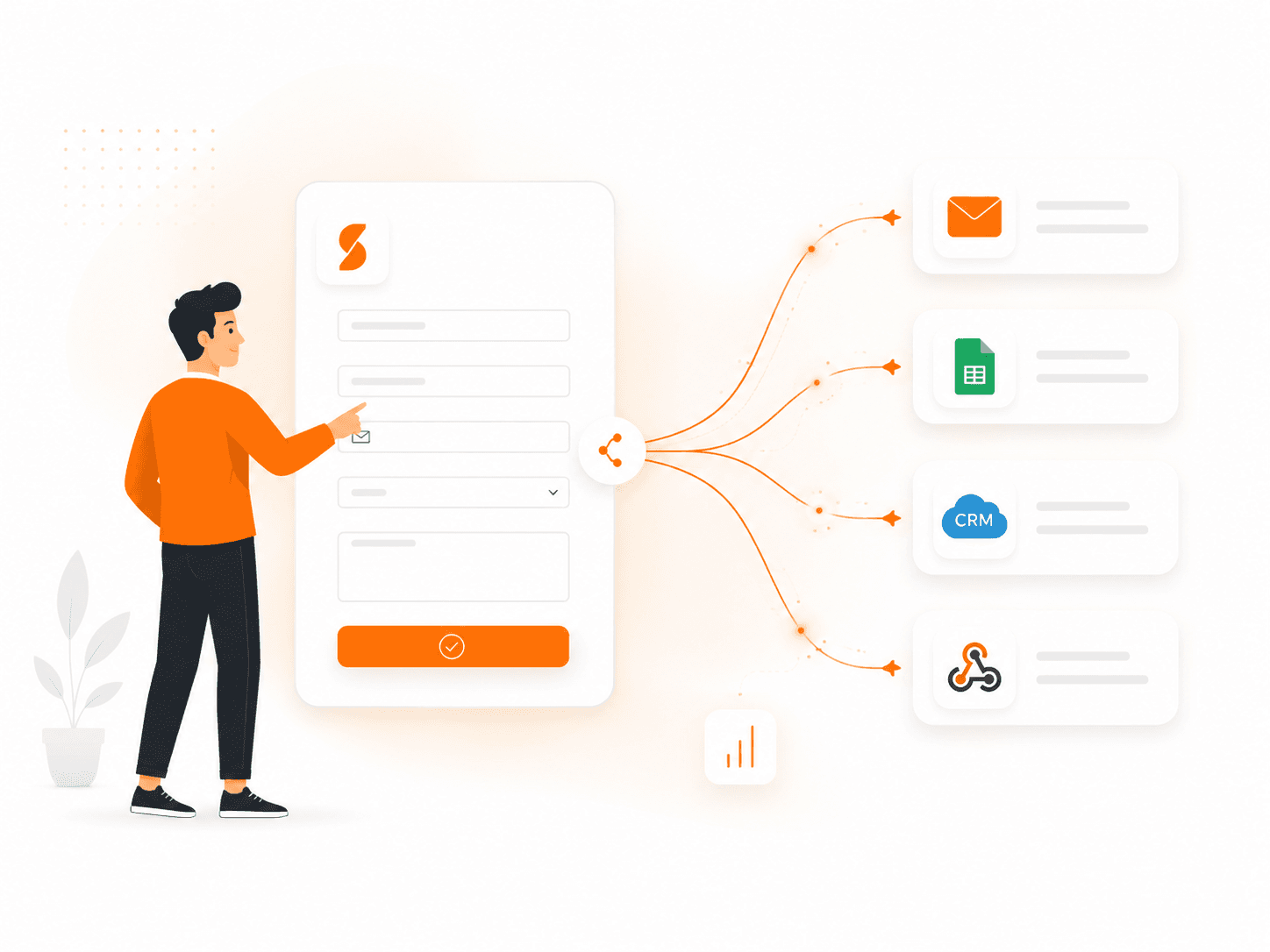
Leave Google Forms in ~10 minutes
Keep your HTML, field names, and styles. Only the POST endpoint changes — most teams finish a site in one short session.
Sign up at splitforms.com — no credit card. Copy your key from the dashboard.
Point your form to https://splitforms.com/api/submit and include your access_key.
Submit a sample entry, confirm inbox + dashboard, then remove the old endpoint.
How SplitForms works
Connect your form, collect every submission, and send data where it needs to go — without building backend infrastructure.
Point your form to your unique SplitForms endpoint. That's it.
We instantly capture and organize every submission in your inbox.
Send data to email, spreadsheets, CRMs, webhooks, and 7,000+ apps.
No credit card required. Set up in under 60 seconds.
Connect & automate
SplitForms works with the destinations you route to and the platforms you build on — from Slack and Sheets to WordPress, Shopify, and Next.js.

Trusted by indie teams and agencies shipping forms worldwide
Testimonials
40 quotes on record — from indie hacks to agency migrations.
“I replaced a Lambda + DynamoDB + SES contact form with six lines of HTML. It took eleven minutes, and the dashboard is better than what I was going to build.”
“We migrated 14 client sites off Formspree in a single weekend. The price is a third of what we paid, the API is more honest, and the spam filter actually works.”
“The webhook payload is signed, idempotent, and well-shaped. It reads like code from a competent team, not a CRUD app held together with duct tape.”
“I stopped reaching for Typeform on small marketing sites. splitforms covers 90% of the use case at none of the bloat.”
“I onboarded our whole agency in an afternoon. The MCP integration meant Cursor literally dropped the form straight into our client repos for us.”
“The free plan gave me 500 submissions before I paid a cent, and Starter is a dollar a month. I've spent more on coffee deciding which backend to use.”
“Spam went from forty junk entries a day to zero, with no reCAPTCHA puzzle ruining the form. The honeypot and time-trap just quietly do their job.”
“Point the form action at one endpoint and you're done. No SDK, no client library, no build step. This is how a form backend should feel.”
“Leads land in Slack the second someone submits, and a copy goes to Google Sheets for the sales team. I wired both up in under ten minutes.”
“I run a static Hugo site on a five-dollar VPS. splitforms gave it a real contact form without me standing up a single server.”
Common questions
Yes. splitforms handles the same core jobs as Google Forms: a POST endpoint, email delivery, a submission dashboard, webhooks, and spam filtering. The Free plan covers 500 submissions/month with unlimited forms, versus Google Forms's Unlimited submissions, free with any Google account — so most developers get more headroom without paying more.
Google Forms is a hosted form builder, so migration requires rebuilding the form as HTML or in your framework, mapping the existing fields, then testing the new endpoint. It is not only an action-URL swap.
splitforms includes email delivery, a searchable dashboard, HMAC-signed webhooks on Starter and higher plans (one attempt, 8-second timeout), storage-backed file uploads on eligible plans, custom redirects, spam filtering, and a documented REST API. Google Forms-specific features like genuinely free forever — no submission cap, no card on file, no upgrade path may need an integration.
splitforms is free for 500 submissions/month; the current paid entry is $1/mo Starter (1,000 submissions), and the $59 3-Year plan includes 15,000 submissions/month across 36 months. Google Forms starts at Free (bundled with Google Workspace). Verify both pricing pages because allowances can change.
The existing Google Forms form will not automatically become a splitforms form. Rebuild its fields in HTML or your framework, preserve the validation and styling you need, then test before replacing the hosted form.
Yes — the 3-Year plan is one $59 payment covering 36 months at 15,000 submissions/month, with no monthly billing in between. Check Google Forms's current pricing page before comparing billing terms.
splitforms is built for developers shipping production sites — static sites, SaaS landing pages, JAMstack apps, and agency client work. For internal team surveys, classroom quizzes, event rsvps, and any workflow where google sheets is the natural destination and a google account is acceptable for respondents, the deciding factor is usually whether genuinely free forever — no submission cap, no card on file, no upgrade path matters to you; if it does, keep Google Forms in the mix. Otherwise splitforms is the endpoint-driven option.
Simple pricing
Choose a plan that fits your workflow — from a free form endpoint to full automations, exports, and higher submission limits.
Free forever
For side projects and indie devs.
For builders who want every paid feature for $1/month.
For agencies and growing products.
Pay $59. 3 years sorted.
No credit card required on Free • Cancel anytime
Deep dive
Short, honest answers on pricing, migration, and when Google Forms is still the better fit.
Google Forms is genuinely the right tool for a real range of jobs: an internal team survey, a classroom quiz, an event RSVP for friends, a quick poll where the responses naturally belong in a Google Sheet and respondents are fine signing in or filling a docs.google.com link. It's free forever with unlimited submissions, the Google Sheets integration is excellent, and the time-to-first-form is roughly two minutes. If that's your job, just use Google Forms — splitforms isn't a replacement for it.
splitforms is the right tool for a different job: an HTML form embedded directly on your own domain, with no Google account requirement, that posts to a backend you can webhook into your stack, with spam filtering, signed webhooks, a developer-friendly API,s from your own sender. Use splitforms when Google Forms can't reach the case — when you need a form on your marketing site, a contact form on your portfolio, a webhook into your CRM in real time, an API to fetch submissions programmatically, or spam filtering on a public-facing form that's getting bot traffic.
Honest framing: this isn't a "Google Forms killer" comparison. The two tools serve different shapes of the same problem.
The most common trigger is the no-API problem. Google Forms doesn't ship a real-time webhook or a clean REST API for fetching submissions. The standard workaround is Apps Script — you write a Google-flavored JavaScript file, hook it to the form's `onFormSubmit` trigger, and POST to wherever you actually want the data. It works, but it's a separate codebase, a separate auth model, a separate deploy story, and the failure modes are silent. splitforms ships HMAC-SHA256 signed webhooks (single delivery attempt, 8-second timeout) from Starter upward, plus an open REST API for pulling submissions on demand.
The second trigger is the hosting model. Google Forms lives on docs.google.com or embeds via iframe. For an internal survey that's fine; for a public marketing-site form, the iframe loads slowly, breaks page styling, and breaks attribution chains. splitforms is a standard form action — your HTML, your domain, your CSS, your analytics, no iframe and no off-site link.
The third trigger is spam. Google Forms has effectively no spam filtering — there's no honeypot, no CAPTCHA option on the free tier, and no AI classifier. For a public form on the open web, this is structural: you'll get bot submissions, and Google Forms will write them to your sheet alongside the real ones. splitforms layers an AI classifier on top of honeypot, which catches modern LLM-generated spam without the user friction of CAPTCHA.
The fourth trigger is the Google-account barrier. By default, Google Forms can require respondents to sign in (and many configurations encourage it). For internal use that's fine; for an outside-the-org contact form, it's a friction tax. splitforms forms accept any submitter, no account required.
“I need a real-time webhook into my CRM and Google Forms only writes to a Sheet.”
splitforms ships HMAC-SHA256 signed webhooks (single delivery attempt, 8-second timeout) from Starter upward. Wire the webhook directly to your CRM endpoint or to a serverless function that maps the payload.
“Apps Script is fine but I want the form, the backend, and the deploy in one codebase.”
splitforms is a standard HTTP endpoint — no Google OAuth, no Apps Script project, no separate deployment story.
“My public Google Form is getting flooded with bot spam and there's no filter.”
splitforms uses an AI classifier on top of honeypot, which catches modern LLM-written spam without CAPTCHA friction.
“I don't want my form to live on a docs.google.com URL.”
splitforms forms are standard HTML on your own domain. No iframe, no off-site link.
“Notification emails come from a generic Google address and land in promotions.”
splitforms uses dedicated SMTP with proper SPF/DKIM, sent from your verified domain.
“Respondents shouldn't need a Google account to submit.”
splitforms requires nothing of the respondent.
“I want a Claude or Cursor agent to read submissions natively.”
splitforms ships an MCP server. Google Forms would require Apps Script plus Google OAuth.
splitforms isn't competing with Google Forms on price for unlimited internal surveys — Google Forms is free and that's hard to beat. splitforms wins in the cases Google Forms structurally can't reach: developer workflows, public-facing forms on your own domain, real-time webhook delivery, spam filtering on open-web traffic, and AI-agent integration via MCP.
Real webhooks from Starter: HMAC-SHA256 signed payloads, per-form scoping, single delivery attempt with an 8-second timeout. Wire submissions directly into your CRM, Slack, internal tools, or AI agent pipeline without Apps Script.
Open REST API on every plan, including free. Fetch submissions and list forms without Google OAuth, Apps Script, or a separate Google project; webhook management unlocks with the paid delivery features.
AI spam classifier on top of honeypot — catches modern LLM-written spam that Google Forms has no filter for.
Forms on your own domain. The form is HTML on your page, your CSS, your analytics, your branding. No iframe, no docs.google.com link, no Google sign-in barrier.
Dedicated SMTP for notification emails with proper SPF/DKIM and a verified sending domain. Notifications land in the inbox.
MCP server for AI agents: Claude, Cursor, and other MCP-aware tools read and act on form data natively. No Apps Script bridge required.
Step 1: sign up at splitforms.com for a free access key — no credit card required. Step 2: rebuild your form as plain HTML on your own page. For each Google Forms question, write a corresponding `<input>`, `<textarea>`, or `<select>` inside `<form action="https://splitforms.com/api/submit" method="POST">`. Question types map directly: short answer to text input, paragraph to textarea, multiple choice to radio, checkboxes to checkbox group, dropdown to select. Step 3: submit a test entry and confirm it lands in the splitforms dashboard.
If you want submissions to keep flowing into a Google Sheet, set up a splitforms webhook pointing at a Zapier or Make scenario that creates a row in your sheet. Or, for a code-first approach, point the webhook at a small serverless function that calls the Sheets API directly. Either way, you keep the Sheet-as-database pattern and gain a real backend underneath it. This is the migration path most teams take when they've outgrown Google Forms but still want the spreadsheet-native workflow.
If you were using Apps Script with `onFormSubmit` to forward submissions elsewhere, you can delete the Apps Script entirely — the splitforms webhook does that job natively, with HMAC-SHA256 signed payloads your receiver can verify — something Apps Script doesn't ship.
Is splitforms trying to replace Google Forms? No, and that framing would be wrong. Google Forms is the right tool for internal surveys, classroom quizzes, and any workflow where Sheets is the natural destination. splitforms is for the cases Google Forms structurally can't reach — public forms on your own domain, real-time webhooks, programmatic API access, spam filtering, AI-agent integration.
Can I keep my Google Sheet as the destination? Yes. Set up a splitforms webhook pointing at a Zapier or Make scenario that creates a Sheet row, or write a small serverless function that calls the Sheets API directly. You keep the Sheet pattern and gain a real backend underneath it.
Will my respondents need a Google account on splitforms? No. splitforms requires nothing of the submitter. Anyone can fill the form and submit.
What about Google Forms' built-in quiz mode and answer keys? splitforms doesn't ship a quiz UI — that's a Google Forms-specific feature for classrooms. If you need quiz mode, stay on Google Forms.
Does splitforms have a real-time webhook that Google Forms doesn't? Yes. splitforms ships HMAC-SHA256 signed webhooks (single delivery attempt, 8-second timeout) on Starter and above. Google Forms' equivalent path is Apps Script with `onFormSubmit`, which works but is a separate codebase.
How does spam filtering compare? splitforms uses an AI classifier on top of honeypot, accurate enough to drop CAPTCHA. Google Forms has no spam filtering at all — every bot submission lands in your Sheet.
Is there a per-form limit? No. splitforms has unlimited forms on every plan, including Free. Google Forms also has no per-form limit on Sheets-destination forms.
Does splitforms have a long-term plan? Yes — $59 for the 3-Year plan at 15,000 submissions/month over 36 months. Useful for a developer who wants a managed backend with no monthly billing.
More comparisons


