
Get a free access key
Sign up at splitforms.com — no credit card. Copy your key from the dashboard.
SplitForms vs Netlify Forms
Netlify Forms is free and unlimited on Netlify's credit-based plans: since April 14, 2026 form submissions cost no credits (before that, each one cost 1 credit), and every account created since September 4, 2025 is on a credit-based plan. Older legacy Free, Starter and Pro accounts include 100 submissions per site per month, and legacy Pro charges from $19 when you go over. The catch is lock-in: Netlify Forms only works on sites hosted on Netlify, so a host-independent endpoint keeps working if you move.
Read our full Netlify Forms review
| Plan type | Forms allowance | Over the limit |
|---|---|---|
| Credit-based plans (accounts since Sep 4, 2025) | Free, unlimited since Apr 14, 2026 (1 credit per submission before) | n/a |
| Legacy Free / Starter | 100 submissions per site per month | On the legacy free tier, reaching a metered limit pauses all sites on the account until it upgrades |
| Legacy Pro | 100 per site per month | $19+ when exceeded |
Sources: Netlify Forms usage and billing docs, Netlify's April 14, 2026 pricing changelog and Netlify's legacy plan docs, checked October 10, 2026.
splitforms or Netlify Forms
Choose Netlify Forms when the site already runs on Netlify and is likely to stay there. Credit-based plans include free, unlimited form submissions, and Netlify provides dashboard storage, file uploads, notifications, webhooks, and API access without adding another vendor. That is a genuinely strong bundled offer.
The structural problem with Netlify Forms is portability: the moment you move hosts — to Vercel, Cloudflare, your own server, anywhere — your forms break. splitforms is host-agnostic. The action URL works the same regardless of where the page is served, which means moving hosts in the future doesn't touch your form layer at all.
Feature-by-feature comparison
A side-by-side look at the details developers actually care about when comparing splitforms and Netlify Forms.
| Feature | splitforms | Netlify Forms |
|---|---|---|
| Free tier | 500 submissions, no card, no time limit, unlimited forms | Free and unlimited on credit-based plans (since April 14, 2026); legacy plans include 100 submissions per site per month |
| Cheapest paid plan | $5/mo Pro (5,000/mo) or $49/yr Annual (15,000/mo) | No separate Forms price; Personal hosting is $9/month |
| Submission dashboard | Yes, with search & export | Yes |
| Webhook delivery | Signed with HMAC-SHA256 (sha256= signature header); 8-second timeout; one automatic retry after about 2 seconds on network errors, timeouts and 5xx responses (4xx is not retried); delivery log in the dashboard. Paid plans (Pro and Annual). | Yes |
| File uploads | Paid plans: 5 files at 5 MB each (500 MB on Pro, 5 GB on Annual) | Yes (often paid) |
| Spam protection | Honeypot, time-trap, rate limits + automatic spam scoring | Akismet filtering + honeypot and reCAPTCHA support |
| Host requirement | None — works anywhere | Netlify hosting required |
Pricing checked October 10, 2026. Source: Netlify Forms' pricing page.
Verdict
Netlify Forms is excellent value for a site that will stay on Netlify: credit-based plans, which every account created since September 4, 2025 uses, include free, unlimited submissions plus native notifications and API access, while legacy plans are metered at 100 submissions per site per month. splitforms is the better fit when the endpoint must work on any host or an MCP agent should provision it. Free is 500 submissions total, no card and no time limit; paid plans are Pro $5/month (5,000/month) and Annual $49/year (15,000/month), with signed webhooks.
| Service | Free plan | Entry paid plan | Free history | Uploads on Free | Webhooks | Source | Checked | Last changed |
|---|---|---|---|---|---|---|---|---|
| splitforms | 500 submissions total (one-time, no card), unlimited forms | Pro: $5/month (5,000/month); Annual: $49/year (15,000/month) | No automatic expiry | No (paid plans: 5 files of 5 MB per submission) | Paid plans (HMAC-SHA256 signed) | splitforms.com/pricing | Pricing set | |
| Netlify Forms | Unlimited on credit-based plans (Netlify-hosted sites only) | No separate Forms price; Personal hosting is $9/month | Not checked | Supported | Yes (form notifications) | docs.netlify.com/manage/forms/usage-and-billing Netlify pricing | Changed April 14, 2026 |
splitforms is a competitor; prices were checked on each vendor's public pricing page on October 10, 2026 (date per row).
Honest take
If you're committed to Netlify hosting, Netlify Forms is one less dependency to manage. Credit-based plans include unlimited form submissions, configuration is a single `netlify` HTML attribute, and the forms panel lives beside deploy logs. Adding a separate form vendor would create an extra account and credential without an obvious economic benefit.
The same answer applies to companies already using Netlify Functions, Netlify Identity, Netlify Edge, Agent Runners, and the Forms feature as one approved platform. Adding splitforms means a fresh vendor review and a new operational surface. Switch only when portability, independent administration, MCP provisioning, or splitforms' delivery controls solve a concrete need.
And if your forms are part of a Jamstack starter template you publish for others, Netlify Forms is the most copy-pasteable option — readers don't need to sign up for a new service to make the template work, just connect to Netlify. Splitforms requires an access key, which is friction for tutorial readers.
Leave Netlify Forms in about 10 minutes
Keep your HTML, field names and styles. Only the action URL changes, plus one hidden access_key field.
Sign up at splitforms.com — no credit card. Copy your key from the dashboard.
Point your form at https://splitforms.com/api/submit and add one hidden access_key field. Field names and styling stay the same.
Send a test entry, confirm it reaches your inbox and dashboard, then remove the old endpoint.
Every submission lands in your inbox and a searchable dashboard on every plan, including Free. Paid plans add webhooks and integrations:
AI agents can manage forms through the splitforms MCP server, included on every plan.
Get started in minutes
Drop one endpoint into the HTML you already have and submissions start flowing — no backend to host, no SDK to install, no lengthy onboarding. Point your form, hit submit, and watch the entries land.


See everything
Search, filter, and export every entry, watch your analytics update live, and let the built-in spam shield drop junk before it ever reaches your inbox — all in one clean control room.
Where your leads go
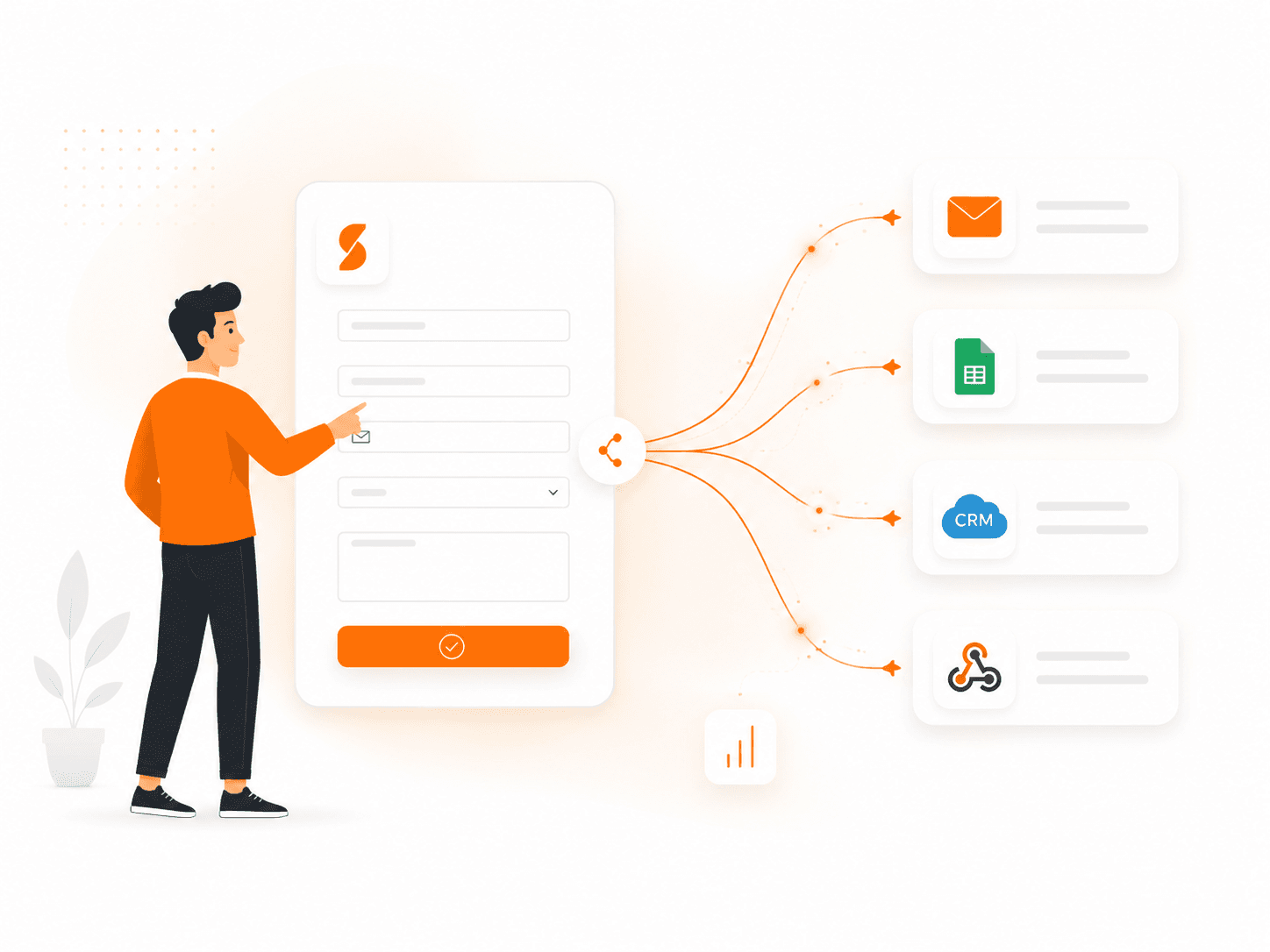
Forward submissions to email, Google Sheets, your CRM, or any webhook the moment they arrive. When you move off Netlify Forms, your leads keep landing exactly where your team expects them — nothing to re-wire.
Common questions
Yes on Netlify's credit-based plans, which all accounts created since September 4, 2025 use: Forms are free and unlimited. Accounts still on legacy Free, Starter or Pro plans get 100 submissions per site per month.
On April 14, 2026, Netlify made form submissions free and unlimited on every credit-based plan; before that, each submission cost 1 credit. Legacy plans still meter forms per site.
It depends on the plan. On paid legacy plans, Netlify meters Forms per site and automatically moves the site up to the next Forms level (legacy Pro lists $19+ when exceeded). On the legacy free tier, reaching 100% of a metered limit pauses all sites on the account until you upgrade. Credit-based plans have no form limit.
No. Netlify detects forms when it builds your site and processes submissions on its own infrastructure, so Netlify Forms only works on sites deployed to Netlify. On other hosts, point the form's action at a host-independent endpoint such as splitforms.
Netlify finds forms by scanning your deployed HTML at build time. Forms rendered only by JavaScript need a hidden static HTML copy with the same name and fields and the data-netlify attribute. An endpoint-based backend doesn't need build-time detection.
Download them as CSV from the Forms section of the Netlify UI, or pull them with the Netlify API. Keep the Netlify site live until the export is done.
Per Netlify's docs, it filters spam automatically with Akismet and supports an optional honeypot field and reCAPTCHA. splitforms uses a honeypot, a time-trap, per-IP rate limits and rule-based content scoring, with a spam folder you can review.
Deep dive
Short, honest answers on pricing, migration, and why teams move from Netlify Forms to splitforms.
The most common trigger is host migration. A team decides to move from Netlify to Vercel or Cloudflare for performance, pricing, or deployment-feature reasons — and discovers Netlify Forms doesn't follow them. Every form has to be rewritten to point at a new backend during the migration. splitforms removes this entirely: the form action URL is host-independent, so moving hosts is a deploy-config change, not a forms-rewrite project.
The second trigger is operational separation. Agencies and product teams sometimes want one form layer across Netlify, Vercel, Cloudflare, and traditional hosts. splitforms gives those sites the same endpoint, dashboard, access model, and signed-delivery behavior instead of coupling each form to its deployment platform.
The third trigger is agent provisioning. splitforms' authenticated MCP server can create a real form with specified fields and return an access key plus ready-to-paste HTML. Netlify has strong Agent Runners and prompt templates, but the workflow remains part of the wider Netlify project platform.
A fourth trigger applies only to older accounts. Sites on legacy Free, Starter or Pro plans get 100 submissions per site per month, and at that limit paid legacy plans move the site to the next usage level while the legacy free tier pauses all sites on the account. Accounts on credit-based plans don't have this cap.
“We're moving off Netlify and our forms are about to break.”
splitforms' action URL is host-independent. Move hosts whenever you want; the forms keep working without changes.
“Our React form isn't detected.”
Netlify finds forms by scanning deployed HTML at build time, so JavaScript-rendered forms need a hidden static copy. splitforms is an endpoint, so there is nothing to detect.
“We manage forms across several hosting vendors.”
splitforms provides one independent access model and delivery pipeline for all of them.
“We need signed webhook delivery at a small-service price.”
splitforms signs webhooks with HMAC-SHA256 on paid plans: Pro $5/month (5,000/month) and Annual $49/year (15,000/month).
“I want to drive form submissions from a Claude or Cursor agent.”
splitforms ships an MCP server natively.
Host portability is the headline. splitforms is the form backend you can point at from Netlify today, Vercel tomorrow, Cloudflare next year, your own server after that — without touching the form. For any team that thinks of hosting as a tradeable layer, this is a structural win.
A standalone control plane. Search submissions, filter by form and date, and export to CSV without coupling those workflows to the hosting account.
A low standalone paid floor: Pro $5/month (5,000/month) and Annual $49/year (15,000/month). Netlify's price includes a much broader hosting platform, so splitforms is attractive when you need only the form backend.
HMAC-SHA256 signed webhooks on paid plans, with an 8-second timeout and one automatic retry on network errors, timeouts and 5xx responses. Netlify also supports outgoing webhooks; evaluate signing and delivery-log requirements for your integration.
Rule-based spam scoring runs alongside a honeypot, a time-trap and per-IP rate limits, and flagged entries go to a spam folder you can review, so a CAPTCHA is optional rather than required.
MCP server for AI agents — Claude and Cursor can provision a form, generate its markup, and inspect submissions through an authenticated tool surface.
Step 1: get a splitforms access key (free, no credit card). Step 2: in your form HTML, remove the `netlify` attribute and add `action="https://splitforms.com/api/submit"` and `method="POST"`. Step 3: deploy and submit a test entry, confirm it lands in the splitforms dashboard and owner inbox; Pro adds signed webhooks when you need automation.
If you've been relying on Netlify's bot-field honeypot, splitforms includes equivalent honeypot protection out of the box plus rule-based spam scoring on top. Before you switch, export past submissions as CSV from the Forms section of the Netlify UI, or pull them with the Netlify API, and keep the Netlify site live until the export is done; splitforms starts collecting from the moment you switch. Field names, validation and styling stay the same, and a custom success page moves from the form's `action` to a hidden `redirect` field.
Day 1, minute zero: `grep -rn 'netlify\|data-netlify\|netlify-honeypot' .` across your repo. You'll find the magic attributes scattered across `index.html`, `src/pages/contact.astro`, or `app/contact/page.tsx` depending on your stack — `<form name="contact" netlify netlify-honeypot="bot-field" action="/thanks">`. The Netlify Forms convention is wholly attribute-driven, so the migration is mostly attribute deletion. Open a `splitforms-migration` branch, strip the `netlify`, `data-netlify`, and `netlify-honeypot` attributes off each form, then add `method="POST"`, `action="https://splitforms.com/api/submit"`, and a hidden `access_key` input.
Minute fifteen: push the branch and let your host build a deploy preview. Submit a test entry from the preview URL, confirm it lands in the splitforms dashboard with the right field values and any file attachments. Now run shadow mode: in your form handler add a `Promise.allSettled([fetch('/', {method:'POST', body:formData}), fetch(splitformsUrl, {method:'POST', body:formData})])` so Netlify's built-in form handler and splitforms both receive every submission for 24 hours. Compare counts in both dashboards, verify file handling and notifications, and keep the provider whose operational model fits the project.
Day 2: remove the duplicate Netlify post, redeploy, watch a full day of real production traffic flow through splitforms only. Once you're confident, turn off form detection in the Netlify UI or just stop using the attributes — Netlify won't capture forms that don't have the `netlify` attribute. splitforms Free (500 submissions total, unlimited forms, full dashboard) covers validation at zero cost, and signed webhooks come with the paid plans, Pro $5/month (5,000/month) and Annual $49/year (15,000/month), if the cutover needs downstream delivery.
Will splitforms work on a site I host on Netlify? Yes — splitforms works on any host, including Netlify. You just remove the `netlify` attribute and add a standard form action URL.
What if I move from Netlify to Vercel later? Nothing changes for your forms. The splitforms action URL is host-independent.
What does splitforms cost after the free plan? Free is 500 submissions total, with no card and no time limit. Paid plans are Pro $5/month (5,000/month) and Annual $49/year (15,000/month), and notification emails are included on every plan.
Does splitforms support file uploads? Yes, on paid plans. Uploads are storage-backed, up to 5 files at 5 MB each.
Is there a yearly plan? Yes. Annual is $49/year for 15,000 submissions/month with every Pro feature, about $4.08/month.
More comparisons