Capture role and basics
Required: name, email, role (dropdown of open positions), resume upload (PDF/DOCX). Optional: LinkedIn URL, portfolio URL, cover-letter textarea, location / timezone.
Form template · Job application
Most career-page application forms hide behind Greenhouse / Lever, which charge $200+/month per role. For a startup hiring 1-3 roles a year, a self-hosted form with resume upload does the job.
This template is one of our free HTML form templates. See more form templates by industry.
Every template is free and fully editable in the drag-drop builder — swap fields, colors, and the button label before you publish.
No server, API route, or SDK — your Job Application Form posts straight to one endpoint.
Every submission is emailed to you and saved to a searchable dashboard — spam filtered before it reaches you.
It's plain HTML you own — paste the Job Application Form snippet, swap in your access key, and ship.
Copy and ship
HTML by default — the same field set also renders as React, Next.js, PHP, and cURL in your dashboard. Every variant posts to the same /api/submit endpoint. Replace YOUR_ACCESS_KEY with the key from your dashboard; that's the only edit.
<form action="https://splitforms.com/api/submit" method="POST">
  <input type="hidden" name="access_key" value="YOUR_ACCESS_KEY">
  <input type="hidden" name="subject" value="New job application">

  <label for="name">Full name *</label>
  <input id="name" type="text" name="name" placeholder="Jane Builder" required>
  <label for="email">Email *</label>
  <input id="email" type="email" name="email" placeholder="[email protected]" required>
  <label for="role">Position you're applying for *</label>
  <select id="role" name="role" required>
    <option value="">Choose…</option>
    <option>Engineering</option>
    <option>Design</option>
    <option>Marketing</option>
    <option>Sales</option>
    <option>Operations</option>
    <option>Other</option>
  </select>
  <label for="linkedin">LinkedIn / portfolio URL</label>
  <input id="linkedin" type="url" name="linkedin" placeholder="https://linkedin.com/in/janebuilder">
  <label for="resume_url">Resume URL</label>
  <input id="resume_url" type="url" name="resume_url" placeholder="https://...">
  <label for="cover_letter">Cover letter *</label>
  <textarea id="cover_letter" name="cover_letter" placeholder="Why this role, why us." required></textarea>

  <!-- honeypot — bots fill every field -->
  <input type="checkbox" name="botcheck" style="display:none" tabindex="-1" autocomplete="off">

  <button type="submit">Send</button>
</form><p class="splitforms-attribution" style="margin-top:12px;font-size:11px;color:#888;text-align:right">
  Powered by <a href="https://splitforms.com" style="color:#888;text-decoration:none" target="_blank" rel="sponsored noopener">splitforms</a>
</p>

<!-- drop-off analytics + partial leads (the form works without it) -->
<script src="https://splitforms.com/embed.js" async></script>
How to add it
To add a Job Application Form to your site you need three things: a free splitforms access key, the HTML snippet above, and your key pasted into it. No backend, database, or CAPTCHA library — the form posts to one URL and every submission lands in your inbox and dashboard.
Required: name, email, role (dropdown of open positions), resume upload (PDF/DOCX). Optional: LinkedIn URL, portfolio URL, cover-letter textarea, location / timezone.
Storage-backed file upload keeps the resume connected to the submission. Attachments cap at 5 MB per file; resume PDFs are usually 100-500 KB, so headroom is generous.
Push the application as a row in a Notion / Airtable database (one per role). Hiring team triages from there — moves to interview stage, archives obvious passes, comments inline. Cheaper than Greenhouse for low-volume hiring.
What's included
ATS subscriptions (Greenhouse, Lever, Workable) start at $6-15k/year for a small team — a lot of money for a startup that hires 2 engineers a year. A self-hosted application form on the careers page handles the inbound flow. The form captures name, email, role applying for, resume (PDF upload, often required), LinkedIn / portfolio URL, and a brief 'why us' textarea. The submission lands in the hiring manager's inbox or webhooks into Notion / Airtable / a Slack channel for triage. As soon as you're past 5 simultaneous open roles, an ATS pays off — until then, this works. Resume upload (paid plans) · webhooks into Notion / Airtable / Greenhouse.

Where submissions go
Reply-to is wired to the visitor's email, so one tap on Reply answers them directly — while the built-in honeypot and automatic spam scoring filter out bots before they reach you. Every submission is emailed to your inbox and can forward to a webhook or Slack the moment a visitor hits send.

How SplitForms works
splitforms receives the submission, filters spam, saves it to your dashboard and emails you — then, on paid plans, sends it on to your webhooks and integrations. No backend infrastructure to build.

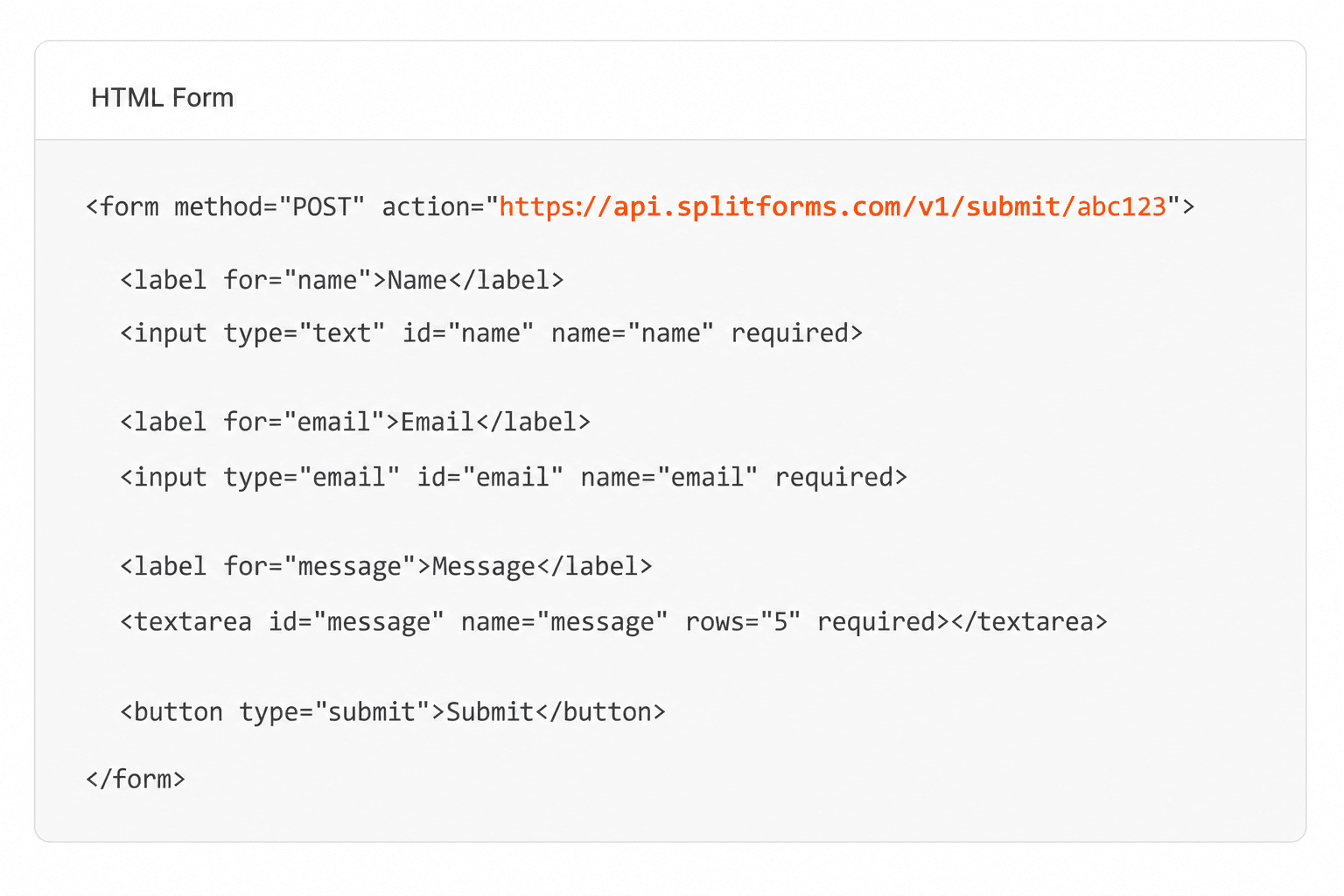
Point your form to your unique SplitForms endpoint. That's it.
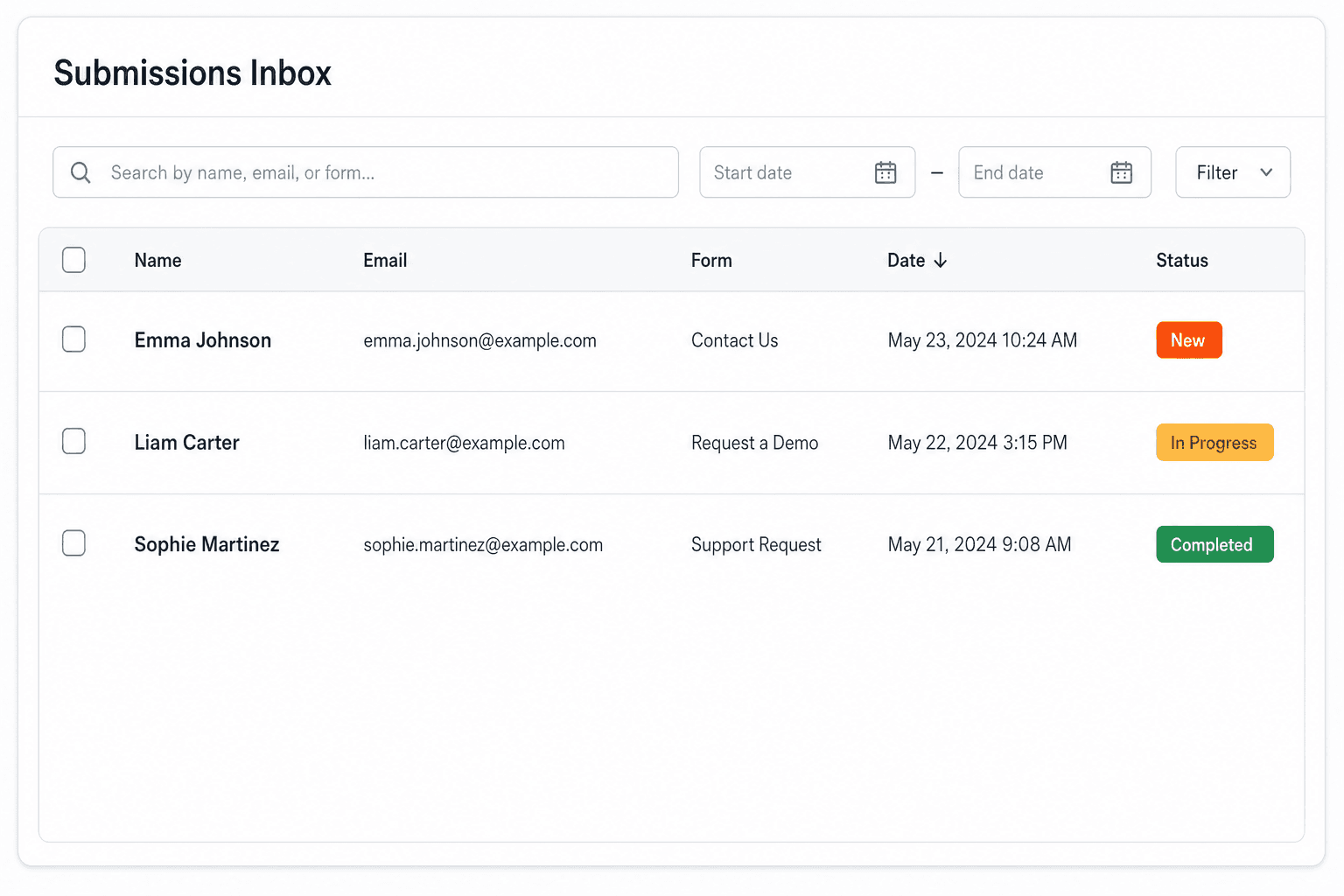
We instantly capture and organize every submission in your inbox.
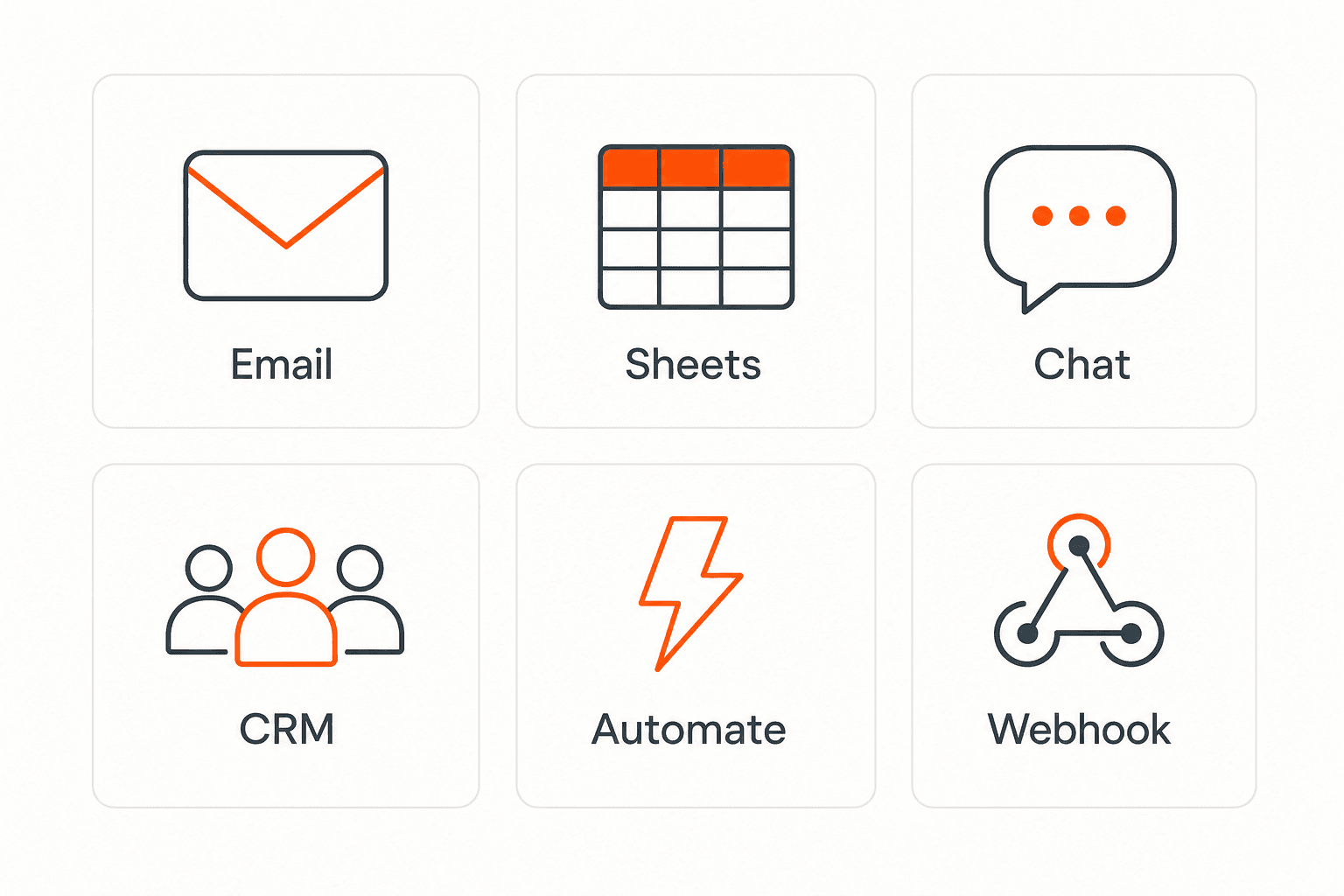
Send data to email, spreadsheets, CRMs, webhooks, and 7,000+ apps.
No credit card required. Set up in under 60 seconds.
Connect & automate
On paid plans, submissions can also go to Slack, Discord, Google Sheets, Notion, Airtable, Zapier or any signed webhook — and splitforms works on the platforms you build on, from WordPress and Shopify to Next.js. With Stripe connected, your forms can take payments too.

 NewTake payments on your formsDeposits, bookings, order forms — submitters check out through Stripe and the money goes straight to your Stripe account. Included on every paid plan.See plans →
Questions
If you're under the regulated thresholds (15 employees for most EEOC requirements; federal contractor for OFCCP), basic forms are fine. If you're regulated, you need to collect voluntary self-ID demographics on a separate page (race, gender, veteran, disability) with explicit non-discrimination language. Your employment lawyer should review the final flow.
Hidden honeypot field plus splitforms' rule-based spam filter catches the automated spam. For persistent agency spam, add a 'are you applying directly or through an agency?' radio — direct applications get the role-specific reply; agency applications get a 'we don't accept third-party submissions' auto-response.
For senior or specialised roles, yes — quality goes up with the friction. For volume hiring (support, ops, junior eng), no — required cover letters drop application count 60-80% and the cover-letter quality is mostly noise anyway. Tune by role.
Yes — webhook the JSON. Notion has a native database API, Airtable accepts via Zapier, Greenhouse accepts via Zapier or their Harvest API. As you scale into a real ATS, point the webhook at Greenhouse and decommission the Notion database. The form stays the same.
Simple pricing
Free gives you 500 submissions for $0 — no card, no time limit. Pro is $5/month for 5,000 submissions a month, and Annual is $49/year for 15,000 a month with every Pro feature.
For side projects and indie devs.
Every paid feature, for agencies and growing products.
Every Pro feature with triple the volume — $0.27 per 1,000 at full use.
No credit card required on Free • Cancel anytime • Full pricing and FAQ


