Get a free access key
Sign up at splitforms.com — no credit card. Copy your key from the dashboard.
SplitForms vs FormKeep
FormKeep Free: 50 submissions/month, unlimited forms, 1-month retention. splitforms Free: 500 submissions with no card and no time limit, on unlimited forms; Pro is $5/month for 5,000 submissions a month with signed webhooks. Switching means changing your form's action URL and adding one hidden field.
splitforms or FormKeep
FormKeep (formkeep.com/pricing, checked October 2, 2026) has a Free plan of 50 submissions a month with 1-month retention and daily email digests, then Essential at $4.99/month for 1,000 submissions on one form, Professional at $19.50 for 10,000 on three forms and Premium at $59 for 100,000 on ten forms. Each form has its own monthly limit.
splitforms suits you when you run several forms or need history that doesn't expire: Free is 500 submissions in total across unlimited forms with no automatic expiry, Pro is $5/month for 5,000 submissions a month on unlimited forms, and the Annual plan is $49/year for 15,000 a month. FormKeep suits you when you want its hosted form designer or need 100,000 submissions a month on one bill.
Feature-by-feature comparison
A side-by-side look at the details developers actually care about when comparing splitforms and FormKeep.
| Feature | splitforms | FormKeep |
|---|---|---|
| Free tier | 500 submissions, no card, no time limit, unlimited forms | 50 submissions/month, unlimited forms, 1-month retention |
| Cheapest paid plan | $5/mo Pro (5,000/mo) or $49/yr Annual (15,000/mo) | $4.99/month (Essential, 1,000 submissions/month, 1 form included) |
| Cost for about 1,000 submissions a month | $5 (Pro, 5,000), or about $4.08/mo on Annual ($49 billed yearly) | $4.99 (Essential, 1,000, 1 form) |
| Submission dashboard | Yes, with search & export | Yes |
| Webhook delivery | Signed with HMAC-SHA256 (sha256= signature header); 8-second timeout; one automatic retry after about 2 seconds on network errors, timeouts and 5xx responses (4xx is not retried); delivery log in the dashboard. Paid plans (Pro and Annual). | Yes |
| File uploads | Paid plans: 5 files at 5 MB each (500 MB on Pro, 5 GB on Annual) | Yes (often paid) |
| Spam protection | Honeypot, time-trap, rate limits + automatic spam scoring | Honeypot / CAPTCHA |
| Host requirement | None — works anywhere | None |
Pricing checked October 2, 2026. Source: FormKeep's pricing page.
Verdict
FormKeep is cheap to start: Free covers 50 submissions a month with a 1-month history, and Essential is $4.99/month for 1,000 submissions with webhooks and file attachments. splitforms gives 500 free submissions in total with no automatic expiry, unlimited forms on every plan and an email for every submission, and Pro is $5/month for 5,000 a month. Pick FormKeep for its form designer or its 100,000-a-month Premium tier; pick splitforms for unlimited forms, longer history and more submissions at the entry price.
| Service | Free plan | Entry paid plan | Free history | Uploads on Free | Webhooks | Source | Checked | Last changed |
|---|---|---|---|---|---|---|---|---|
| splitforms | 500 submissions total (one-time, no card), unlimited forms | Pro: $5/month (5,000/month); Annual: $49/year (15,000/month) | No automatic expiry | No (paid plans: 5 files of 5 MB per submission) | Paid plans (HMAC-SHA256 signed) | splitforms.com/pricing | Pricing set | |
| FormKeep | 50 submissions/month | Essential: $4.99/month (1,000/month) | 1 month | No (Essential and up) | Essential plan and up | formkeep.com/pricing | Not tracked before October 2, 2026 |
splitforms is a competitor; prices were checked on each vendor's public pricing page on October 2, 2026 (date per row).
Honest take
Stay with FormKeep if one of these matters more to you than switching:
Leave FormKeep in about 10 minutes
Keep your HTML, field names and styles. Only the action URL changes, plus one hidden access_key field.
Sign up at splitforms.com — no credit card. Copy your key from the dashboard.
Point your form at https://splitforms.com/api/submit and add one hidden access_key field. Field names and styling stay the same.
Send a test entry, confirm it reaches your inbox and dashboard, then remove the old endpoint.
Every submission lands in your inbox and a searchable dashboard on every plan, including Free. Paid plans add webhooks and integrations:
AI agents can manage forms through the splitforms MCP server, included on every plan.
Get started in minutes
Drop one endpoint into the HTML you already have and submissions start flowing — no backend to host, no SDK to install, no lengthy onboarding. Point your form, hit submit, and watch the entries land.


See everything
Search, filter, and export every entry, watch your analytics update live, and let the built-in spam shield drop junk before it ever reaches your inbox — all in one clean control room.
Where your leads go
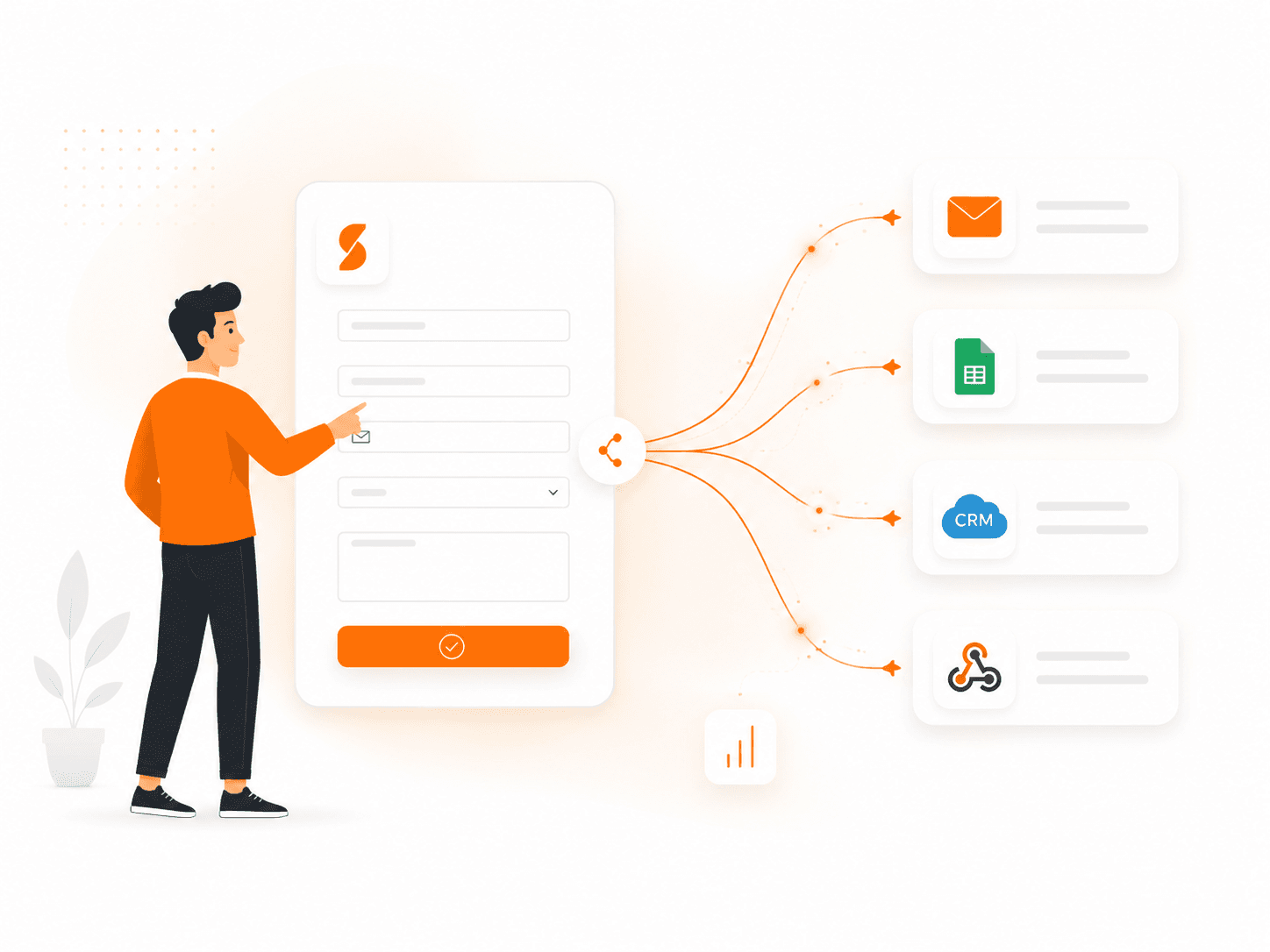
Forward submissions to email, Google Sheets, your CRM, or any webhook the moment they arrive. When you move off FormKeep, your leads keep landing exactly where your team expects them — nothing to re-wire.
Common questions
Yes. splitforms handles the same core jobs as FormKeep: a POST endpoint, email delivery, a submission dashboard, webhooks, and spam filtering. FormKeep Free is 50 submissions/month, unlimited forms, 1-month retention. splitforms Free is 500 submissions with no card and no time limit; it is a total, not a monthly allowance, so for a steady trickle a monthly plan can last longer. For webhooks and exports, splitforms Pro is $5/month.
For an endpoint-based form service, migrate by creating a splitforms access key, changing the form action to https://splitforms.com/api/submit, deploying, and sending a test entry. Field names, validation, and styling can stay unchanged.
splitforms includes email delivery, a searchable dashboard, HMAC-signed webhooks on paid plans (8-second timeout, one automatic retry on network errors, timeouts and 5xx responses), storage-backed file uploads on eligible plans, custom redirects on every plan, smart spam filtering, and a documented REST API. FormKeep-specific features like low entry price: essential is $4.99/month for 1,000 submissions with webhooks and file attachments may need an integration.
splitforms is free for 500 submissions total with no card; paid plans are $5/mo Pro (5,000 submissions/month) and $49/year Annual (15,000 submissions/month, about $4.08/mo). At full use that is $1.00 per 1,000 submissions on Pro and $0.27 on Annual. FormKeep starts at $4.99/month (Essential, 1,000 submissions/month, 1 form included). Verify both pricing pages because allowances can change.
Your HTML can stay in place. Preserve field names, validation, and styling, change the action and access key, then test the production form before completing the switch.
Yes — the Annual plan is $49/year (about $4.08/mo) for 15,000 submissions/month with every Pro feature, billed once a year. Check FormKeep's current pricing page before comparing billing terms.
splitforms is built for developers shipping production sites — static sites, SaaS landing pages, JAMstack apps, and agency client work. For small sites that want a hosted form designer and are happy with daily email digests on the cheaper plans, the deciding factor is usually whether low entry price: essential is $4.99/month for 1,000 submissions with webhooks and file attachments matters to you; if it does, keep FormKeep in the mix. Otherwise splitforms is the endpoint-driven option.
Deep dive
Short, honest answers on pricing, migration, and why teams move from FormKeep to splitforms.
The most common trigger is the per-form model. FormKeep's paid plans include a fixed number of forms (1 on Essential, 3 on Professional, 10 on Premium), so a site with a contact form, a newsletter form and a quote form outgrows the entry plan on form count before volume. splitforms has no per-form limit on any plan.
The second is history. FormKeep keeps submissions for 1 month on Free and 3 months on Essential. splitforms keeps them until you delete them on every plan, Free included, so an old lead is still searchable in the dashboard.
The third is notifications. FormKeep sends daily digests on Free and Essential and realtime emails from Professional. splitforms emails you for every accepted submission on every plan.
Step 1: sign up at splitforms.com for a free access key (no credit card). Step 2: change your form's action from `https://formkeep.com/f/YOUR_ID` to `https://splitforms.com/api/submit` and add a hidden access_key field. Step 3: test a submission and confirm it lands in the splitforms dashboard.
Export your FormKeep submissions first: Free keeps only one month of history. If a FormKeep integration feeds a CRM, recreate it with a splitforms webhook or a native integration on a paid plan.
Does FormKeep have a free plan? Yes: 50 submissions a month, unlimited forms and 1-month retention, per formkeep.com/pricing (checked October 2, 2026).
Is splitforms a viable FormKeep alternative? Yes for endpoint-style forms: the same action-URL setup, with unlimited forms on every plan and history that doesn't expire.
Is there a free tier I can test on? Yes: 500 submissions total with dashboard storage and spam filtering, no credit card and no time limit.
Is there a yearly plan? Yes. Annual is $49/year for 15,000 submissions/month with every Pro feature, about $4.08/month.
More comparisons