Get a free access key
Sign up at splitforms.com — no credit card. Copy your key from the dashboard.
SplitForms vs FormBold
FormBold Free is 100 submissions a month on 5 forms; Starter is $6/month billed yearly for 3,000. splitforms gives 500 free submissions (no card, no time limit) across unlimited forms, then $5/month for 5,000 a month on Pro.
splitforms or FormBold
If you're a developer, splitforms is the better fit on every dimension that matters to a developer: more free submissions up front (500 total vs FormBold's 100/month), more volume for the money at the entry paid tier ($5/mo Pro for 5,000 vs FormBold's Starter plan for 3,000/month), HMAC-SHA256 signed webhooks, an open API and MCP server on every plan, and a $49/year Annual plan if you'd rather not pay monthly. splitforms has native Notion and Airtable integrations on paid plans, and reaches Telegram via webhook.
FormBold has a real niche with non-technical operators who want one-click Notion, Airtable and Telegram connectors in one place. If Telegram is your main destination, FormBold's built-in option is simpler than a webhook. For developers, splitforms is the cleaner long-term architecture.
Feature-by-feature comparison
A side-by-side look at the details developers actually care about when comparing splitforms and FormBold.
| Feature | splitforms | FormBold |
|---|---|---|
| Free tier | 500 submissions, no card, no time limit, unlimited forms | 100 submissions/month, 5 forms |
| Cheapest paid plan | $5/mo Pro (5,000/mo) or $49/yr Annual (15,000/mo) | $6/month billed yearly, $10/month normally (Starter, 3,000/month) |
| Cost for about 1,000 submissions a month | $5 (Pro, 5,000), or about $4.08/mo on Annual ($49 billed yearly) | $6 billed yearly (Starter, 3,000) |
| Submission dashboard | Yes, with search & export | Yes |
| Webhook delivery | Signed with HMAC-SHA256 (sha256= signature header); 8-second timeout; one automatic retry after about 2 seconds on network errors, timeouts and 5xx responses (4xx is not retried); delivery log in the dashboard. Paid plans (Pro and Annual). | Yes |
| File uploads | Paid plans: 5 files at 5 MB each (500 MB on Pro, 5 GB on Annual) | Yes (often paid) |
| Spam protection | Honeypot, time-trap, rate limits + automatic spam scoring | Honeypot / CAPTCHA |
| Host requirement | None — works anywhere | None |
Pricing checked September 27, 2026. Source: FormBold's pricing page.
| Service | Free plan | Entry paid plan | Free history | Uploads on Free | Webhooks | Source | Checked | Last changed |
|---|---|---|---|---|---|---|---|---|
| splitforms | 500 submissions total (one-time, no card), unlimited forms | Pro: $5/month (5,000/month); Annual: $49/year (15,000/month) | No automatic expiry | No (paid plans: 5 files of 5 MB per submission) | Paid plans (HMAC-SHA256 signed) | splitforms.com/pricing | Pricing set | |
| FormBold | 100 submissions/month, 5 forms | Starter: $6/month billed yearly (3,000/month) | Not checked | Not checked | Not checked | formbold.com/pricing | Not tracked before September 27, 2026 |
splitforms is a competitor; prices were checked on each vendor's public pricing page on September 27, 2026 (date per row).
Honest take
Stay with FormBold if one of these matters more to you than switching:
Leave FormBold in about 10 minutes
Keep your HTML, field names and styles. Only the action URL changes, plus one hidden access_key field.
Sign up at splitforms.com — no credit card. Copy your key from the dashboard.
Point your form at https://splitforms.com/api/submit and add one hidden access_key field. Field names and styling stay the same.
Send a test entry, confirm it reaches your inbox and dashboard, then remove the old endpoint.
Every submission lands in your inbox and a searchable dashboard on every plan, including Free. Paid plans add webhooks and integrations:
AI agents can manage forms through the splitforms MCP server, included on every plan.
Get started in minutes
Drop one endpoint into the HTML you already have and submissions start flowing — no backend to host, no SDK to install, no lengthy onboarding. Point your form, hit submit, and watch the entries land.


See everything
Search, filter, and export every entry, watch your analytics update live, and let the built-in spam shield drop junk before it ever reaches your inbox — all in one clean control room.
Where your leads go
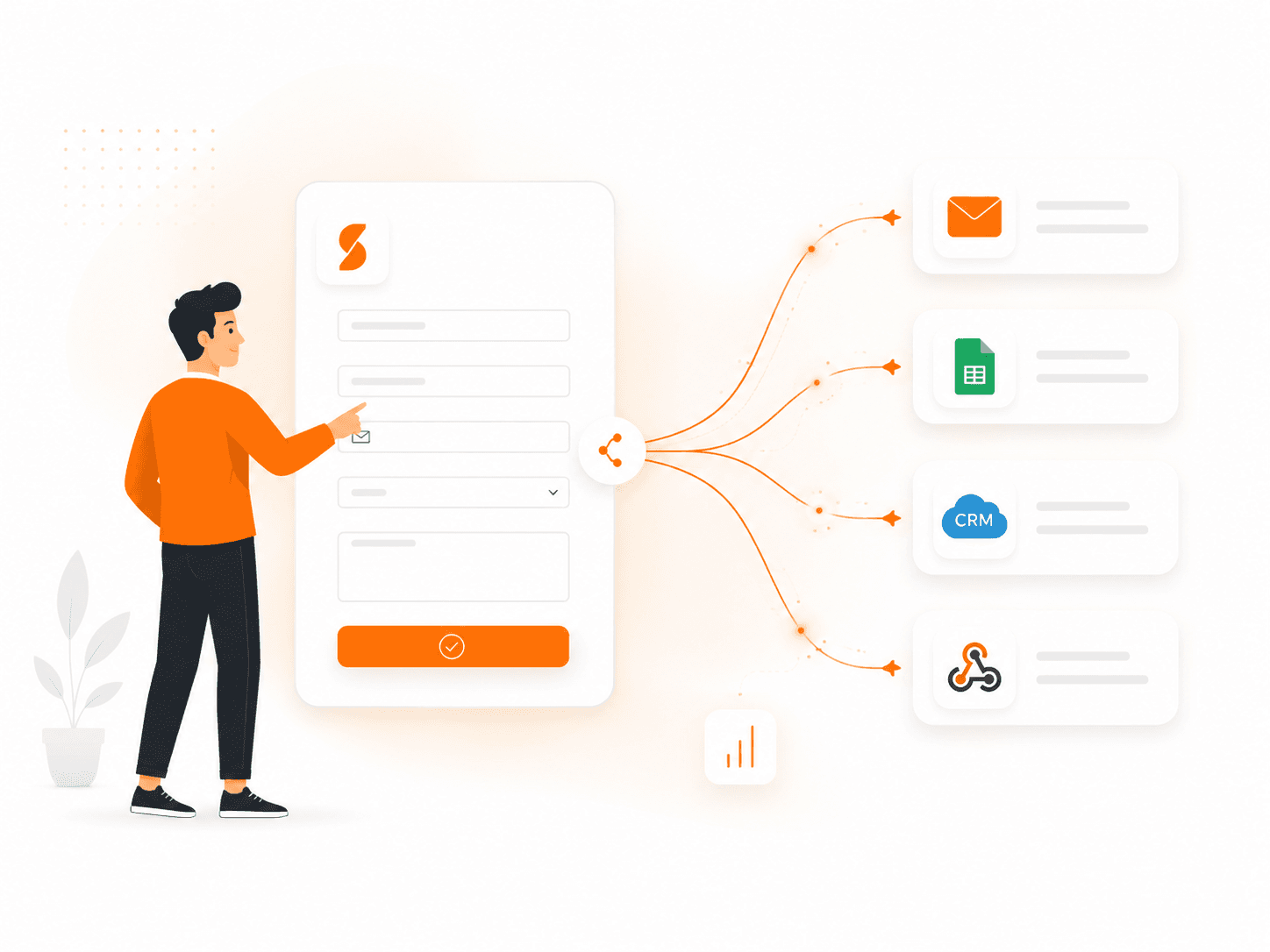
Forward submissions to email, Google Sheets, your CRM, or any webhook the moment they arrive. When you move off FormBold, your leads keep landing exactly where your team expects them — nothing to re-wire.
Common questions
Yes. splitforms handles the same core jobs as FormBold: a POST endpoint, email delivery, a submission dashboard, webhooks, and spam filtering. FormBold Free is 100 submissions/month, 5 forms. splitforms Free is 500 submissions with no card and no time limit; it is a total, not a monthly allowance, so for a steady trickle a monthly plan can last longer. For webhooks and exports, splitforms Pro is $5/month.
For an endpoint-based form service, migrate by creating a splitforms access key, changing the form action to https://splitforms.com/api/submit, deploying, and sending a test entry. Field names, validation, and styling can stay unchanged.
splitforms includes email delivery, a searchable dashboard, HMAC-signed webhooks on paid plans (8-second timeout, one automatic retry on network errors, timeouts and 5xx responses), storage-backed file uploads on eligible plans, custom redirects on every plan, smart spam filtering, and a documented REST API. FormBold-specific features like native one-click notion connector may need an integration.
splitforms is free for 500 submissions total with no card; paid plans are $5/mo Pro (5,000 submissions/month) and $49/year Annual (15,000 submissions/month, about $4.08/mo). At full use that is $1.00 per 1,000 submissions on Pro and $0.27 on Annual. FormBold starts at $6/month billed yearly, $10/month normally (Starter, 3,000/month). Verify both pricing pages because allowances can change.
Your HTML can stay in place. Preserve field names, validation, and styling, change the action and access key, then test the production form before completing the switch.
Yes — the Annual plan is $49/year (about $4.08/mo) for 15,000 submissions/month with every Pro feature, billed once a year. Check FormBold's current pricing page before comparing billing terms.
splitforms is built for developers shipping production sites — static sites, SaaS landing pages, JAMstack apps, and agency client work. For non-technical operators routing forms into notion or airtable, the deciding factor is usually whether native one-click notion connector matters to you; if it does, keep FormBold in the mix. Otherwise splitforms is the endpoint-driven option.
Deep dive
Short, honest answers on pricing, migration, and why teams move from FormBold to splitforms.
The most common trigger is the price-per-submission gap. FormBold's Starter plan is $6/mo billed yearly (or $10/mo month-to-month) for 3,000 submissions; splitforms Pro is $5/mo for 5,000 — more volume for less. Over three years, that's roughly $216 on FormBold's yearly-billed Starter plan vs $180 on splitforms Pro, or $147 on the Annual plan — meaningful savings for a side project, dramatic savings for an agency running multiple sites.
The second trigger is webhook verifiability. splitforms signs every webhook payload with HMAC-SHA256 — an `sha256=`-prefixed signature header your receiver can verify — scopes each webhook to a single form, and ships a free webhook tester at splitforms.com/webhook-tester so you can inspect the exact payload before wiring production. Each delivery has an 8-second timeout and one automatic retry on network errors, timeouts and 5xx responses, so keep your receiver fast.
The third trigger is choice of integration style. splitforms has native Notion, Airtable, Google Sheets and Slack integrations on paid plans, and a signed webhook into your own serverless function when you want a transparent contract: you see the JSON, you control the transformation, you log everything.
“FormBold's Starter plan tops out at 3,000/month.”
splitforms Pro is $5/mo for 5,000 submissions — more headroom for about the same price.
“I can't verify a webhook actually came from my form backend.”
splitforms signs every payload with HMAC-SHA256 (`sha256=` header prefix), and the free webhook tester at splitforms.com/webhook-tester shows the exact payload before you wire production.
“The Notion connector failed silently and I have no audit trail.”
A splitforms webhook into your own serverless function gives you full logs, transformations, and retry control.
“I'm getting AI-generated spam slipping past CAPTCHA.”
splitforms runs every submission through smart spam filtering: automatic, rule-based scoring of content signals such as links, spam phrases and disposable email addresses.
“I want to expose form data to a Claude or Cursor agent.”
splitforms ships an MCP server natively.
FormBold's Notion and Airtable connectors are easy to set up, and so are splitforms' native Notion and Airtable integrations on paid plans. The difference shows up when you need more than 'submission lands in a row': a native connector hides the JSON payload, so you can't transform fields before they hit Notion, add conditional logic, or debug a missing row from an audit trail.
A webhook is a transparent contract. You see exactly what JSON splitforms sends, you control the transformation in your own code, you log every attempt, and you can add any logic you want — deduplication, enrichment, conditional routing, fallback destinations. For a marketing team that just wants 'submission lands in Notion,' the connector is fine. For an engineering team that wants observability and the ability to evolve the integration, the webhook architecture is more durable — and on splitforms, both options come with the paid plans.
Five things make the difference for developers. First, the free tier gives 500 submissions up front (vs FormBold's 100/month) and includes the dashboard and email notifications, while Pro adds signed webhooks and file uploads for $5/month. Second, the Pro tier packs more volume for about the same price as FormBold's Starter plan. Third, HMAC-SHA256 signed webhooks (one retry after ~2s on network errors, timeouts and 5xx; not on 4xx; 8-second timeout) ship on paid plans. Fourth, the API is open and includes an MCP server for AI agents. Fifth, the Annual plan is $49/year for 15,000 submissions/month.
Notion and Airtable connect natively on paid plans. Telegram works via webhook: point the splitforms webhook at a tiny serverless function (Vercel, Cloudflare, AWS Lambda, anywhere) that sends the message.
Step 1: sign up at splitforms.com for a free access key (no credit card). Step 2: swap your form's action from `https://formbold.com/s/YOUR_ID` to `https://splitforms.com/api/submit`. Step 3: test a submission and confirm it lands in the dashboard.
If you're using FormBold's Notion or Airtable connector, connect the matching splitforms integration from the dashboard (paid plans). For Telegram, point the webhook at a small function that calls your bot's `sendMessage` endpoint, which gives you full control over the message format.
Is splitforms a viable FormBold alternative? Yes. Every core capability — POST endpoint, dashboard, webhooks, file uploads, spam filtering, custom redirects, CC recipients — is covered, with 500 free submissions up front and cheaper paid tiers.
What about the Notion / Airtable / Telegram integrations? Notion and Airtable are native splitforms integrations on paid plans. Telegram works through a webhook to a small function that calls your bot.
Are the webhooks verifiable? Yes — every payload is HMAC-SHA256 signed with an `sha256=`-prefixed header so your receiver can authenticate it. Each delivery has an 8-second timeout and one automatic retry on network errors, timeouts and 5xx responses; validate the payload shape first with the free tester at splitforms.com/webhook-tester.
Does splitforms support file uploads? Yes, on paid plans (Pro and Annual).
Is there a per-form limit? No. Every plan — Free, Pro and Annual — includes unlimited forms.
Is there a yearly plan? Yes. Annual is $49/year for 15,000 submissions/month with every Pro feature, about $4.08/month.
More comparisons