Keep the essay in the form
A textarea with a word range ('300–500 words') beats file uploads for small scholarships — no format chaos, and every essay exports cleanly in the CSV for scoring.
Form template · Scholarship application
For community foundations, memorial funds, and local scholarships: one form that collects the applicant, the academics, and the essay — every application in the same shape for the committee.
This template is one of our free HTML form templates. See more form templates by industry.
Overview
A scholarship application form has to carry more than a name and email — it has to bring the transcript, the essay, and the recommendation letters with each entry, and get them in before a hard deadline. SplitForms turns a plain HTML application form into that intake pipeline: every applicant's fields and attached files land in one dashboard, each stamped with the exact time it arrived. Point the form's action at https://splitforms.com/api/submit, add a hidden access_key input, and you have a working application portal — no admissions software, no server, and nothing to install on your school or nonprofit's site, even if it's a static page on GitHub Pages or Netlify.
Every template is free and fully editable in the drag-drop builder — swap fields, colors, and the button label before you publish.
No server, API route, or SDK — your Scholarship Application Form posts straight to one endpoint.
Every submission is emailed to you and saved to a searchable dashboard — spam filtered before it reaches you.
It's plain HTML you own — paste the Scholarship Application Form snippet, swap in your access key, and ship.
Copy and ship
HTML by default — the same field set also renders as React, Next.js, PHP, and cURL in your dashboard. Every variant posts to the same /api/submit endpoint. Replace YOUR_ACCESS_KEY with the key from your dashboard; that's the only edit.
<form action="https://splitforms.com/api/submit" method="POST">
  <input type="hidden" name="access_key" value="YOUR_ACCESS_KEY">
  <input type="hidden" name="subject" value="New scholarship application">

  <label for="name">Full name *</label>
  <input id="name" type="text" name="name" placeholder="Maria Gonzalez" required>
  <label for="email">Email *</label>
  <input id="email" type="email" name="email" placeholder="[email protected]" required>
  <label for="phone">Phone</label>
  <input id="phone" type="tel" name="phone" placeholder="+1 555 0142">
  <label for="school">School / institution *</label>
  <input id="school" type="text" name="school" placeholder="Lincoln High School" required>
  <label for="graduation_year">Graduation year *</label>
  <input id="graduation_year" type="number" name="graduation_year" placeholder="2027" required>
  <label for="gpa">GPA</label>
  <input id="gpa" type="text" name="gpa" placeholder="3.8">
  <label for="essay">Personal statement *</label>
  <textarea id="essay" name="essay" placeholder="Tell us why you're applying (300–500 words)." required></textarea>

  <!-- honeypot — bots fill every field -->
  <input type="checkbox" name="botcheck" style="display:none" tabindex="-1" autocomplete="off">

  <button type="submit">Send</button>
</form><p class="splitforms-attribution" style="margin-top:12px;font-size:11px;color:#888;text-align:right">
  Powered by <a href="https://splitforms.com" style="color:#888;text-decoration:none" target="_blank" rel="sponsored noopener">splitforms</a>
</p>

<!-- drop-off analytics + partial leads (the form works without it) -->
<script src="https://splitforms.com/embed.js" async></script>
How to add it
To add a Scholarship Application Form to your site you need three things: a free splitforms access key, the HTML snippet above, and your key pasted into it. No backend, database, or CAPTCHA library — the form posts to one URL and every submission lands in your inbox and dashboard.
A textarea with a word range ('300–500 words') beats file uploads for small scholarships — no format chaos, and every essay exports cleanly in the CSV for scoring.
The auto-responder tells applicants their application landed and when decisions go out — the two questions every applicant emails about otherwise.
Pause the form (Settings → form pause) the morning after the deadline. Late hopefuls see it's closed instead of testing whether 'deadline' was a suggestion.
What's included
Small scholarships run by clubs and memorial funds still take applications as email attachments, and every review season starts with a volunteer building a spreadsheet from forty differently-formatted PDFs. A form fixes the intake: name, school, graduation year, GPA, and the personal statement arrive identically structured, exportable to one CSV the committee can score. Applicants get a confirmation instead of wondering if the email landed. The essay lives in the submission, not in attachment purgatory.

Where submissions go
Reply-to is wired to the visitor's email, so one tap on Reply answers them directly — while the built-in honeypot and automatic spam scoring filter out bots before they reach you. Every submission is emailed to your inbox and can forward to a webhook or Slack the moment a visitor hits send.

How SplitForms works
splitforms receives the submission, filters spam, saves it to your dashboard and emails you — then, on paid plans, sends it on to your webhooks and integrations. No backend infrastructure to build.

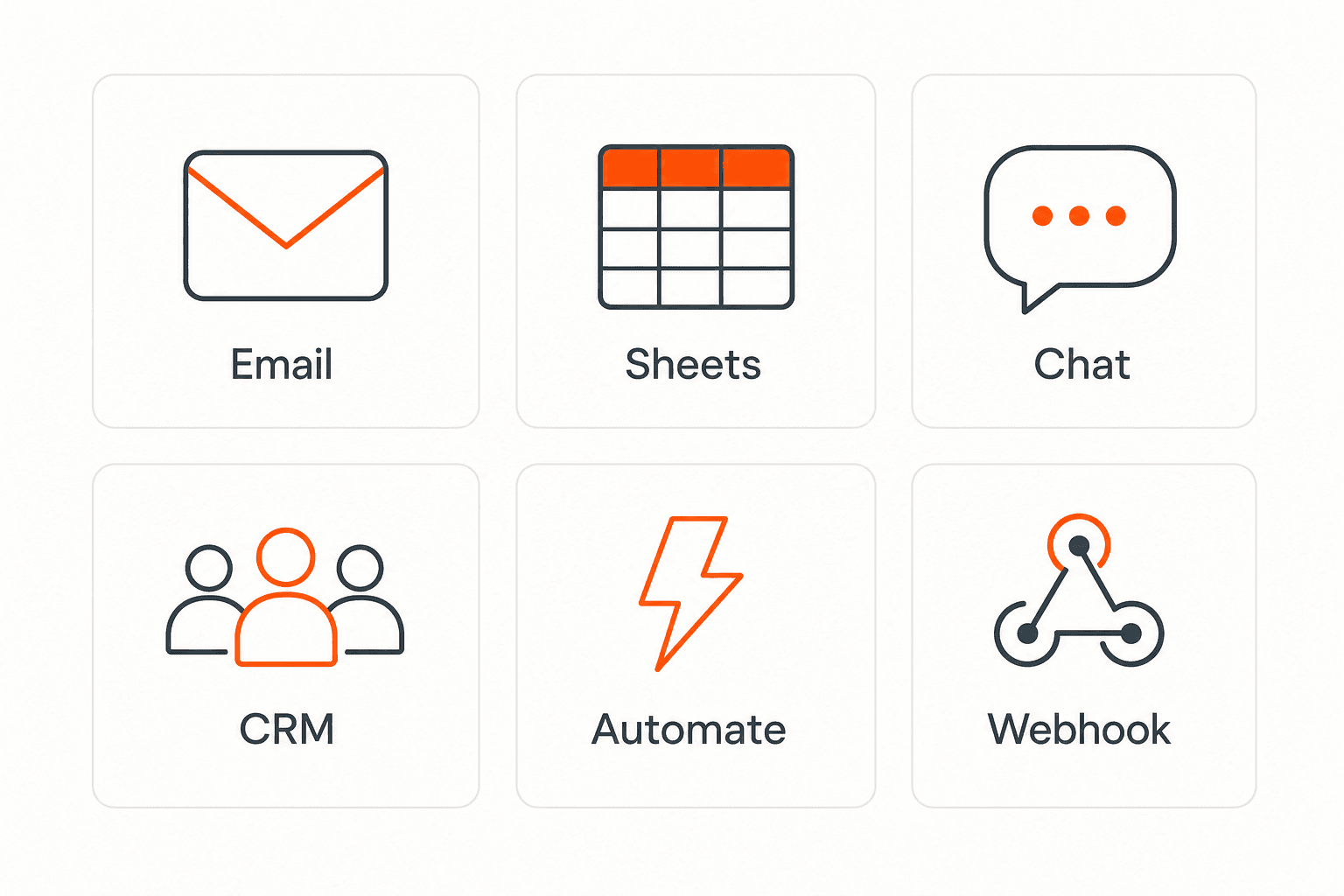
Point your form to your unique SplitForms endpoint. That's it.
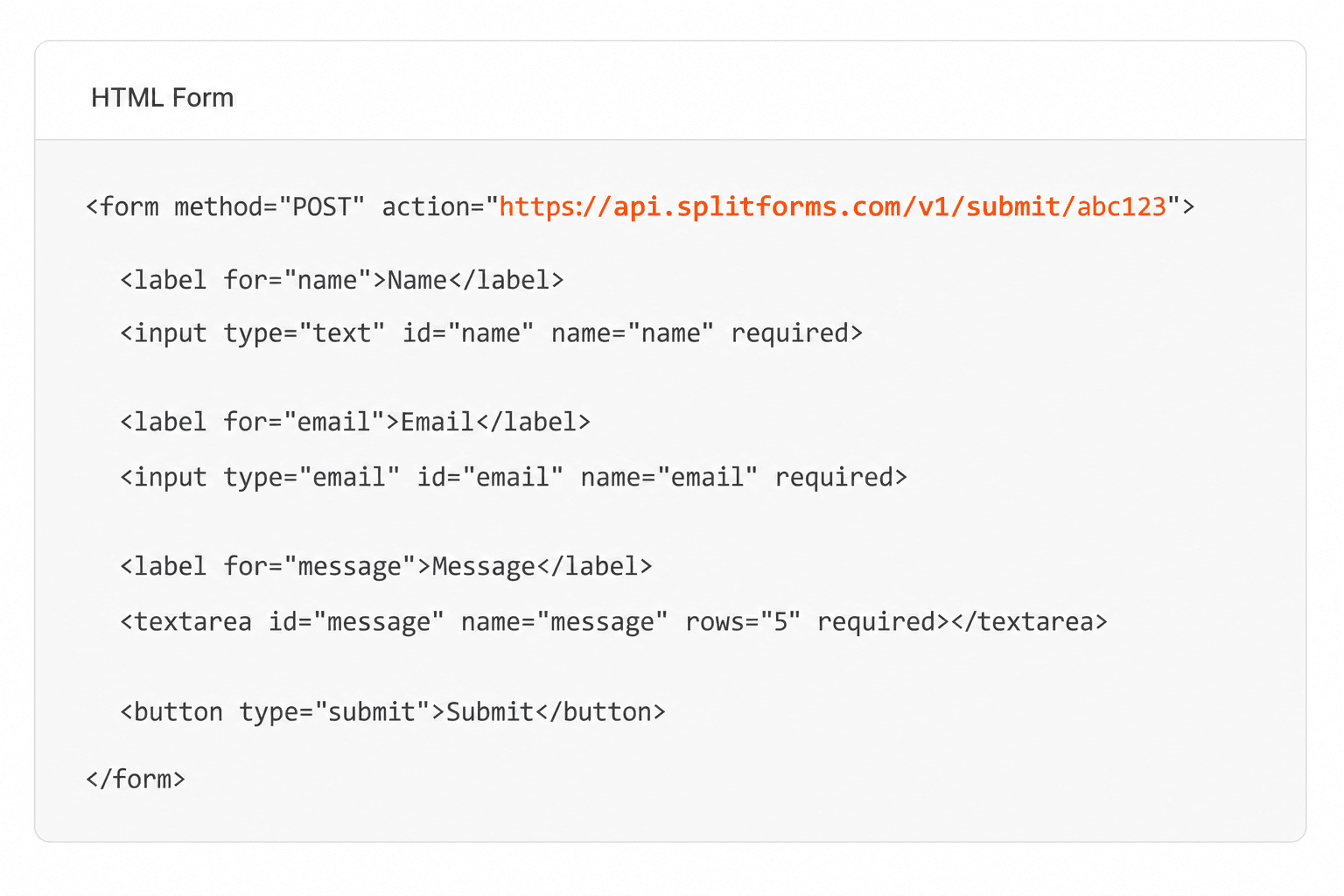
We instantly capture and organize every submission in your inbox.
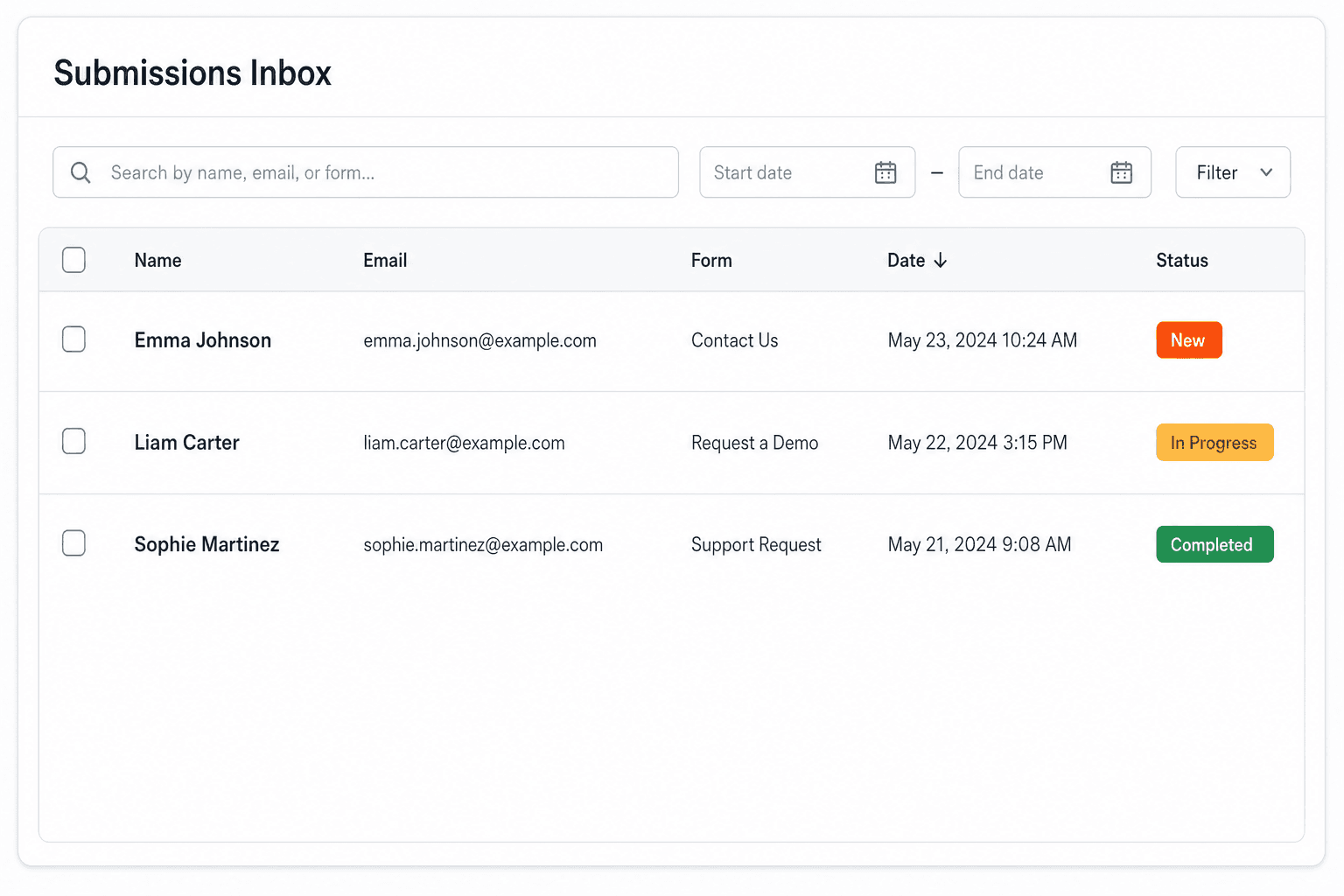
Send data to email, spreadsheets, CRMs, webhooks, and 7,000+ apps.
No credit card required. Set up in under 60 seconds.
Connect & automate
On paid plans, submissions can also go to Slack, Discord, Google Sheets, Notion, Airtable, Zapier or any signed webhook — and splitforms works on the platforms you build on, from WordPress and Shopify to Next.js. With Stripe connected, your forms can take payments too.

 NewTake payments on your formsDeposits, bookings, order forms — submitters check out through Stripe and the money goes straight to your Stripe account. Included on every paid plan.See plans →
Questions
Yes — file uploads are a paid feature (Pro, $5/mo), and each uploaded document attaches to that applicant's entry in the dashboard instead of scattering across inboxes as loose email attachments. You open one student's transcript, essay, and reference letters straight from their record. The free plan (500 submissions) collects text fields only, so if documents are required, you're on a paid plan.
Turn on the auto-responder (a paid feature): the instant an applicant submits, SplitForms emails them an 'application received' confirmation so they aren't left wondering. That's separate from your own notification email — the alert to your committee that a new application landed — which is free on every plan.
Every application shows up in the dashboard the moment it's submitted, and you can export the full cycle to CSV. Open it in a spreadsheet to sort by GPA or program, add a score column, and hand reviewers a ranked shortlist instead of reading raw entries one at a time.
The free plan is 500 submissions total — a scholarship you promote to a mailing list or on social can burn through that before the deadline closes. Pro is $5/mo for 5,000 submissions per month, and the count resets monthly, so it fits a recurring or annual award without topping anything up mid-cycle.
Yes — add a file-upload field (Pro) for transcripts or recommendation letters. For free-tier setups, ask finalists only to email transcripts; it keeps the initial application friction low.
Export CSV and score in a shared sheet, or invite reviewers to the dashboard. Each submission has every field in the same order, which is the whole battle.
Submissions are stored encrypted and only reachable from your logged-in dashboard. Don't ask for SSNs or financial-aid details on a public form — name, school, GPA, and essay are the right scope.
Simple pricing
Free gives you 500 submissions for $0 — no card, no time limit. Pro is $5/month for 5,000 submissions a month, and Annual is $49/year for 15,000 a month with every Pro feature.
For side projects and indie devs.
Every paid feature, for agencies and growing products.
Every Pro feature with triple the volume — $0.27 per 1,000 at full use.
No credit card required on Free • Cancel anytime • Full pricing and FAQ


