
Get a free access key
Sign up at splitforms.com — no credit card. Copy your key from the dashboard.
SplitForms vs Mailform
Mailform Free: Free for low-volume email forwarding; PDF and physical mail are paid. splitforms Free: 500 submissions with no card and no time limit, on unlimited forms; Pro is $5/month for 5,000 submissions a month with signed webhooks. Switching means changing your form's action URL and adding one hidden field.
splitforms or Mailform
Mailform is the right call if you specifically need to mail a printed letter or generate a signed PDF from a form submission — it's one of the few backends with a real postal-delivery integration. If your workflow ends in 'this needs to arrive on paper at a physical address', Mailform earns the slot.
splitforms is the right call for everything else. If 'a user filled out a form' should result in storage, spam classification, webhook fan-out, and an inbox notification — without paying for postal infrastructure you'll never use — splitforms is leaner and cheaper at every volume tier.
Feature-by-feature comparison
A side-by-side look at the details developers actually care about when comparing splitforms and Mailform.
| Feature | splitforms | Mailform |
|---|---|---|
| Free tier | 500 submissions, no card, no time limit, unlimited forms | Free for low-volume email forwarding; PDF and physical mail are paid |
| Cheapest paid plan | $5/mo Pro (5,000/mo) or $49/yr Annual (15,000/mo) | Pay-as-you-go for PDF/postal; recurring plans for higher email volume |
| Submission dashboard | Yes, with search & export | Yes |
| Webhook delivery | Signed with HMAC-SHA256 (sha256= signature header); 8-second timeout; one automatic retry after about 2 seconds on network errors, timeouts and 5xx responses (4xx is not retried); delivery log in the dashboard. Paid plans (Pro and Annual). | Yes |
| File uploads | Paid plans: 5 files at 5 MB each (500 MB on Pro, 5 GB on Annual) | Yes (often paid) |
| Spam protection | Honeypot, time-trap, rate limits + automatic spam scoring | Honeypot / CAPTCHA |
| Host requirement | None — works anywhere | None |
Pricing checked July 11, 2026. Source: Mailform's pricing page.
Honest take
Stay with Mailform if one of these matters more to you than switching:
Leave Mailform in about 10 minutes
Keep your HTML, field names and styles. Only the action URL changes, plus one hidden access_key field.
Sign up at splitforms.com — no credit card. Copy your key from the dashboard.
Point your form at https://splitforms.com/api/submit and add one hidden access_key field. Field names and styling stay the same.
Send a test entry, confirm it reaches your inbox and dashboard, then remove the old endpoint.
Every submission lands in your inbox and a searchable dashboard on every plan, including Free. Paid plans add webhooks and integrations:
AI agents can manage forms through the splitforms MCP server, included on every plan.
Get started in minutes
Drop one endpoint into the HTML you already have and submissions start flowing — no backend to host, no SDK to install, no lengthy onboarding. Point your form, hit submit, and watch the entries land.


See everything
Search, filter, and export every entry, watch your analytics update live, and let the built-in spam shield drop junk before it ever reaches your inbox — all in one clean control room.
Where your leads go
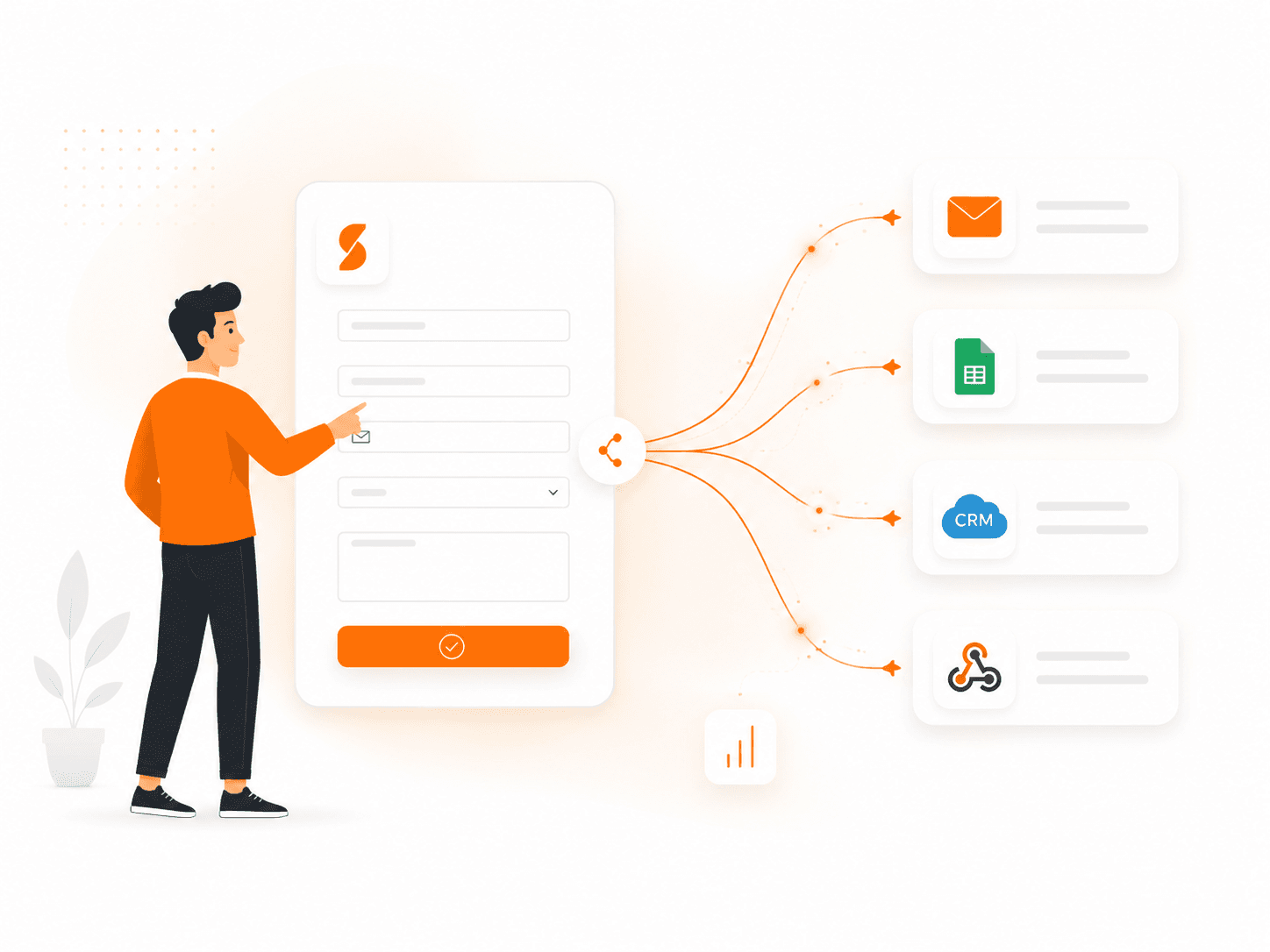
Forward submissions to email, Google Sheets, your CRM, or any webhook the moment they arrive. When you move off Mailform, your leads keep landing exactly where your team expects them — nothing to re-wire.
Common questions
Yes. splitforms handles the same core jobs as Mailform: a POST endpoint, email delivery, a submission dashboard, webhooks, and spam filtering. Mailform's free plan: free for low-volume email forwarding; PDF and physical mail are paid. splitforms Free is 500 submissions with no card and no time limit, on unlimited forms; for webhooks and exports, splitforms Pro is $5/month.
For an endpoint-based form service, migrate by creating a splitforms access key, changing the form action to https://splitforms.com/api/submit, deploying, and sending a test entry. Field names, validation, and styling can stay unchanged.
splitforms includes email delivery, a searchable dashboard, HMAC-signed webhooks on paid plans (8-second timeout, one automatic retry on network errors, timeouts and 5xx responses), storage-backed file uploads on eligible plans, custom redirects on every plan, smart spam filtering, and a documented REST API. Mailform-specific features like can mail a printed letter from a form submission (postal upsell) may need an integration.
splitforms is free for 500 submissions total with no card; paid plans are $5/mo Pro (5,000 submissions/month) and $49/year Annual (15,000 submissions/month, about $4.08/mo). At full use that is $1.00 per 1,000 submissions on Pro and $0.27 on Annual. Mailform starts at Pay-as-you-go for PDF/postal; recurring plans for higher email volume. Verify both pricing pages because allowances can change.
Your HTML can stay in place. Preserve field names, validation, and styling, change the action and access key, then test the production form before completing the switch.
Yes — the Annual plan is $49/year (about $4.08/mo) for 15,000 submissions/month with every Pro feature, billed once a year. Check Mailform's current pricing page before comparing billing terms.
splitforms is built for developers shipping production sites — static sites, SaaS landing pages, JAMstack apps, and agency client work. For workflows that need a physical mailing or signed pdf, not just an email, the deciding factor is usually whether can mail a printed letter from a form submission (postal upsell) matters to you; if it does, keep Mailform in the mix. Otherwise splitforms is the endpoint-driven option.
Deep dive
Short, honest answers on pricing, migration, and why teams move from Mailform to splitforms.
The most common trigger is realizing the postal-mail and PDF features were never actually used. Mailform's pricing reflects those features whether or not you use them — pay-as-you-go fees and tiered plans tuned to physical-mail volume. splitforms is priced purely on submission volume with no per-event surprises.
The second trigger is the dashboard. Mailform's UI is tuned for the compliance/government-vendor buyer, which makes it heavier than developers usually want. splitforms ships a fast, search-and-filter-first dashboard that's faster to inspect submissions in.
The third trigger is webhooks and API surface. Mailform has webhooks, but the API and developer documentation are thinner than a developer-first product. splitforms ships an open REST API and MCP server on every plan, with signed webhooks on paid plans.
“I'm paying for postal-mail features I never use.”
splitforms has flat per-submission pricing and no per-event upcharges.
“The dashboard feels heavy.”
splitforms is built for fast inspection: search, filter, export.
“I want a real REST API.”
splitforms ships an open REST API and MCP server on every plan, including free.
“I want signed webhooks.”
splitforms unlocks HMAC-SHA256 signed webhooks on paid plans — 8-second timeout, one retry after ~2s on network errors, timeouts and 5xx (not on 4xx).
If you don't use the postal-mail or PDF features, migration is the standard action-URL swap — change your form's action to `https://splitforms.com/api/submit` and you're done. If you do use those features, keep Mailform for the specific workflows that need them and route everything else to splitforms.
Is splitforms a viable Mailform alternative? Yes for everything except physical-mail and PDF delivery. If those aren't on your workflow, splitforms is cheaper, faster, and developer-first.
Can splitforms send postal mail? No. If you need that, keep Mailform for the postal-mail routes and use splitforms for everything else.
What about PDF generation? Use a service like DocRaptor or Carbone, wire it to splitforms via a webhook.
Is there a yearly plan? Yes. Annual is $49/year for 15,000 submissions/month with every Pro feature, about $4.08/month.
More comparisons