
Get a free access key
Sign up at splitforms.com — no credit card. Copy your key from the dashboard.
SplitForms vs Getform / Forminit
Forminit (formerly Getform) gives 100 free submissions a month on one form, and Pro is $19/month or $190/year (about $15.83/month billed yearly) for 5,000. splitforms gives 500 free submissions (no card, no time limit) across unlimited forms; Pro is $5/month for 5,000 a month.
splitforms or Getform / Forminit
If you're a developer or small agency shipping client work — Webflow, Next.js, Astro, static sites, anything — splitforms is the modern fit. The free tier covers 500 submissions total with unlimited forms, and every plan includes unlimited forms. Forminit's Pro plan ($19/month, or $190/year) is one of the more expensive starting prices in the form-backend market, and splitforms Pro unlocks paid features for $5/month.
Forminit (the renamed Getform) has a real niche with teams that want file uploads on the free plan, submissions hosted in the EU, and typed server-side validation. If that's you, it's a solid choice. For anyone else, splitforms gives you a developer API, an MCP server, a bigger free start, and an Annual plan at $49/year if you'd rather not pay monthly.
Feature-by-feature comparison
A side-by-side look at the details developers actually care about when comparing splitforms and Getform / Forminit.
| Feature | splitforms | Getform / Forminit |
|---|---|---|
| Free tier | 500 submissions, no card, no time limit, unlimited forms | 100 submissions/month, 1 form |
| Cheapest paid plan | $5/mo Pro (5,000/mo) or $49/yr Annual (15,000/mo) | $19/month, or $190/year (about $15.83/month billed yearly) (Pro, 5,000 submissions/month) |
| Cost for about 1,000 submissions a month | $5 (Pro, 5,000), or about $4.08/mo on Annual ($49 billed yearly) | $15.83 billed yearly ($190/year), or $19 monthly (Pro, 5,000) |
| Submission dashboard | Yes, with search & export | Yes |
| Webhook delivery | Signed with HMAC-SHA256 (sha256= signature header); 8-second timeout; one automatic retry after about 2 seconds on network errors, timeouts and 5xx responses (4xx is not retried); delivery log in the dashboard. Paid plans (Pro and Annual). | Yes |
| File uploads | Paid plans: 5 files at 5 MB each (500 MB on Pro, 5 GB on Annual) | Yes (often paid) |
| Spam protection | Honeypot, time-trap, rate limits + automatic spam scoring | Honeypot / CAPTCHA |
| Host requirement | None — works anywhere | None |
Pricing checked October 10, 2026. Source: Getform / Forminit's pricing page.
Verdict
Getform was renamed Forminit on January 14, 2026; it is the same service, and Forminit says existing Getform endpoints keep working. Forminit Free is 100 submissions/month on 1 form; Pro is $19/month or $190/year for 5,000/month. splitforms gives developers 500 free submissions total, unlimited forms on every plan, and a $5/month Pro plan for 5,000/month.
| Service | Free plan | Entry paid plan | Free history | Uploads on Free | Webhooks | Source | Checked | Last changed |
|---|---|---|---|---|---|---|---|---|
| splitforms | 500 submissions total (one-time, no card), unlimited forms | Pro: $5/month (5,000/month); Annual: $49/year (15,000/month) | No automatic expiry | No (paid plans: 5 files of 5 MB per submission) | Paid plans (HMAC-SHA256 signed) | splitforms.com/pricing | Pricing set | |
| Forminit (formerly Getform) | 100 submissions/month, 1 form | Pro: $19/month, or $190/year (about $15.83/month billed yearly) (5,000/month) | Kept until you delete them | Yes, 100 MB storage | Pro plan and up | forminit.com/pricing | Not tracked before October 10, 2026 |
splitforms is a competitor; prices were checked on each vendor's public pricing page on October 10, 2026 (date per row).
Honest take
If you've already built deep custom workflows on Getform — a chained Zapier automation that fans out to HubSpot, Notion, and a custom Slack bot, with field-level transformations the marketing team relies on — switching costs may exceed any feature gain. Splitforms can replicate the end state via webhooks and your own automation, but rebuilding a six-step Zap that's been running cleanly for three years means re-testing every branch, re-mapping every field, and getting non-technical stakeholders to re-bless the result. The roughly $14/month saving on a single client doesn't pay for that engineering time.
Forminit is also the better answer if you need submissions stored in the EU (it hosts on AWS in Ireland), file uploads on a free plan, or typed server-side validation with if/else routing. splitforms keeps file uploads for paid plans and does not offer EU-only hosting.
And if you have a long-running enterprise Getform contract with custom data residency, signed DPAs, or a procurement-approved vendor relationship, the legal and procurement cost of re-clearing splitforms exceeds the subscription delta. Stay where you are.
Leave Getform / Forminit in about 10 minutes
Keep your HTML, field names and styles. Only the action URL changes, plus one hidden access_key field.
Sign up at splitforms.com — no credit card. Copy your key from the dashboard.
Point your form at https://splitforms.com/api/submit and add one hidden access_key field. Field names and styling stay the same.
Send a test entry, confirm it reaches your inbox and dashboard, then remove the old endpoint.
Every submission lands in your inbox and a searchable dashboard on every plan, including Free. Paid plans add webhooks and integrations:
AI agents can manage forms through the splitforms MCP server, included on every plan.
Get started in minutes
Drop one endpoint into the HTML you already have and submissions start flowing — no backend to host, no SDK to install, no lengthy onboarding. Point your form, hit submit, and watch the entries land.


See everything
Search, filter, and export every entry, watch your analytics update live, and let the built-in spam shield drop junk before it ever reaches your inbox — all in one clean control room.
Where your leads go
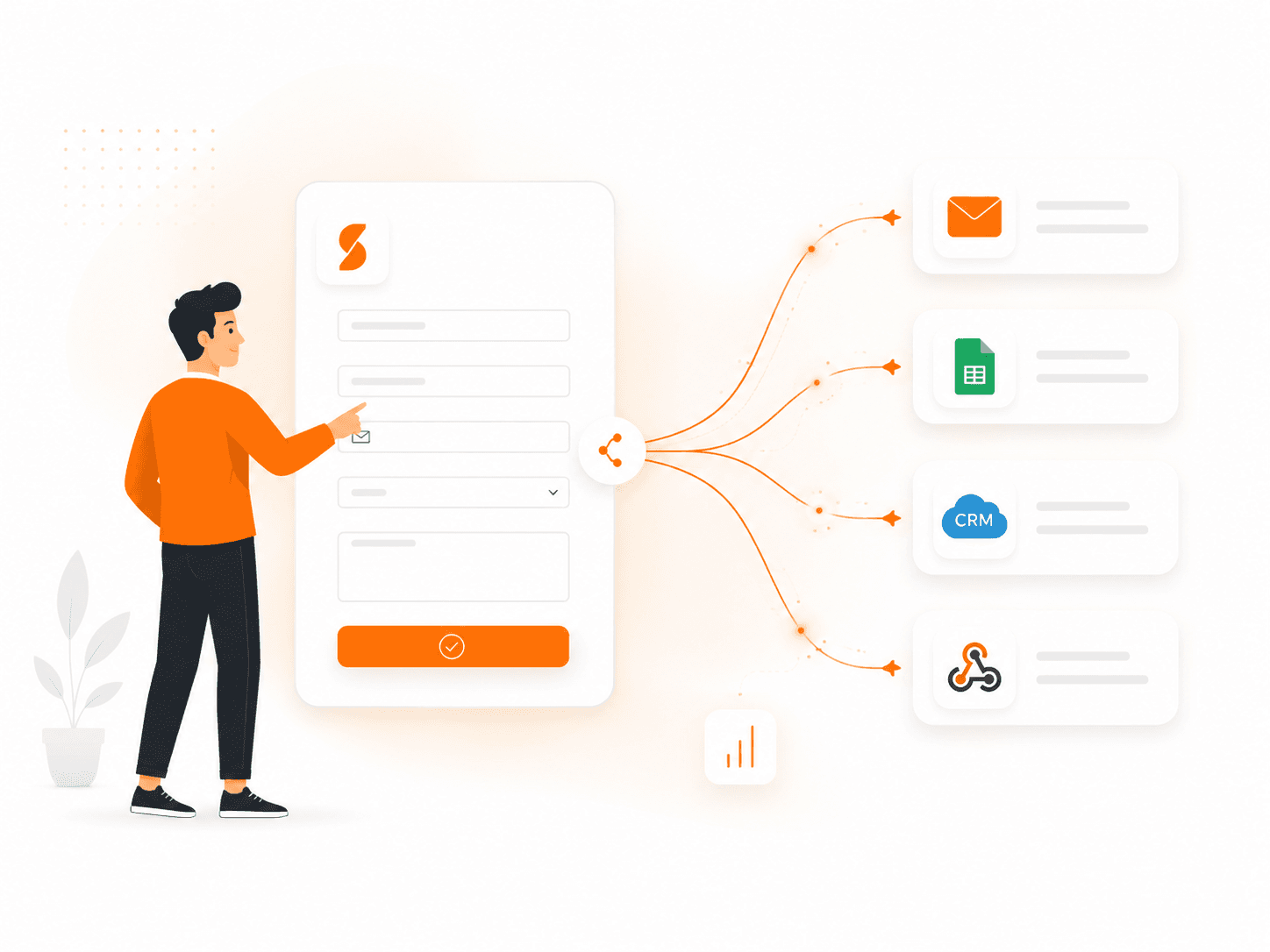
Forward submissions to email, Google Sheets, your CRM, or any webhook the moment they arrive. When you move off Getform / Forminit, your leads keep landing exactly where your team expects them — nothing to re-wire.
Common questions
Yes. splitforms handles the same core jobs as Getform / Forminit: a POST endpoint, email delivery, a submission dashboard, webhooks, and spam filtering. Getform / Forminit Free is 100 submissions/month, 1 form. splitforms Free is 500 submissions with no card and no time limit; it is a total, not a monthly allowance, so for a steady trickle a monthly plan can last longer. For webhooks and exports, splitforms Pro is $5/month.
For an endpoint-based form service, migrate by creating a splitforms access key, changing the form action to https://splitforms.com/api/submit, deploying, and sending a test entry. Field names, validation, and styling can stay unchanged.
splitforms includes email delivery, a searchable dashboard, HMAC-signed webhooks on paid plans (8-second timeout, one automatic retry on network errors, timeouts and 5xx responses), storage-backed file uploads on eligible plans, custom redirects on every plan, smart spam filtering, and a documented REST API. Getform / Forminit-specific features like file uploads on every plan, including free (100 mb storage, up to 25 mb per submission) may need an integration.
splitforms is free for 500 submissions total with no card; paid plans are $5/mo Pro (5,000 submissions/month) and $49/year Annual (15,000 submissions/month, about $4.08/mo). At full use that is $1.00 per 1,000 submissions on Pro and $0.27 on Annual. Getform / Forminit starts at $19/month, or $190/year (about $15.83/month billed yearly) (Pro, 5,000 submissions/month). Verify both pricing pages because allowances can change.
Your HTML can stay in place. Preserve field names, validation, and styling, change the action and access key, then test the production form before completing the switch.
Yes — the Annual plan is $49/year (about $4.08/mo) for 15,000 submissions/month with every Pro feature, billed once a year. Check Getform / Forminit's current pricing page before comparing billing terms.
splitforms is built for developers shipping production sites — static sites, SaaS landing pages, JAMstack apps, and agency client work. For teams that want file uploads on the free tier, eu-hosted submissions and typed server-side validation, the deciding factor is usually whether file uploads on every plan, including free (100 mb storage, up to 25 mb per submission) matters to you; if it does, keep Getform / Forminit in the mix. Otherwise splitforms is the endpoint-driven option.
Deep dive
Short, honest answers on pricing, migration, and why teams move from Getform / Forminit to splitforms.
The most common trigger is the form-count cap. Getform/Forminit's free plan is capped at 1 form, which pushes agencies running multiple low-volume client sites onto a paid plan for reasons unrelated to actual traffic. splitforms removes that ceiling entirely: unlimited forms on every tier, including Free.
The second trigger is price. Forminit Pro is $19/month (or $190/year) for 5,000 submissions a month and 15 forms. splitforms Pro is $5/month for the same 5,000 with unlimited forms, and the $49/year Annual plan covers 15,000 a month.
The third trigger is field naming. Forminit says existing Getform endpoints keep working, but new Forminit forms only store inputs named with the fi- prefix (fi-sender-email, fi-text-message), so rebuilding a form on the new setup means renaming fields. splitforms stores whatever input names your form already uses, ships HMAC-SHA256 signed webhooks (one retry after ~2s on network errors, timeouts and 5xx; not on 4xx; 8-second timeout), and an MCP server so AI agents can read and act on form data without a custom integration.
“I'm hitting the 1-form cap on Free.”
splitforms gives you unlimited forms on every plan, including Free. You scale by total submissions instead of paying for arbitrary tiny form buckets.
“New Forminit forms want fi- prefixed field names.”
splitforms accepts the input names your form already has.
“My agency is running 30 client sites and the per-form pricing is killing margins.”
splitforms gives you unlimited forms on every plan, including Free, and the $49/year Annual plan (15,000 submissions/month) for high-traffic clients.
“I want to drive form submissions from a Claude or Cursor agent.”
splitforms ships an MCP server that exposes submissions, webhooks, and configuration to AI agents natively.
“I'm seeing AI-generated spam slip past CAPTCHA.”
splitforms runs every submission through smart spam filtering: automatic, rule-based scoring of content signals such as links, spam phrases and disposable email addresses.
Concrete numbers for an agency running 30 client sites, average 200 submissions/month per site, two to three forms each: with Getform/Forminit's 1-form cap on Free, nearly every client needs the $19/month Pro plan ($190/year) as soon as a second form or more than 100 submissions/month is needed. Annualized agency spend adds up fast across 30 sites, billed forever.
On splitforms, the same 30 sites can run on a mix of free tiers (small clients under 500 total) and the $5/mo Pro plan (anyone larger), with high-traffic clients on the $49/year Annual plan (15,000 submissions/month). Across 30 sites, the yearly difference adds up to thousands of dollars.
Beyond the price, the operational difference is real: no per-form planning constraint. You stop budgeting which forms a client "gets" and start treating forms as free. The accounting question becomes total submission volume across the agency, not form count per client — which is a much simpler number to forecast.
Step 1: sign up at splitforms.com for a free access key. Step 2: in each form's HTML, swap `https://getform.io/f/YOUR_ENDPOINT` in the action attribute for `https://splitforms.com/api/submit`. Step 3: trigger a test submission and confirm it lands in your dashboard.
If you have file upload fields, splitforms accepts the same `multipart/form-data` encoding Getform uses — your existing `<input type="file">` markup works without changes. Copy each webhook URL into the splitforms dashboard and update the receiver for the splitforms payload. For agencies, the recommended migration order is: pick one low-traffic client site, migrate as a pilot, run both endpoints in parallel for 24 hours, then roll out across the rest of the portfolio.
Day 1, minute zero: you open the Webflow project (or the Next.js repo, or the Astro site) and run `grep -r 'getform.io/f/' .`. In a typical agency setup you'll find the endpoint hardcoded in a Webflow form's action field via Designer, or referenced as `https://getform.io/f/abc123def` in a `components/ContactForm.tsx`. For Webflow: open Designer, select the form, replace the action URL with `https://splitforms.com/api/submit`, and add a hidden `access_key` field with your splitforms key. For a code-managed site: change the URL inline and include `access_key` in the form body. File upload fields keep their existing `multipart/form-data` markup — splitforms accepts the same encoding Getform does, so no field-name changes.
Minute fifteen: deploy the staging branch (`vercel deploy --target preview`, or in Webflow, publish to a staging subdomain). Trigger a real submission with a real email address and a real file attachment. Watch it land in the splitforms dashboard within seconds, including the file URL. Now run shadow mode: in your client-side form handler, fire a `Promise.allSettled([fetch(getformUrl, {...}), fetch(splitformsUrl, {...})])` so every production submission hits both backends for 24 hours. Compare the two dashboards — submission counts should match exactly, and you can sanity-check that file uploads, CC recipients, and any custom redirect URLs work identically before flipping the cutover switch.
Day 2: remove the Getform `fetch` call, leave splitforms as the sole backend, redeploy. Migrate Zapier triggers by re-pointing each Zap's webhook trigger at splitforms, then re-map fields, because the payload shape differs. Once the new path has run a full day clean, archive the Getform endpoint from their dashboard and downgrade the subscription. Splitforms's free tier (500 total, unlimited forms) covers the parallel shadow window for any single client, and Pro at $5/mo (5,000/month) or Annual at $49/year (15,000/month) covers a portfolio mid-cutover.
Is splitforms a true Getform alternative? Yes. Every core capability — POST endpoint, file uploads, dashboard, webhooks, spam filtering, custom redirects, CC recipients — is covered, with unlimited forms on every plan, including Free.
Does it work on Webflow? Yes. splitforms is just an HTML form action — Webflow's form element accepts it natively. Paste the splitforms URL into the form's action field and you're done.
What about file uploads? Yes, on paid plans (Pro and Annual). Standard `multipart/form-data` encoding.
Will my Zapier integration break? splitforms supports webhooks on paid plans; point a Zapier webhook trigger at the splitforms webhook URL and you have the same downstream automation.
Is there a per-form limit? No. Every plan — Free, Pro and Annual — includes unlimited forms.
Is there a yearly plan? Yes. Annual is $49/year for 15,000 submissions/month with every Pro feature, about $4.08/month.
More comparisons