
Create a free access key
Sign up for splitforms and copy the access key for your form from the dashboard — no credit card required.
Contact form · GitHub Pages
GitHub Pages only serves static files, so it has no server to catch a form submission. Point your form at one splitforms endpoint and every message lands in your inbox and dashboard — spam-filtered, free for your first 500 submissions.

GitHub Pages has no PHP runtime or mail server. Your static form posts to one hosted endpoint instead.
Honeypot, time-trap, and per-IP rate limits screen bots before they ever reach your inbox.
Accepted submissions are saved to your dashboard before owner notification email is attempted; delivery time and inbox placement depend on provider and recipient settings.
Copy-paste ready
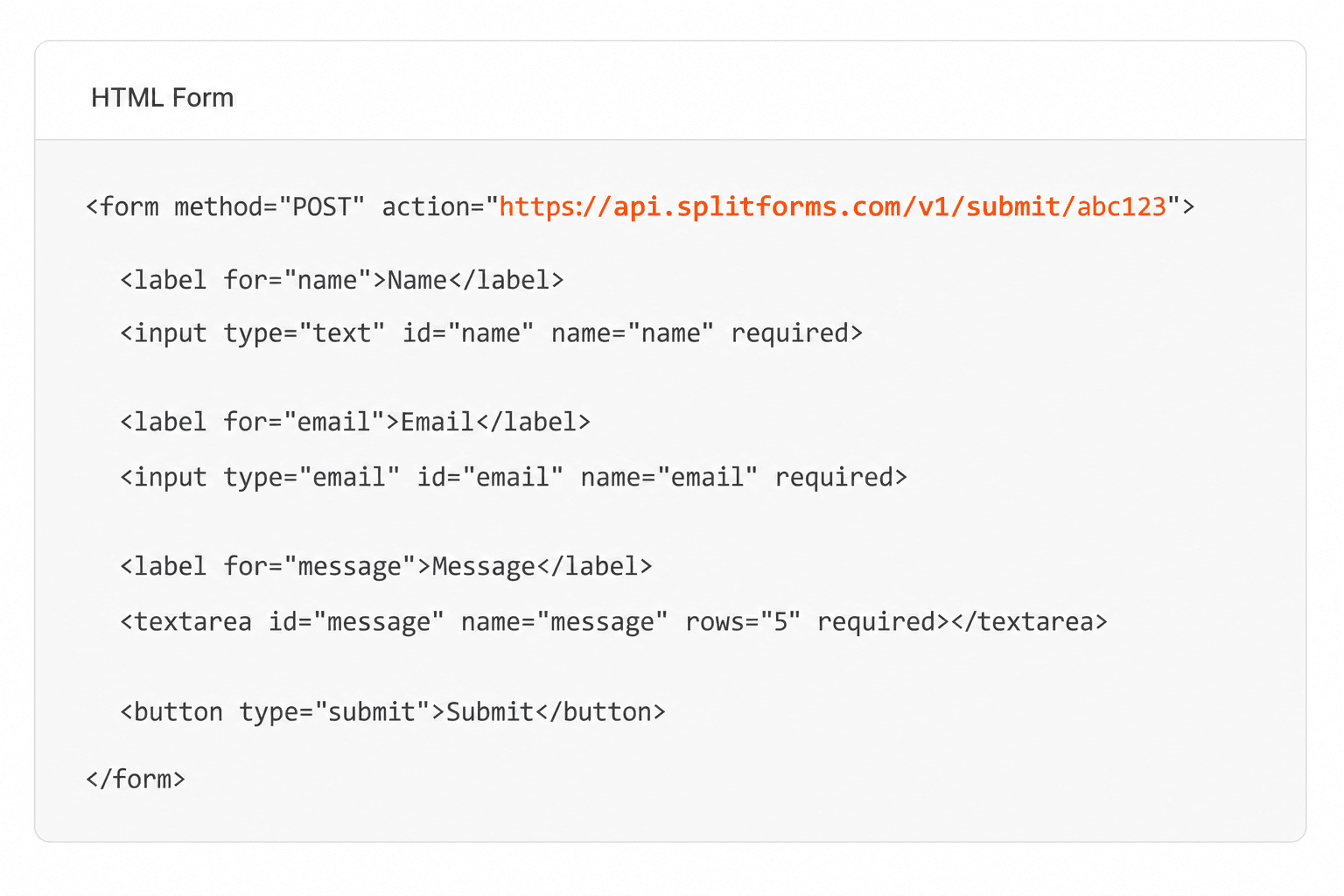
Drop this into index.html, a contact page, or a Jekyll partial, point the action at the endpoint, and add your access key. The whole change is a single attribute — no PHP, no plugin, no build step.
<form action="https://splitforms.com/api/submit" method="POST">
  <input type="hidden" name="access_key" value="YOUR_ACCESS_KEY" />
  <input type="hidden" name="redirect" value="https://yourdomain.com/thanks" />

  <label>
    Name
    <input name="name" autocomplete="name" required />
  </label>
  <label>
    Email
    <input name="email" type="email" autocomplete="email" required />
  </label>
  <label>
    Message
    <textarea name="message" required></textarea>
  </label>
  <input type="checkbox" name="botcheck" style="display:none" tabindex="-1" autocomplete="off" />
  <button type="submit">Send message</button>
</form>
How to add it
Same five steps whether the page is plain HTML or a Jekyll layout — no build plugin, no serverless function, no change to how Pages deploys your site.
Sign up for splitforms and copy the access key for your form from the dashboard — no credit card required.
Drop the HTML form below into index.html, contact.html, or a Jekyll _includes/contact.html partial. No build step or plugin needed.
Keep the hidden botcheck honeypot field empty and add a form_loaded_at time-trap field so instant bot fills get filtered before they reach your inbox.
Commit and push to your Pages branch as usual. GitHub rebuilds and redeploys the static site automatically — nothing changes on the hosting side.
Submit the live form once. The entry should appear in your splitforms dashboard and land in your inbox within seconds.
Why an endpoint
The browser renders your form fine — the problem is the submit. GitHub’s servers have no process to catch the POST, validate it, or email it to you. splitforms receives that request at a hosted HTML form backend, so your repo stays fully static and nothing about how Pages deploys has to change.

Spam protection
The page stays fully static — splitforms filters server-side before a submission reaches your dashboard. The hidden botcheck honeypot and the form_loaded_at time-trap catch bots, and per-IP rate limits stop floods. See the full spam protection reference in the docs.

Jekyll & custom domains
Your form keeps its existing fields, layout, and styling — only the action URL points at splitforms. The same static HTML works for plain pages, a reusable Jekyll contact form partial, and custom domains alike.

How SplitForms works
splitforms receives the submission, filters spam, saves it to your dashboard and emails you — then, on paid plans, sends it on to your webhooks and integrations. No backend infrastructure to build.
Point your form to your unique SplitForms endpoint. That's it.
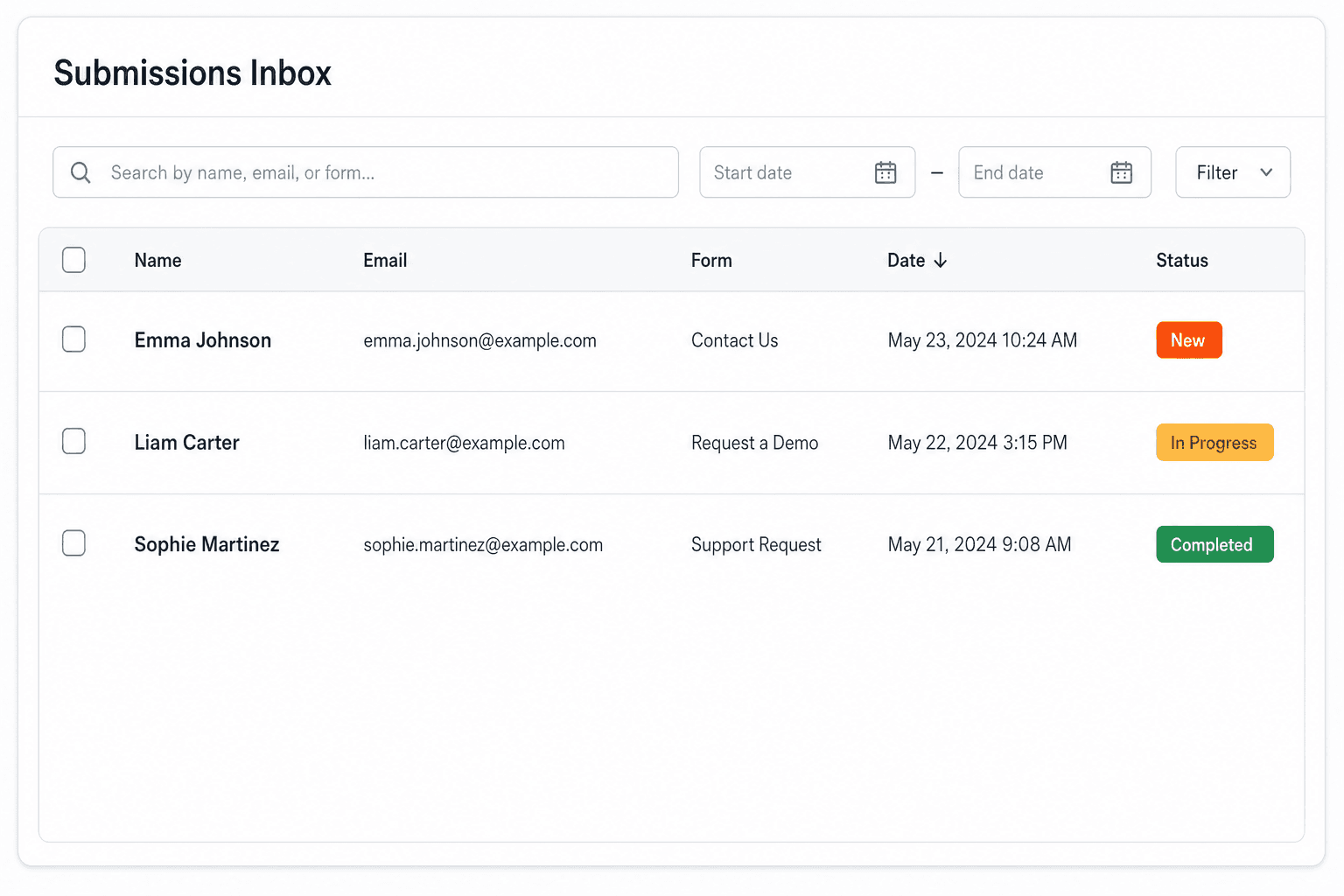
We instantly capture and organize every submission in your inbox.
Send data to email, spreadsheets, CRMs, webhooks, and 7,000+ apps.

No credit card required. Set up in under 60 seconds.
Connect & automate
On paid plans, submissions can also go to Slack, Discord, Google Sheets, Notion, Airtable, Zapier or any signed webhook — and splitforms works on the platforms you build on, from WordPress and Shopify to Next.js. With Stripe connected, your forms can take payments too.
 NewTake payments on your formsDeposits, bookings, order forms — submitters check out through Stripe and the money goes straight to your Stripe account. Included on every paid plan.See plans →
Questions
No. GitHub Pages only serves static files, so it cannot run PHP, Node, Ruby, or a server-side mail handler for each submission. A hosted form backend receives the POST request instead.
Yes. Paste the form into a page, layout, or _includes/contact.html partial. The rendered HTML submits to splitforms, so no unsupported Jekyll plugin is required.
No. A native HTML form with method POST works on its own. The only exception is the optional form_loaded_at time-trap field, which needs a few lines of script to stamp the load time — everything else works with plain HTML.
Add the hidden botcheck honeypot field and the form_loaded_at time-trap field, then let splitforms run server-side spam checks and IP rate limiting. That keeps the page static while filtering junk submissions before they reach your inbox.
Yes. The splitforms Free plan includes 500 submissions total, unlimited forms, owner email notifications, spam filtering, and dashboard storage — no credit card required.
Yes. If your GitHub Pages site uses a custom domain, add that domain to the form's allowed-domains list in your splitforms dashboard so submissions sent from it are accepted.
Yes. Add a hidden redirect field with your thank-you page URL, and splitforms sends the visitor there after a successful submission.
splitforms rate-limits submissions to 6 per minute and 20 per 15 minutes per IP address. Requests past that limit get an HTTP 429 response instead of reaching your dashboard.
Simple pricing
Free gives you 500 submissions for $0 — no card, no time limit. Pro is $5/month for 5,000 submissions a month, and Annual is $49/year for 15,000 a month with every Pro feature.
For side projects and indie devs.
Every paid feature, for agencies and growing products.
Every Pro feature with triple the volume — $0.27 per 1,000 at full use.
No credit card required on Free • Cancel anytime • Full pricing and FAQ


