
Get your free splitforms access key
Sign up at splitforms.com, verify your email, and copy your access key from the dashboard. No credit card required.
Contact form · Jekyll
Jekyll-built static sites have no backend by design — splitforms gives them one. Drop the form into a Liquid template, point the action at splitforms, and your GitHub Pages or S3-hosted Jekyll site has a working contact form in seconds.

No server, API route, or SDK. Your Jekyll form posts straight to one endpoint.
Every submission is emailed to you and saved to a searchable dashboard — spam filtered before it reaches you.
It's your own Jekyll markup and styles. Splitforms is only the backend, so nothing constrains how the form looks.
Copy-paste ready
Replace YOUR_ACCESS_KEY with the key from your dashboard — that's the whole integration. No SDK to install, no build step, just the html you already write.
---
layout: default
title: Contact
permalink: /contact/
---

<form action="https://splitforms.com/api/submit" method="POST">
  <input type="hidden" name="access_key" value="{{ site.splitforms_key }}" />

  <label>Name<input name="name" required /></label>
  <label>Email<input name="email" type="email" required /></label>
  <label>Message<textarea name="message" required></textarea></label>

  <input type="checkbox" name="botcheck" style="display:none" tabindex="-1" />
  <button type="submit">Send</button>
</form>

{% comment %}
  Put your access key in _config.yml as:
    splitforms_key: "YOUR_ACCESS_KEY"
  This keeps it out of every individual form file.
{% endcomment %}
How to add it
To add a contact form to a Jekyll website you need three things: a free splitforms access key, the html snippet above, and your key pasted into it. No backend, server, or SDK — the form posts to one URL and every submission lands in your inbox and dashboard.
Sign up at splitforms.com, verify your email, and copy your access key from the dashboard. No credit card required.
Copy the Jekyll code example into your project and replace YOUR_ACCESS_KEY with the key from step 1.
Submissions arrive in the splitforms dashboard within seconds. Free includes owner email notification attempts; Pro adds Slack, Discord, Sheets, or any signed webhook URL.
Where submissions go
Every submission is emailed to you and saved to a searchable dashboard — spam filtered before it ever reaches you. Search, export to CSV, or forward it to a webhook or Slack on Pro.

No backend needed
Your Jekyll form posts standard FormData to one URL. Splitforms validates the access key, runs its spam checks, and forwards it to your email — so there's no server, API route, or database for you to build or maintain.

Best practices
The difference between a form that works in the demo and one that survives launch traffic — the production-tested defaults, in priority order.

How SplitForms works
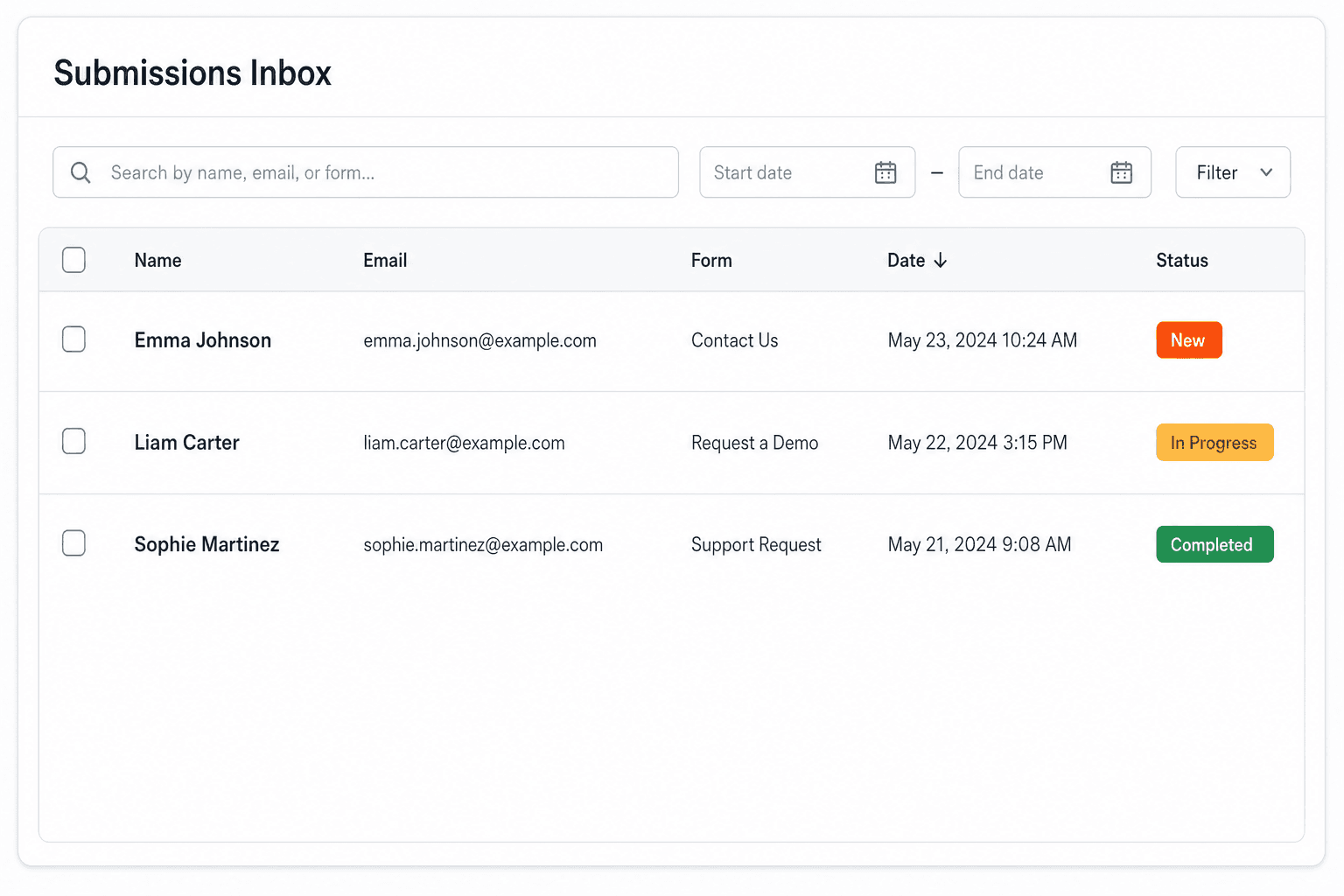
splitforms receives the submission, filters spam, saves it to your dashboard and emails you — then, on paid plans, sends it on to your webhooks and integrations. No backend infrastructure to build.

Point your form to your unique SplitForms endpoint. That's it.
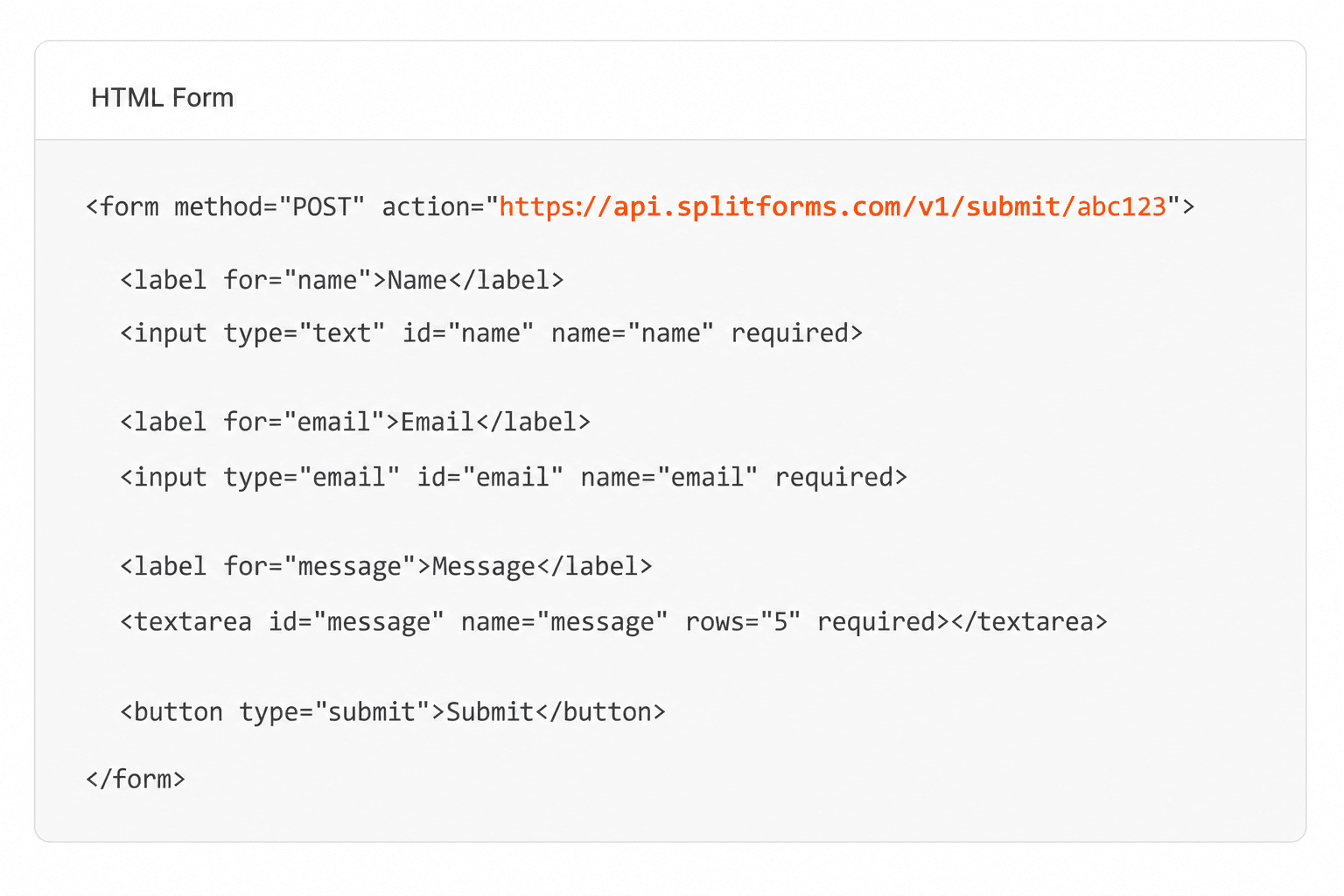
We instantly capture and organize every submission in your inbox.
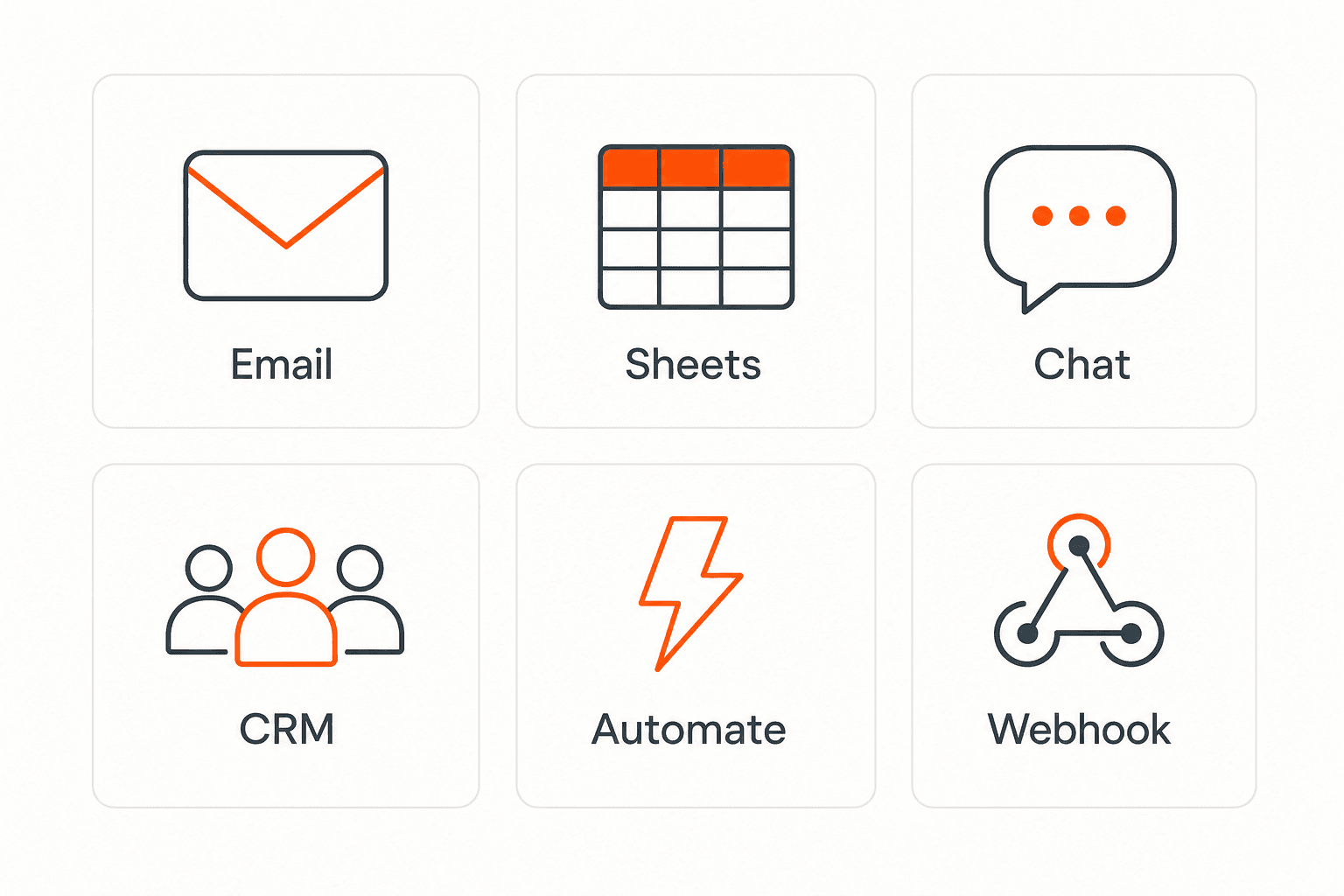
Send data to email, spreadsheets, CRMs, webhooks, and 7,000+ apps.
No credit card required. Set up in under 60 seconds.
Connect & automate
On paid plans, submissions can also go to Slack, Discord, Google Sheets, Notion, Airtable, Zapier or any signed webhook — and splitforms works on the platforms you build on, from WordPress and Shopify to Next.js. With Stripe connected, your forms can take payments too.
 NewTake payments on your formsDeposits, bookings, order forms — submitters check out through Stripe and the money goes straight to your Stripe account. Included on every paid plan.See plans →
Questions
Yes. You get 500 free submissions with no credit card and no time limit, plus unlimited forms, spam filtering, the dashboard, and owner email delivery. The 500 is a one-time allowance rather than a monthly one. Pro is $5/mo for 5,000 submissions a month and adds signed webhooks, exports, integrations, and retained uploads when Storage is connected.
No. Splitforms is API-only. There's no SDK, no plugin, no PHP. Your form posts standard FormData to one URL.
A hidden honeypot field catches the obvious bots. A rule-based filter scores everything else (links, spam phrases, disposable emails, gibberish) and quarantines what looks like spam to a separate Spam tab, so your inbox stays clean and nothing is lost.
Yes — use a server-side environment variable and post from a server route or server action. Or expose it client-side and rely on per-domain locking. Either path is supported.
Simple pricing
Free gives you 500 submissions for $0 — no card, no time limit. Pro is $5/month for 5,000 submissions a month, and Annual is $49/year for 15,000 a month with every Pro feature.
For side projects and indie devs.
Every paid feature, for agencies and growing products.
Every Pro feature with triple the volume — $0.27 per 1,000 at full use.
No credit card required on Free • Cancel anytime • Full pricing and FAQ


