
Generate a free splitforms key
Sign in at splitforms.com — your access key is created instantly. No credit card, no setup wizard, no SDK to install.
Bug Report · WordPress
Bug reports with severity, environment, and reproduction steps. Free for 500 submissions total — no backend, no SDK, no plugin.

Copy-paste code
Replace YOUR_ACCESS_KEY with your splitforms key, paste into a WordPress page, and ship. No build-time integration required.
<?php
// Drop into a PHP page. Receives a form POST and proxies it to splitforms.com.
// Useful when you want to add server-side validation or rate limiting.

if ($_SERVER['REQUEST_METHOD'] === 'POST') {
    // sf_sid: passing it on lets partial leads close once the visitor
    // submits. It only exists if the page with your form also has
    //   <form data-sf-key="YOUR_ACCESS_KEY" ...>   (this proxy adds access_key, so the form has none)
    //   <script src="https://splitforms.com/embed.js" async></script>
    // — embed.js then adds the hidden sf_sid input. Harmless without it.
    $allowed = ['title', 'severity', 'browser', 'steps', 'email', 'sf_sid'];
    $payload = ['access_key' => 'YOUR_ACCESS_KEY'];
    $payload['subject'] = 'New bug report';

    foreach ($allowed as $f) {
        if (isset($_POST[$f])) $payload[$f] = $_POST[$f];
    }

    $ch = curl_init('https://splitforms.com/api/submit');
    curl_setopt($ch, CURLOPT_POST, true);
    curl_setopt($ch, CURLOPT_POSTFIELDS, http_build_query($payload));
    curl_setopt($ch, CURLOPT_RETURNTRANSFER, true);
    curl_setopt($ch, CURLOPT_HTTPHEADER, ['Accept: application/json']);
    $response = curl_exec($ch);
    $status   = curl_getinfo($ch, CURLINFO_HTTP_CODE);
    curl_close($ch);

    header('Content-Type: application/json');
    http_response_code($status);
    echo $response;
    exit;
}
?>
WordPress + Bug Report
WordPress contact form plugins (Contact Form 7, WPForms, Fluent Forms) work but add database bloat, update fatigue, and a monthly subscription for features like webhook delivery or advanced spam controls. The bug report on this page drops into a Custom HTML block — no PHP, no plugin activation, no settings page to configure. Every field POSTs to splitforms as standard form data, so your WordPress admin stays clean. You keep using WordPress for content management and page building while splitforms handles the form pipeline.

Bug Report fields
The posted payload contains short summary, severity, browser & os, steps to reproduce, your email (so we can follow up). Required fields are short summary, severity, steps to reproduce and your email (so we can follow up). Rename, remove, or add your own — splitforms accepts any name you POST.

Template playbook
Bug reports without reproduction steps waste hours of triage. The form structures the report — what happened, what was expected, steps to reproduce, browser / OS / device, screenshot. Screenshot upload is critical: 'the page broke' tells you nothing; a screenshot of the broken state tells you everything. Webhook the structured report into Linear or GitHub Issues so it lands as a triageable ticket, not a Slack message that scrolls away. For SaaS teams the time saved is huge — instead of a 4-message back-and-forth gathering basic context, the engineer opens the issue and starts debugging.

Setup
Three actions stand between you and your first bug report submission — no backend, no database, no CAPTCHA library.
Sign in at splitforms.com — your access key is created instantly. No credit card, no setup wizard, no SDK to install.
Drop the form snippet into a WordPress page, component, or layout. Replace YOUR_ACCESS_KEY with the key from your dashboard. The form action is a hard-coded URL — no env vars or build-time wiring needed.
Dashboard updates live on Free. Free includes owner email delivery; paid plans add signed webhooks, CSV export, Slack/Discord forwarding, and BCC to your team.
How SplitForms works
splitforms receives the submission, filters spam, saves it to your dashboard and emails you — then, on paid plans, sends it on to your webhooks and integrations. No backend infrastructure to build.

Point your form to your unique SplitForms endpoint. That's it.
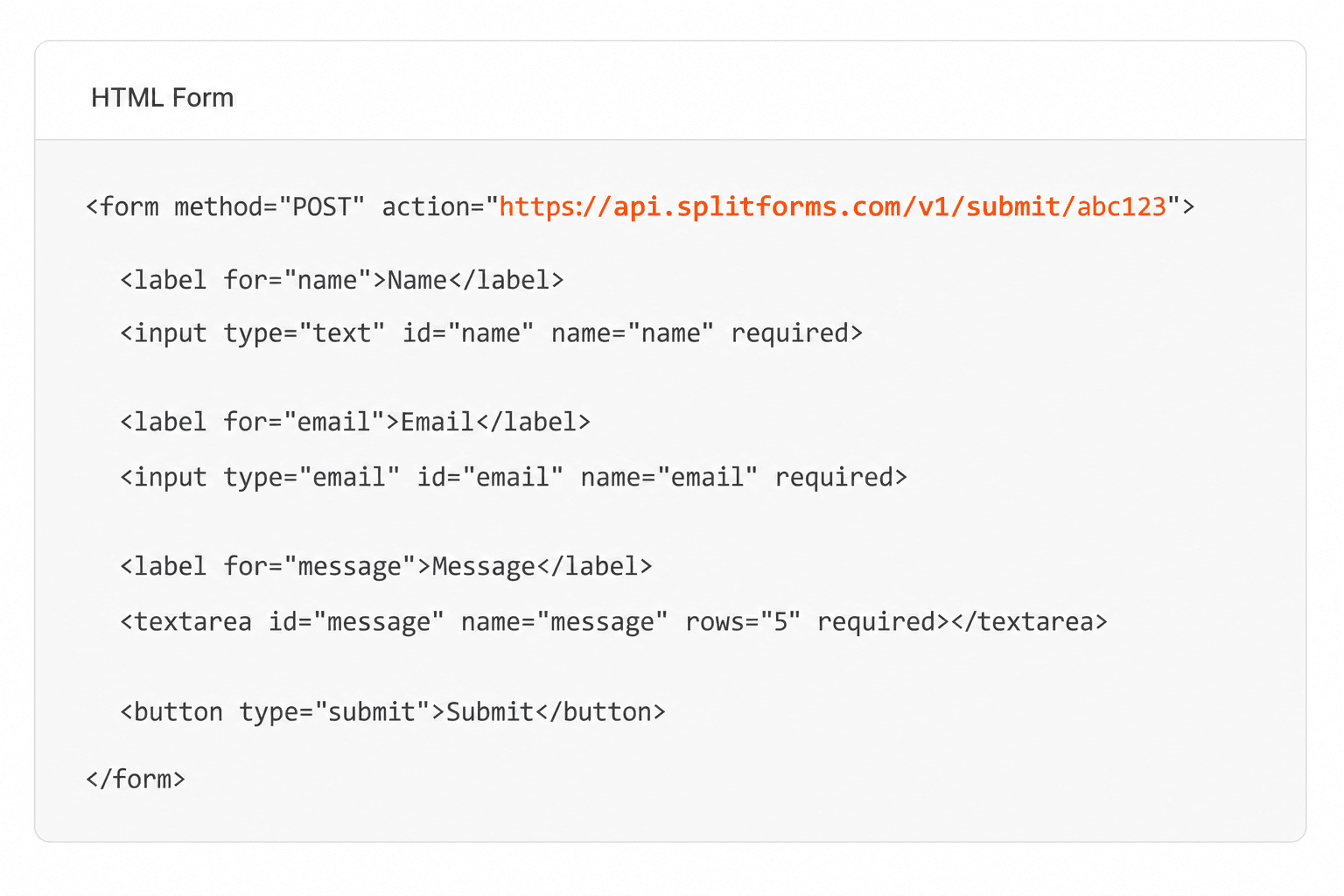
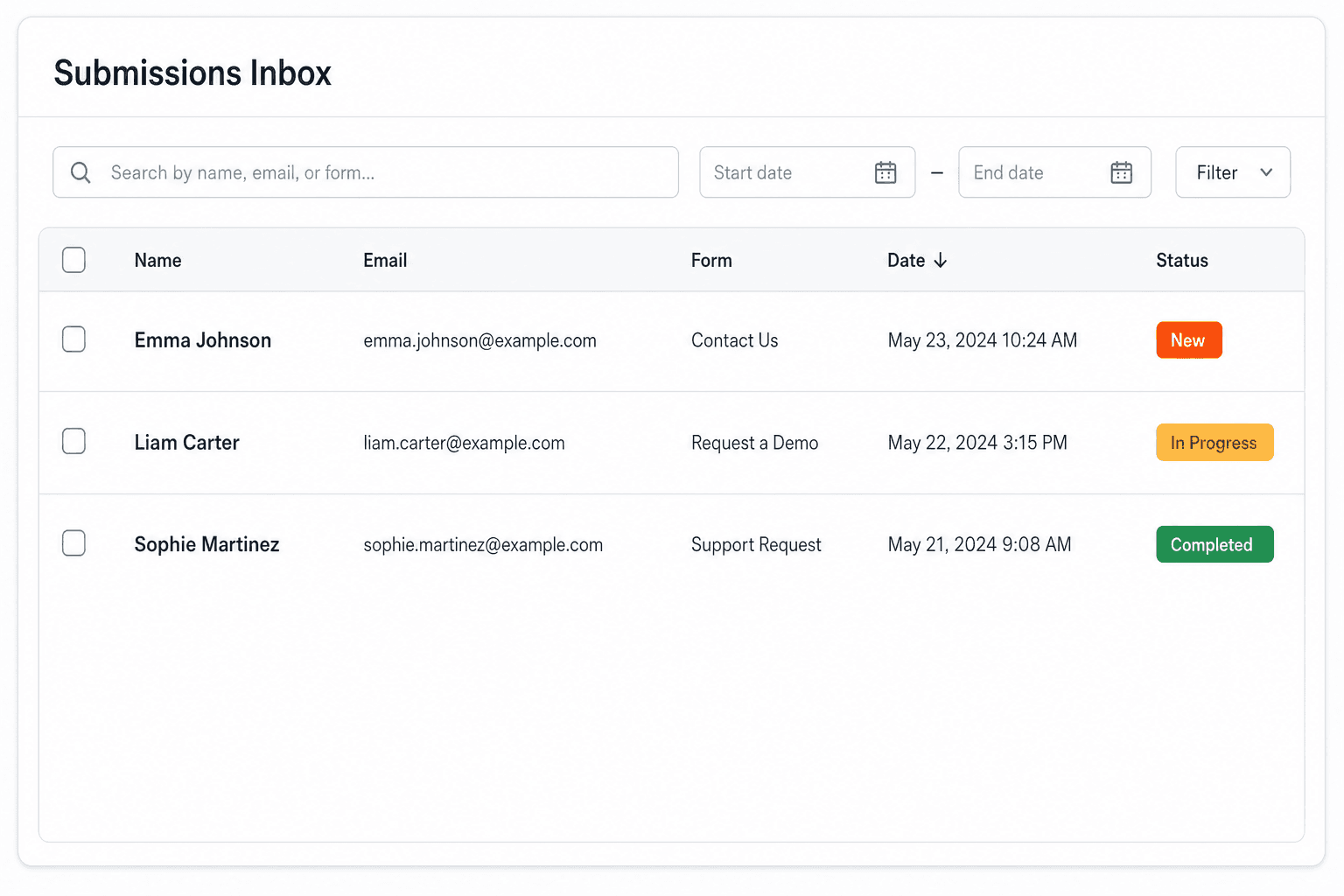
We instantly capture and organize every submission in your inbox.
Send data to email, spreadsheets, CRMs, webhooks, and 7,000+ apps.

No credit card required. Set up in under 60 seconds.
Connect & automate
On paid plans, submissions can also go to Slack, Discord, Google Sheets, Notion, Airtable, Zapier or any signed webhook — and splitforms works on the platforms you build on, from WordPress and Shopify to Next.js. With Stripe connected, your forms can take payments too.
 NewTake payments on your formsDeposits, bookings, order forms — submitters check out through Stripe and the money goes straight to your Stripe account. Included on every paid plan.See plans →
Common questions
Yes. The form is plain HTML with a single POST endpoint, so it runs on any WordPress site without server-side code, plugins, or SDKs. Drop the snippet into a WordPress page or component and submissions land in your splitforms dashboard.
Free for 500 submissions — no credit card, no time limit. Pro is $5/mo for 5,000 submissions a month, and Annual is $49/year for 15,000 submissions a month. The same pricing applies regardless of which framework hosts the form.
Yes. The template ships with sensible defaults (short summary, severity, browser & os, steps to reproduce…) — add, remove, or rename any of them. Splitforms accepts whatever fields you POST.
A hidden honeypot field catches dumb bots, and a rule-based filter scores the rest; anything that looks like spam goes to a separate Spam tab instead of your inbox. No CAPTCHA, no friction for human users — and it works the same on WordPress as on any other framework.
Yes. Webhooks are available on paid plans, with auto-formatted payloads for Slack, Discord, and WhatsApp (via CallMeBot). Or send raw signed JSON to any URL — Zapier, n8n, your own server. Configure in the splitforms dashboard.
Yes — the form posts directly to splitforms from the browser, so no server is involved. Works on Vercel, Netlify, GitHub Pages, Cloudflare Pages, S3, or any plain Apache host.
Yes — JavaScript can read navigator.userAgent and pre-fill hidden fields with browser name, version, OS, and screen size. The user doesn't see them; the engineer gets them. Saves 90% of 'what browser are you on?' replies.
Yes — webhook the JSON. Linear and GitHub both accept inbound issue creation via API or Zapier. Sentry doesn't accept user-reported bugs as events but you can webhook to a Slack channel where the on-call engineer triages and creates the Sentry issue manually.
Public bug-report forms attract spam — hidden honeypot plus splitforms' rule-based spam filter catches the automated spam. Require an email field; disposable and malformed addresses add to the spam score. For severe abuse, gate the form behind a logged-in user session.
Simple pricing
Free gives you 500 submissions for $0 — no card, no time limit. Pro is $5/month for 5,000 submissions a month, and Annual is $49/year for 15,000 a month with every Pro feature.
For side projects and indie devs.
Every paid feature, for agencies and growing products.
Every Pro feature with triple the volume — $0.27 per 1,000 at full use.
No credit card required on Free • Cancel anytime • Full pricing and FAQ


