
Get your free splitforms access key
Sign up at splitforms.com, verify your email, and copy your access key from the dashboard. No credit card required.
Contact form · Hugo
Hugo builds blazing-fast static sites — but ships zero backend. Drop a partial or shortcode in your theme, pull the access key from site params, and you have a working contact form without spinning up a Cloud Run service or wiring Netlify Functions. Pure HTML, zero JavaScript, full spam protection.

No server, API route, or SDK. Your Hugo form posts straight to one endpoint.
Every submission is emailed to you and saved to a searchable dashboard — spam filtered before it reaches you.
It's your own Hugo markup and styles. Splitforms is only the backend, so nothing constrains how the form looks.
Copy-paste ready
Replace YOUR_ACCESS_KEY with the key from your dashboard — that's the whole integration. No SDK to install, no build step, just the html you already write.
{{/*
  layouts/partials/contact-form.html
  Use in any template with: {{ partial "contact-form.html" . }}
  Set splitformsKey in your site config (hugo.toml):
    [params]
      splitformsKey = "YOUR_ACCESS_KEY"
*/}}

<form action="https://splitforms.com/api/submit" method="POST">
  <input type="hidden" name="access_key" value="{{ .Site.Params.splitformsKey }}" />

  <input type="text"  name="name"    placeholder="Name"  required />
  <input type="email" name="email"   placeholder="Email" required />
  <textarea           name="message" placeholder="Message" required></textarea>

  <input type="checkbox" name="botcheck" style="display:none" tabindex="-1" />

  <button type="submit">Send</button>
</form>
How to add it
To add a contact form to a Hugo website you need three things: a free splitforms access key, the html snippet above, and your key pasted into it. No backend, server, or SDK — the form posts to one URL and every submission lands in your inbox and dashboard.
Sign up at splitforms.com, verify your email, and copy your access key from the dashboard. No credit card required.
Copy the Hugo code example into your project and replace YOUR_ACCESS_KEY with the key from step 1.
Submissions arrive in the splitforms dashboard within seconds. Free includes inbox delivery; Pro adds Slack, Discord, Sheets, or any signed webhook URL.
Where submissions go
Every submission is emailed to you and saved to a searchable dashboard — spam filtered before it ever reaches you. Search, export to CSV, or forward it to a webhook or Slack on Pro.

No backend needed
Your Hugo form posts standard FormData to one URL. Splitforms validates the access key, runs the spam classifier, and forwards it to your email — so there's no server, API route, or database for you to build or maintain.

Best practices
The difference between a form that works in the demo and one that survives launch traffic — the production-tested defaults, in priority order.

How SplitForms works
Connect your form, collect every submission, and send data where it needs to go — without building backend infrastructure.

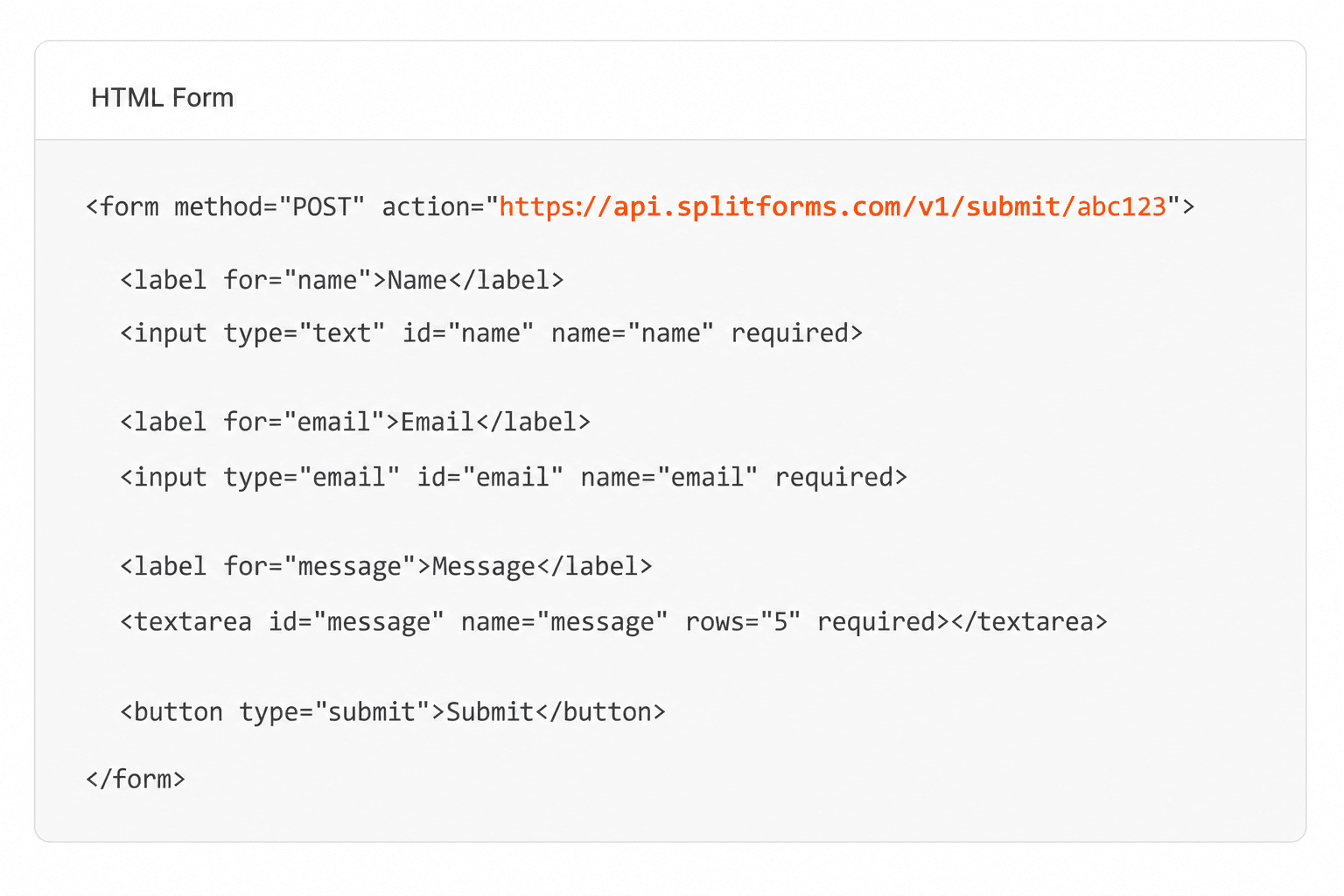
Point your form to your unique SplitForms endpoint. That's it.
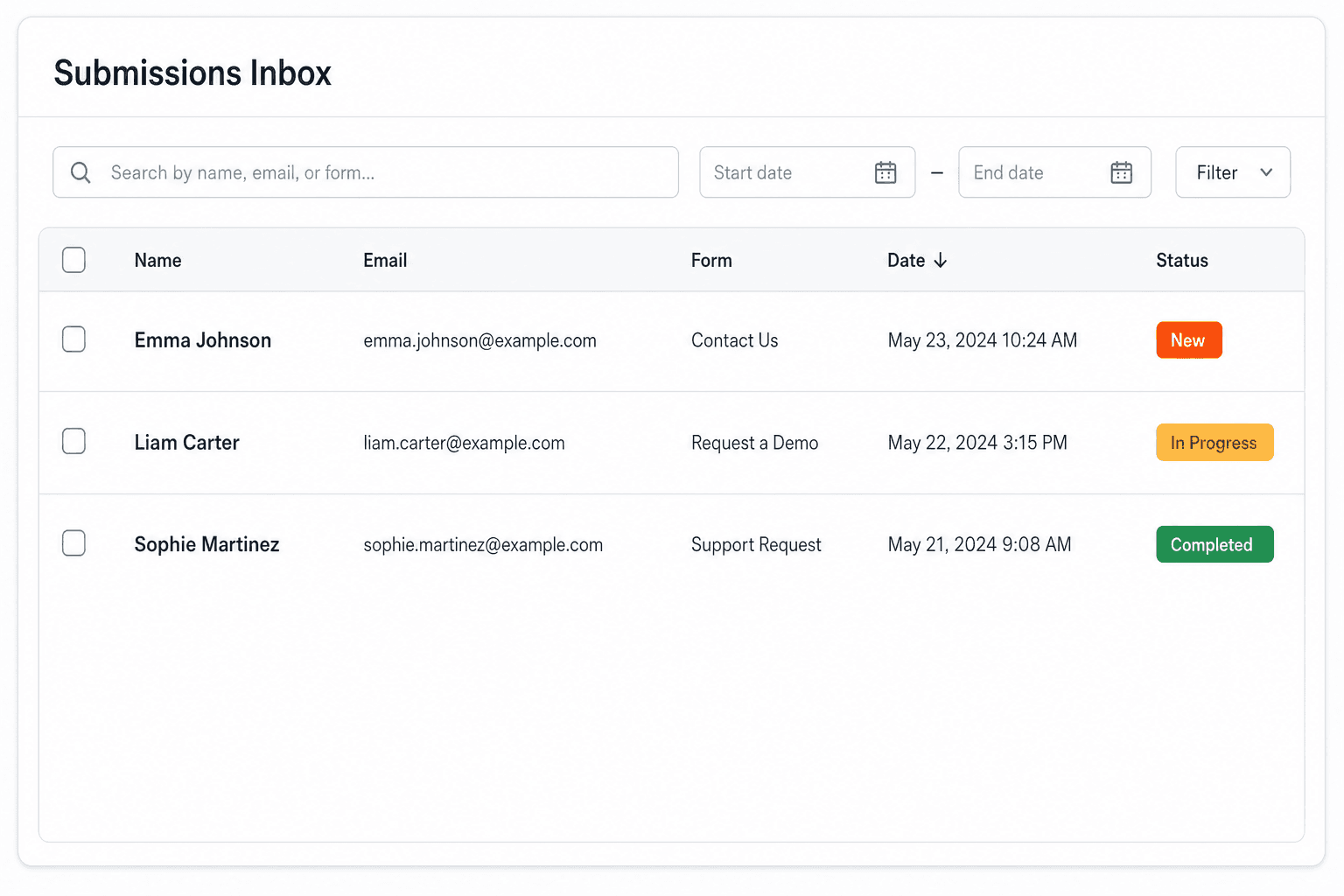
We instantly capture and organize every submission in your inbox.
Send data to email, spreadsheets, CRMs, webhooks, and 7,000+ apps.

No credit card required. Set up in under 60 seconds.
Connect & automate
SplitForms works with the destinations you route to and the platforms you build on — from Slack and Sheets to WordPress, Shopify, and Next.js.
Trusted by indie teams and agencies shipping forms worldwide
Testimonials
40 quotes on record — from indie hacks to agency migrations.
“I replaced a Lambda + DynamoDB + SES contact form with six lines of HTML. It took eleven minutes, and the dashboard is better than what I was going to build.”
“We migrated 14 client sites off Formspree in a single weekend. The price is a third of what we paid, the API is more honest, and the spam filter actually works.”
“The webhook payload is signed, idempotent, and well-shaped. It reads like code from a competent team, not a CRUD app held together with duct tape.”
“I stopped reaching for Typeform on small marketing sites. splitforms covers 90% of the use case at none of the bloat.”
“I onboarded our whole agency in an afternoon. The MCP integration meant Cursor literally dropped the form straight into our client repos for us.”
“The free plan gave me 500 submissions before I paid a cent, and Pro is five dollars a month. I've spent more on coffee deciding which backend to use.”
“Spam went from forty junk entries a day to zero, with no reCAPTCHA puzzle ruining the form. The honeypot and time-trap just quietly do their job.”
“Point the form action at one endpoint and you're done. No SDK, no client library, no build step. This is how a form backend should feel.”
“Leads land in Slack the second someone submits, and a copy goes to Google Sheets for the sales team. I wired both up in under ten minutes.”
“I run a static Hugo site on a five-dollar VPS. splitforms gave it a real contact form without me standing up a single server.”
Questions
Save the snippet above as layouts/partials/contact-form.html in your project (NOT in the vendored theme). Add splitformsKey = "sk_live_…" to [params] in hugo.toml. Then call {{ partial "contact-form.html" . }} from any template, or use the shortcode variant for Markdown content.
Yes — that's the default Hugo mode. The form is pure HTML, posts directly to splitforms.com from the browser, and doesn't need any Hugo server feature. Works with hugo --minify and any deployment target.
Hugo doesn't render dynamic responses, so error UI is split between two paths. (1) Pure-HTML pattern: splitforms returns a generic error page on failure — customize it via splitforms dashboard → Settings → Error Page. (2) Hybrid: add a small inline <script> that intercepts submit, calls fetch, and renders inline errors (see the AJAX page).
Yes — every Hugo theme. The partial lives in your project's layouts directory, which Hugo's lookup order prefers over the theme. No theme modifications required.
Build the thank-you page in Hugo, then set its absolute URL in Dashboard → Form settings → Redirect. The setting applies per splitforms form. Submitted redirect fields and shortcode arguments are ignored.
Yes. The form is plain HTML — Hugo's HTML minifier compresses whitespace but doesn't touch attributes. Asset fingerprinting only affects linked CSS/JS files, not inline form markup.
If you set splitformsKey in hugo.toml under [params] but reference it as {{ .Site.Params.SplitformsKey }} in the template, recent Hugo versions still resolve it — but Hugo 0.110 and earlier don't. Use the exact case from your config file.
If you put a <form> directly in a Markdown content file, Goldmark's HTML sanitizer strips it. Either set markup.goldmark.renderer.unsafe = true in your config, or wrap the form in a shortcode (recommended): {{< contact-form >}}.
Configure the exact absolute thank-you URL in the splitforms dashboard. Hugo normalizes trailing slashes according to uglyURLs; if the generated page is /thanks.html, a dashboard redirect to /thanks/ will 404. Check the built output before saving the redirect.
If you copy contact-form.html into a vendored theme's layouts/partials/, your changes get overwritten on the next theme update. Always put custom partials in your project's own layouts/partials/ — Hugo's lookup chain prefers project over theme automatically.
If your splitforms key contains an underscore (it does — keys are sk_live_...), Hugo's HTML escaping is fine for input values, but if you echo it into JS contexts you may need safeJS. Sticking to <input value="…"> works as-is.
If you build with hugo --minify, the HTML minifier strips whitespace and newlines aggressively — including the contents between <textarea>…</textarea> tags. A textarea pre-filled with \n\nWrite your message here… collapses to a single line, breaking the visual hint. The minifier respects <pre> but not <textarea> by default. Either avoid pre-filled textarea content (use a placeholder attribute instead — that's what placeholders are for) or disable minification of HTML via minify.tdewolff.html.keepWhitespace = true in your config.
Hugo is a static site generator — there's no runtime, no /server/api, no way to handle a form POST without an external service. The native paths are: (a) a Cloudflare Worker / Lambda / Cloud Run service handling POST /contact and emailing you (~4 hours of setup, ongoing operation), (b) Netlify Forms when the Hugo site is hosted on Netlify, or (c) a third-party form backend like Formspree, Basin, or Web3Forms. Hugo's templating shines for the form's HTML — {{ partial }}, {{ .Site.Params }} for the access key, {{< shortcode >}} for Markdown reuse — but the delivery layer is always external. Splitforms is the simplest portable option that doesn't require a Cloud Run service.
Hugo deploys to any static host: Vercel, Netlify, Cloudflare Pages, GitHub Pages, S3, Surge, plain Apache/nginx. The form posts cross-origin so the host is irrelevant. Set splitformsKey in hugo.toml under [params] for private repos; for public repos, build with hugo --param splitformsKey=$SPLITFORMS_KEY and read it from CI env. Hugo's local dev server runs on localhost:1313 — add that to splitforms allowed-domains for testing or use a separate dev key. hugo --minify compresses HTML but doesn't touch attribute values — the form works under minification.
Simple pricing
Choose a plan that fits your workflow — from a free form endpoint to full automations, exports, and higher submission limits.
Free forever
For side projects and indie devs.
For agencies and growing products.
Pay $59. 3 years sorted.
No credit card required on Free • Cancel anytime


