
Generate a free splitforms key
Sign in at splitforms.com — your access key is created instantly. No credit card, no setup wizard, no SDK to install.
Feedback Form · WordPress
Rating + free-text feedback with optional follow-up email. Free for 500 submissions total — no backend, no SDK, no plugin.

Copy-paste code
Replace YOUR_ACCESS_KEY with your splitforms key, paste into a WordPress page, and ship. No build-time integration required.
<?php
// Drop into a PHP page. Receives a form POST and proxies it to splitforms.com.
// Useful when you want to add server-side validation or rate limiting.

if ($_SERVER['REQUEST_METHOD'] === 'POST') {
    // sf_sid: passing it on lets partial leads close once the visitor
    // submits. It only exists if the page with your form also has
    //   <form data-sf-key="YOUR_ACCESS_KEY" ...>   (this proxy adds access_key, so the form has none)
    //   <script src="https://splitforms.com/embed.js" async></script>
    // — embed.js then adds the hidden sf_sid input. Harmless without it.
    $allowed = ['rating', 'feedback', 'email', 'sf_sid'];
    $payload = ['access_key' => 'YOUR_ACCESS_KEY'];
    $payload['subject'] = 'New feedback submission';

    foreach ($allowed as $f) {
        if (isset($_POST[$f])) $payload[$f] = $_POST[$f];
    }

    $ch = curl_init('https://splitforms.com/api/submit');
    curl_setopt($ch, CURLOPT_POST, true);
    curl_setopt($ch, CURLOPT_POSTFIELDS, http_build_query($payload));
    curl_setopt($ch, CURLOPT_RETURNTRANSFER, true);
    curl_setopt($ch, CURLOPT_HTTPHEADER, ['Accept: application/json']);
    $response = curl_exec($ch);
    $status   = curl_getinfo($ch, CURLINFO_HTTP_CODE);
    curl_close($ch);

    header('Content-Type: application/json');
    http_response_code($status);
    echo $response;
    exit;
}
?>
WordPress + Feedback Form
WordPress contact form plugins (Contact Form 7, WPForms, Fluent Forms) work but add database bloat, update fatigue, and a monthly subscription for features like webhook delivery or advanced spam controls. The feedback form on this page drops into a Custom HTML block — no PHP, no plugin activation, no settings page to configure. Every field POSTs to splitforms as standard form data, so your WordPress admin stays clean. You keep using WordPress for content management and page building while splitforms handles the form pipeline.

Feedback Form fields
The posted payload contains how would you rate your experience?, what can we do better?, email (optional, for follow-up). Required fields are how would you rate your experience? and what can we do better?. Rename, remove, or add your own — splitforms accepts any name you POST.

Template playbook
Feedback forms cost almost nothing to ship and pay back disproportionately — every NPS detractor (score 0-6) is a conversation that prevents churn, every promoter (9-10) is a referral or testimonial source. The form is simple: 0-10 rating, an optional comment, and an email. The leverage is in the routing: detractors auto-DM your support lead in Slack within minutes, promoters get a 'mind leaving us a G2 / Trustpilot review?' follow-up, passives go into a digest. Survey tools (SurveyMonkey, Typeform, Hotjar) charge $30-100/mo for the same pattern. The form pattern is 30 lines of HTML.
Setup
Three actions stand between you and your first feedback form submission — no backend, no database, no CAPTCHA library.
Sign in at splitforms.com — your access key is created instantly. No credit card, no setup wizard, no SDK to install.
Drop the form snippet into a WordPress page, component, or layout. Replace YOUR_ACCESS_KEY with the key from your dashboard. The form action is a hard-coded URL — no env vars or build-time wiring needed.
Dashboard updates live on Free. Free includes owner email delivery; paid plans add signed webhooks, CSV export, Slack/Discord forwarding, and BCC to your team.
How SplitForms works
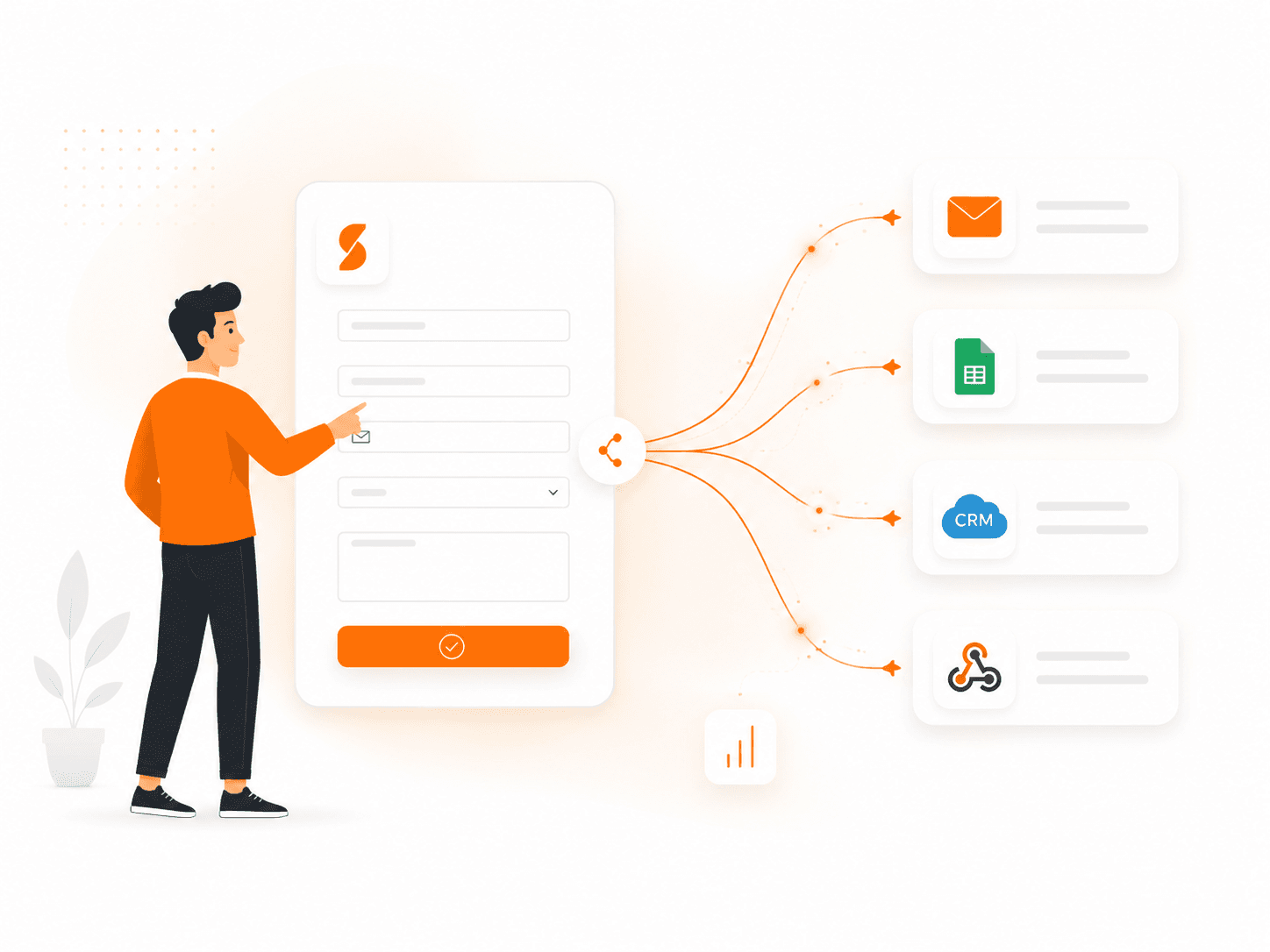
splitforms receives the submission, filters spam, saves it to your dashboard and emails you — then, on paid plans, sends it on to your webhooks and integrations. No backend infrastructure to build.

Point your form to your unique SplitForms endpoint. That's it.
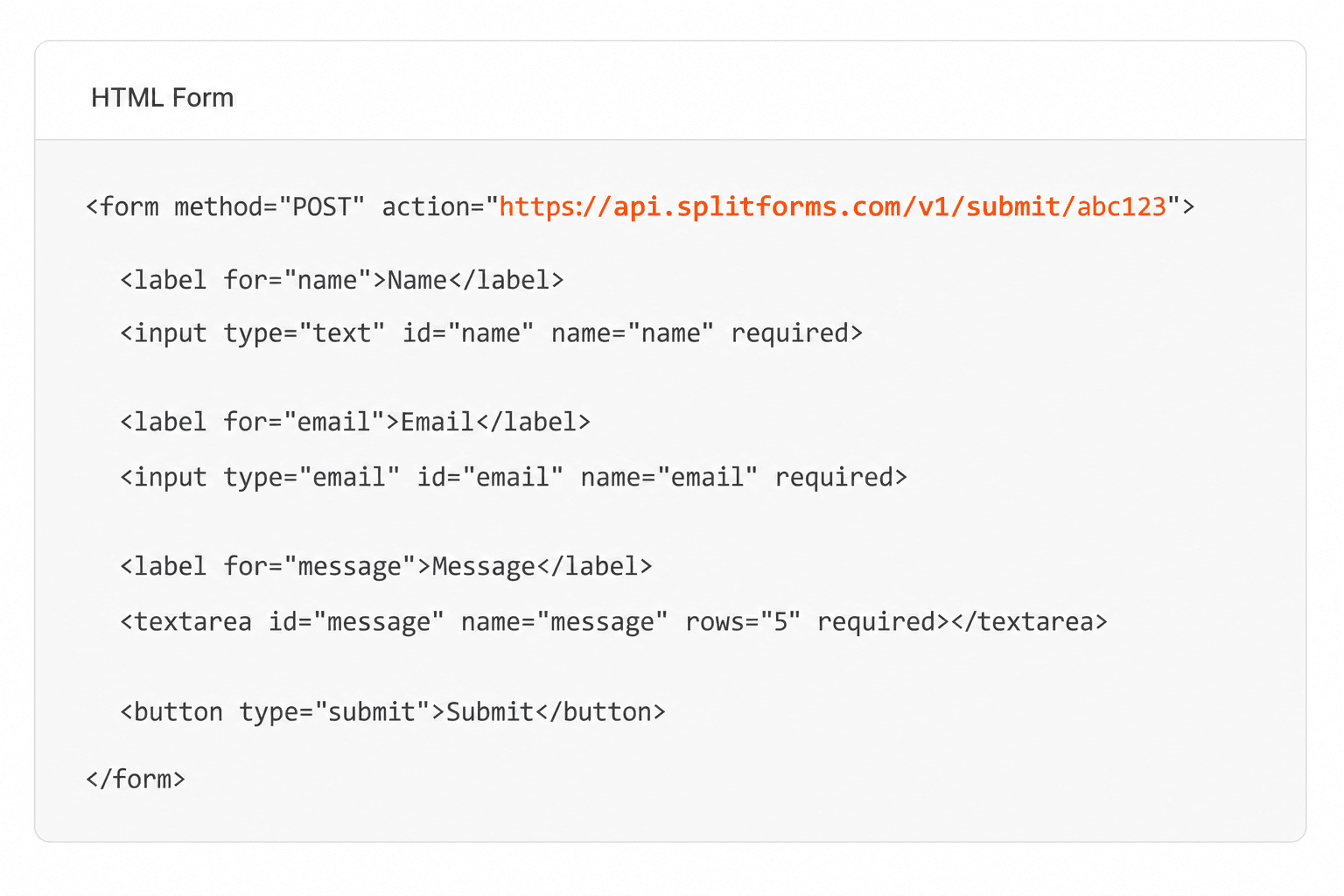
We instantly capture and organize every submission in your inbox.
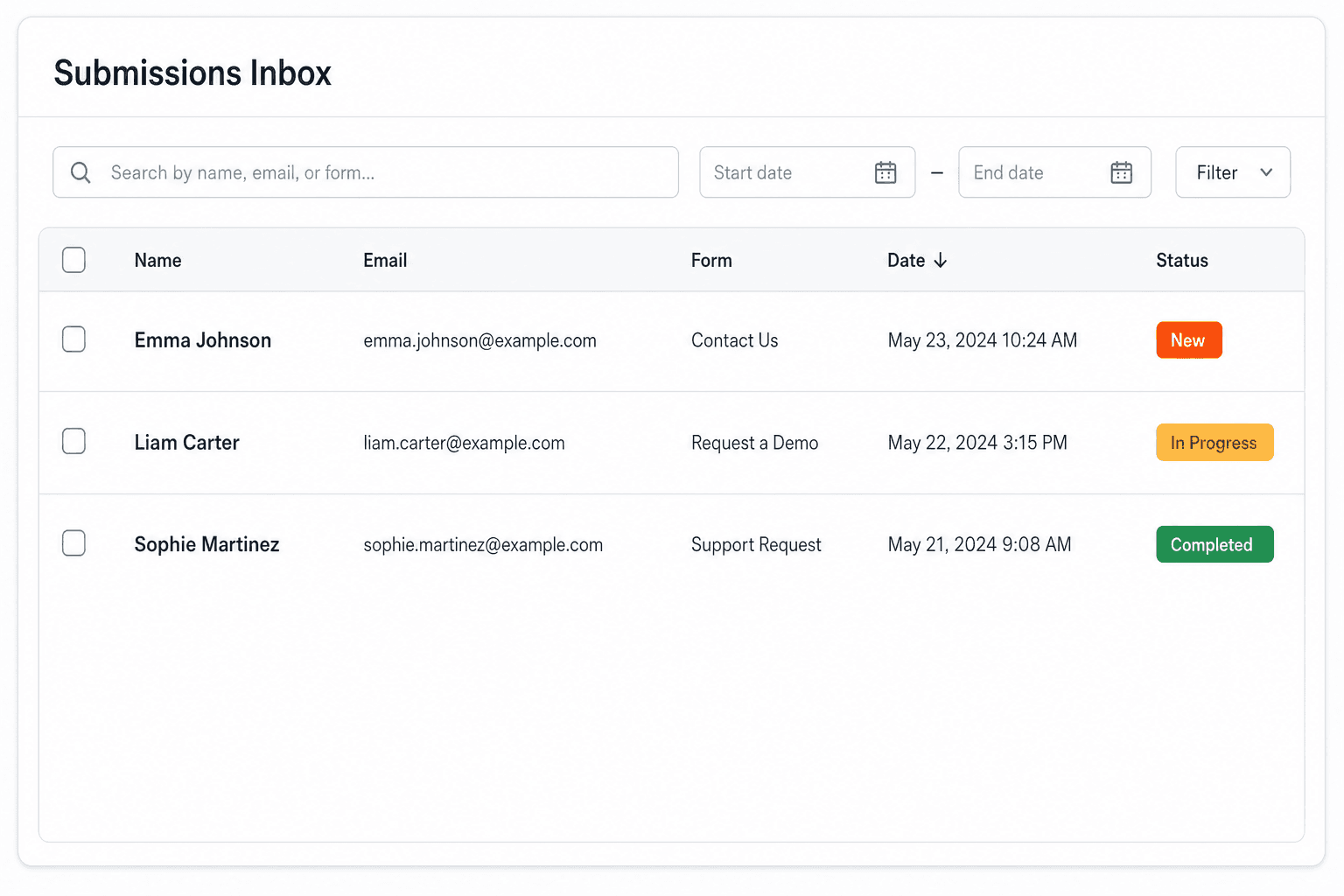
Send data to email, spreadsheets, CRMs, webhooks, and 7,000+ apps.
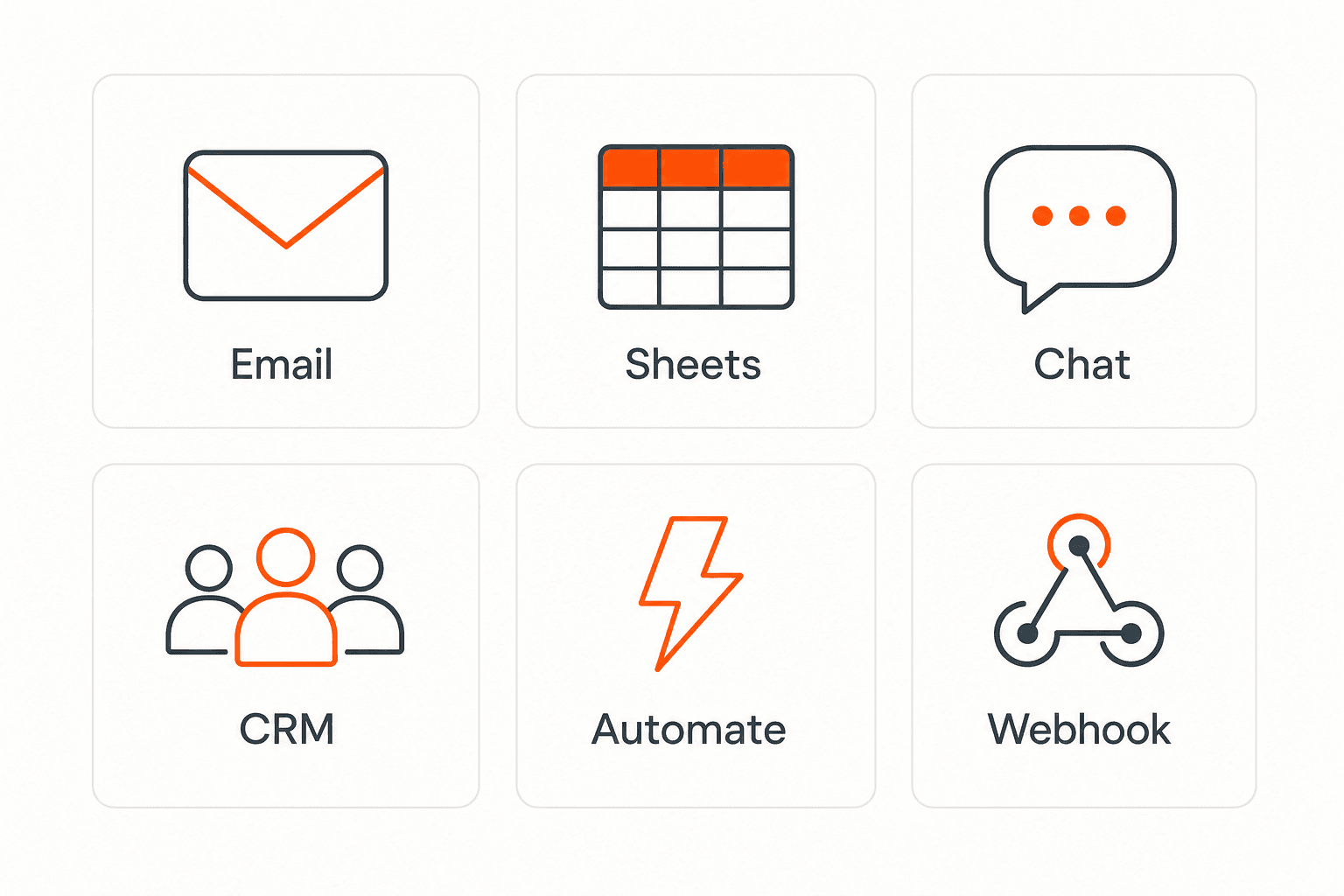
No credit card required. Set up in under 60 seconds.
Connect & automate
On paid plans, submissions can also go to Slack, Discord, Google Sheets, Notion, Airtable, Zapier or any signed webhook — and splitforms works on the platforms you build on, from WordPress and Shopify to Next.js. With Stripe connected, your forms can take payments too.
 NewTake payments on your formsDeposits, bookings, order forms — submitters check out through Stripe and the money goes straight to your Stripe account. Included on every paid plan.See plans →
Common questions
Yes. The form is plain HTML with a single POST endpoint, so it runs on any WordPress site without server-side code, plugins, or SDKs. Drop the snippet into a WordPress page or component and submissions land in your splitforms dashboard.
Free for 500 submissions — no credit card, no time limit. Pro is $5/mo for 5,000 submissions a month, and Annual is $49/year for 15,000 submissions a month. The same pricing applies regardless of which framework hosts the form.
Yes. The template ships with sensible defaults (how would you rate your experience?, what can we do better?, email (optional, for follow-up)…) — add, remove, or rename any of them. Splitforms accepts whatever fields you POST.
A hidden honeypot field catches dumb bots, and a rule-based filter scores the rest; anything that looks like spam goes to a separate Spam tab instead of your inbox. No CAPTCHA, no friction for human users — and it works the same on WordPress as on any other framework.
Yes. Webhooks are available on paid plans, with auto-formatted payloads for Slack, Discord, and WhatsApp (via CallMeBot). Or send raw signed JSON to any URL — Zapier, n8n, your own server. Configure in the splitforms dashboard.
Yes — the form posts directly to splitforms from the browser, so no server is involved. Works on Vercel, Netlify, GitHub Pages, Cloudflare Pages, S3, or any plain Apache host.
NPS (0-10) for relationship surveys ('how likely are you to recommend us?') sent quarterly or after major moments. CSAT (1-5) for transactional surveys ('how was this support ticket?') sent right after the interaction. Different questions, different cadences, both common patterns.
Yes — open-link feedback skews toward people with strong feelings (positive or negative). For statistically representative measurement, send the survey via email to a random sample of users. The public form catches the heat-of-moment feedback you'd otherwise miss.
Yes — webhook the JSON. Slack has incoming webhooks (free); Linear and Productboard accept inbound issue creation via Zapier or native APIs. Detractor comments showing up as a Linear issue with the rating prefilled in the title is a powerful workflow.
Simple pricing
Free gives you 500 submissions for $0 — no card, no time limit. Pro is $5/month for 5,000 submissions a month, and Annual is $49/year for 15,000 a month with every Pro feature.
For side projects and indie devs.
Every paid feature, for agencies and growing products.
Every Pro feature with triple the volume — $0.27 per 1,000 at full use.
No credit card required on Free • Cancel anytime • Full pricing and FAQ


