
Generate a free splitforms key
Sign in at splitforms.com — your access key is created instantly. No credit card, no setup wizard, no SDK to install.
Demo Request · Astro
B2B SaaS lead capture — qualifies company size, role, use case before the call. Free for 500 submissions total — no backend, no SDK, no plugin.

Copy-paste code
Replace YOUR_ACCESS_KEY with your splitforms key, paste into a Astro page, and ship. No build-time integration required.
<form action="https://splitforms.com/api/submit" method="POST">
  <input type="hidden" name="access_key" value="YOUR_ACCESS_KEY">
  <input type="hidden" name="subject" value="New demo request">

  <label for="name">Full name *</label>
  <input id="name" type="text" name="name" placeholder="Hans Becker" required>
  <label for="work_email">Work email *</label>
  <input id="work_email" type="email" name="work_email" placeholder="[email protected]" required>
  <label for="phone">Phone</label>
  <input id="phone" type="tel" name="phone" placeholder="+1 415 555 0142">
  <label for="company">Company *</label>
  <input id="company" type="text" name="company" placeholder="Kraft GmbH" required>
  <label for="role">Your role *</label>
  <select id="role" name="role" required>
    <option value="">Choose…</option>
    <option>Founder / CEO</option>
    <option>Engineering</option>
    <option>Product</option>
    <option>Marketing</option>
    <option>Sales</option>
    <option>Operations</option>
    <option>Other</option>
  </select>
  <label for="team_size">Team size *</label>
  <select id="team_size" name="team_size" required>
    <option value="">Choose…</option>
    <option>1–10</option>
    <option>11–50</option>
    <option>51–250</option>
    <option>250+</option>
  </select>
  <label for="use_case">What are you trying to solve? *</label>
  <textarea id="use_case" name="use_case" placeholder="Replacing Formspree across 14 client sites." required></textarea>

  <!-- honeypot — bots fill every field -->
  <input type="checkbox" name="botcheck" style="display:none" tabindex="-1" autocomplete="off">

  <button type="submit">Send</button>
</form>
Astro + Demo Request
Astro's static-first architecture means your form HTML ships pre-rendered with zero client JavaScript — perfect for fast page loads, but it also means you can't call a server-side endpoint on static hosts. splitforms is designed for exactly this: the browser POSTs directly to our edge endpoint, so the form works on Netlify, Cloudflare Pages, Vercel, or any static host without an Astro API route. The demo request is pure HTML — no <script> tag, no client component, no island. Astro's view transitions and partial hydration don't interfere with the form submission because it uses a standard browser POST.

Demo Request fields
The posted payload contains full name, work email, phone, company, your role, team size, what are you trying to solve?. Required fields are full name, work email, company, your role, team size and what are you trying to solve?. Rename, remove, or add your own — splitforms accepts any name you POST.

Template playbook
Demo requests cost the SaaS team real money — an AE spends 30-45 minutes on each call. Unqualified demos burn money. The form qualifies on company size, role, use case, current tools, and timeline. ICP-fit leads (right company size, right industry, right pain point) get the AE calendar slot; off-ICP get nurtured via email. The qualifying data also pre-loads the CRM so the AE walks in knowing the prospect's stack and use case — demo close rates climb 30-50% on prepared calls vs cold ones. Most B2B SaaS uses Calendly / Chili Piper for the booking step; the form is the gating layer in front of the calendar.
Setup
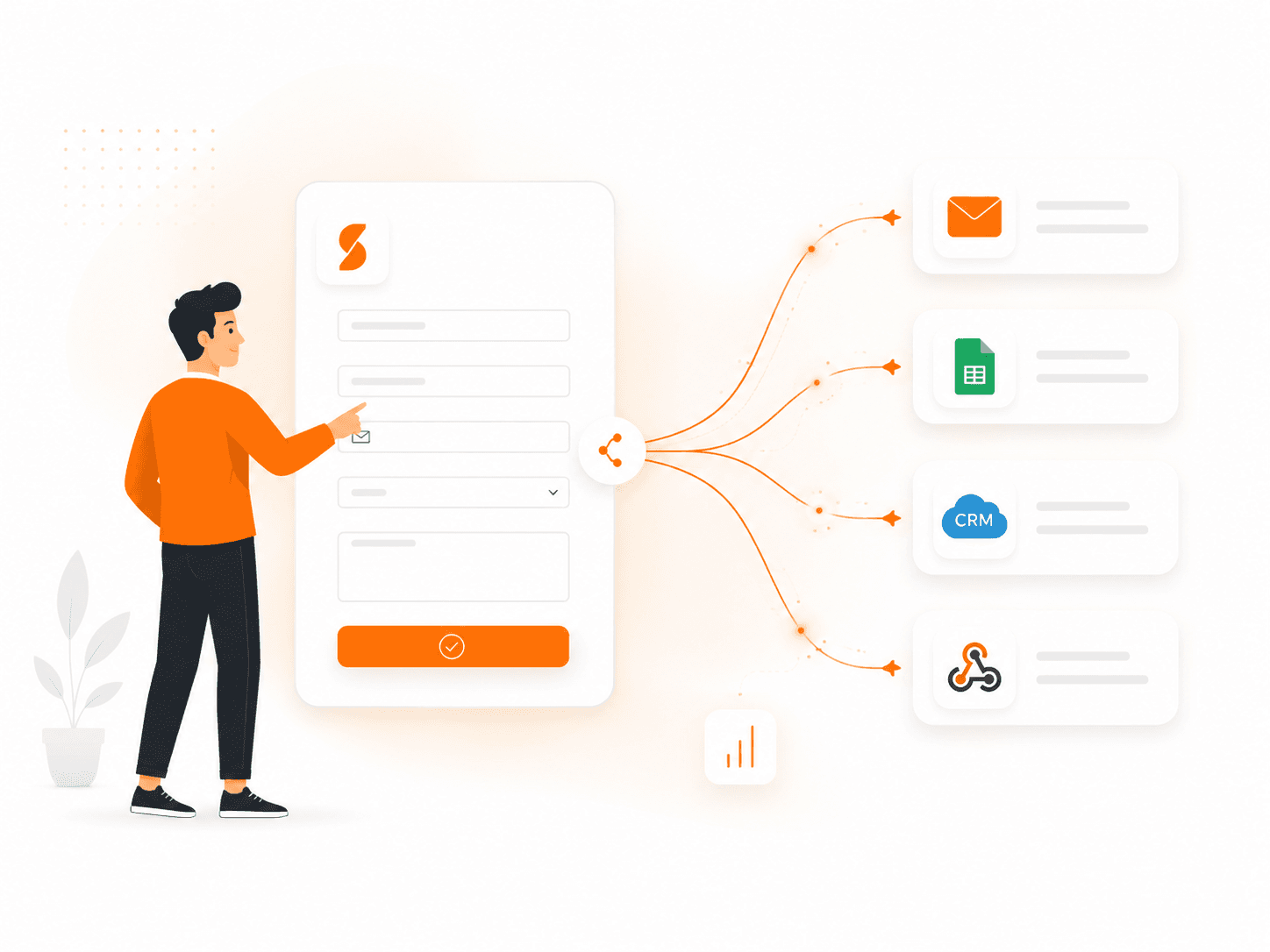
Three actions stand between you and your first demo request submission — no backend, no database, no CAPTCHA library.
Sign in at splitforms.com — your access key is created instantly. No credit card, no setup wizard, no SDK to install.
Drop the form snippet into a Astro page, component, or layout. Replace YOUR_ACCESS_KEY with the key from your dashboard. The form action is a hard-coded URL — no env vars or build-time wiring needed.
Dashboard updates live on Free. Free includes owner email delivery; Starter adds signed webhooks, CSV export, Slack/Discord forwarding, and BCC to your team.
How SplitForms works
splitforms receives the submission, filters spam, saves it to your dashboard and emails you — then, on paid plans, sends it on to your webhooks and integrations. No backend infrastructure to build.

Point your form to your unique SplitForms endpoint. That's it.
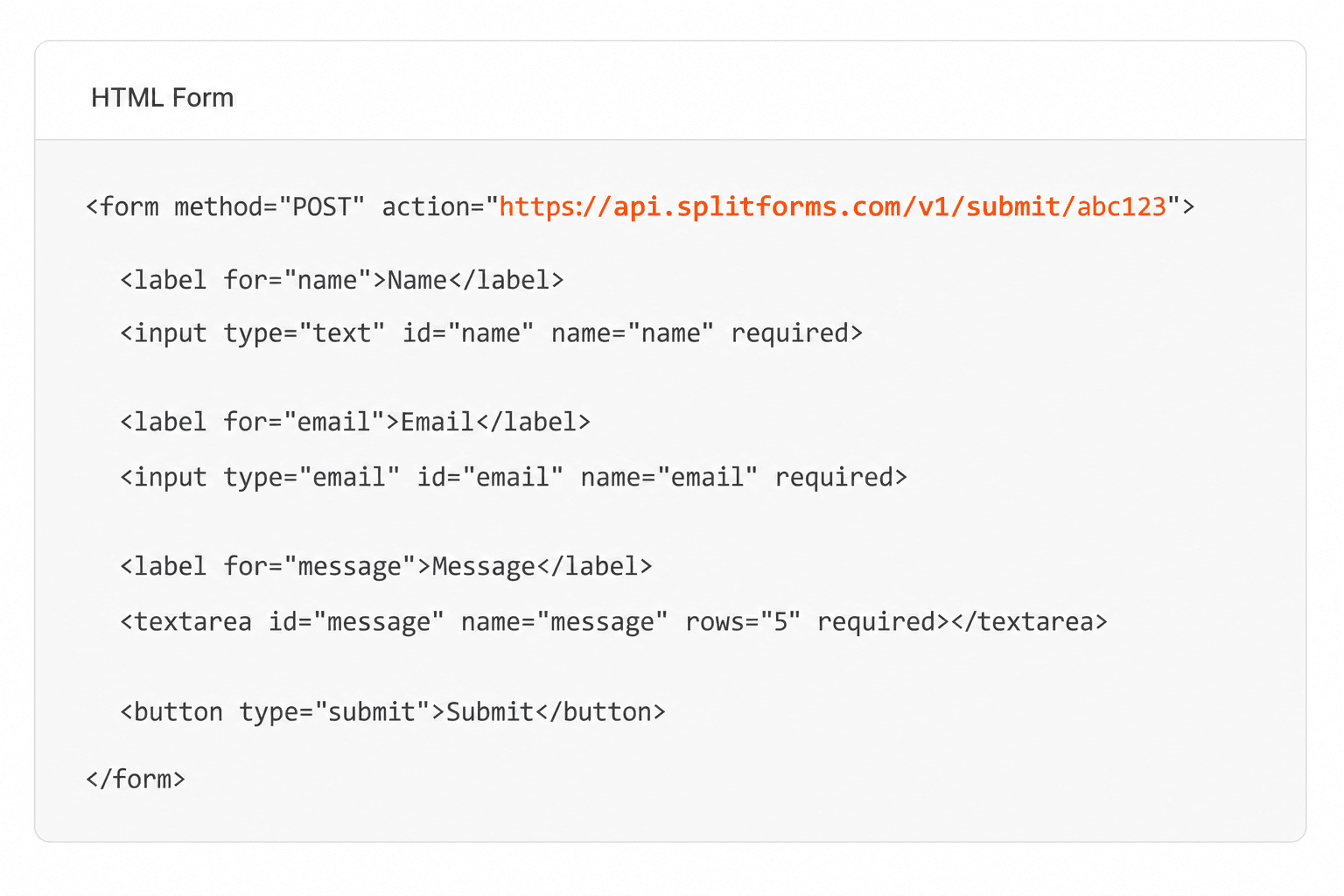
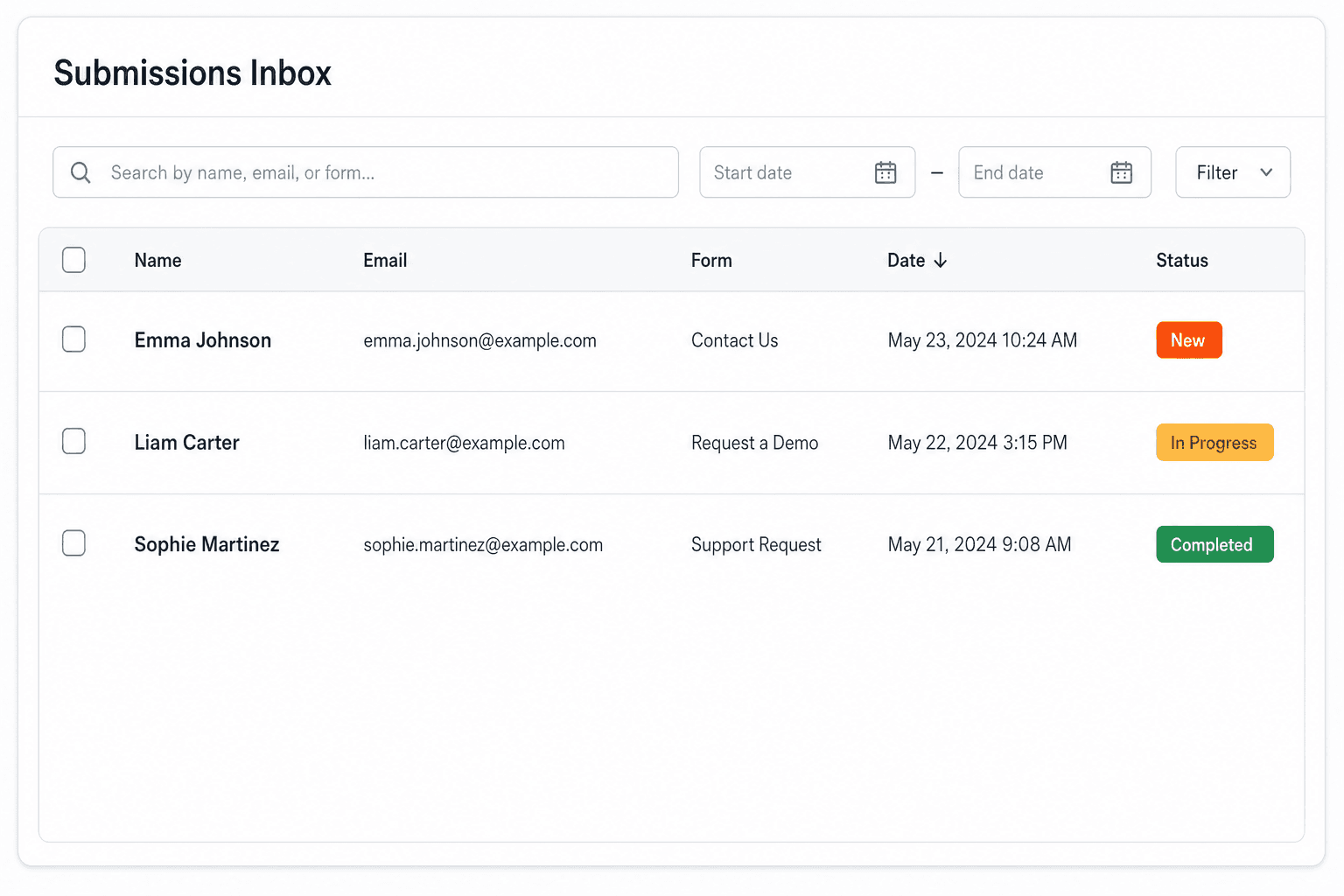
We instantly capture and organize every submission in your inbox.
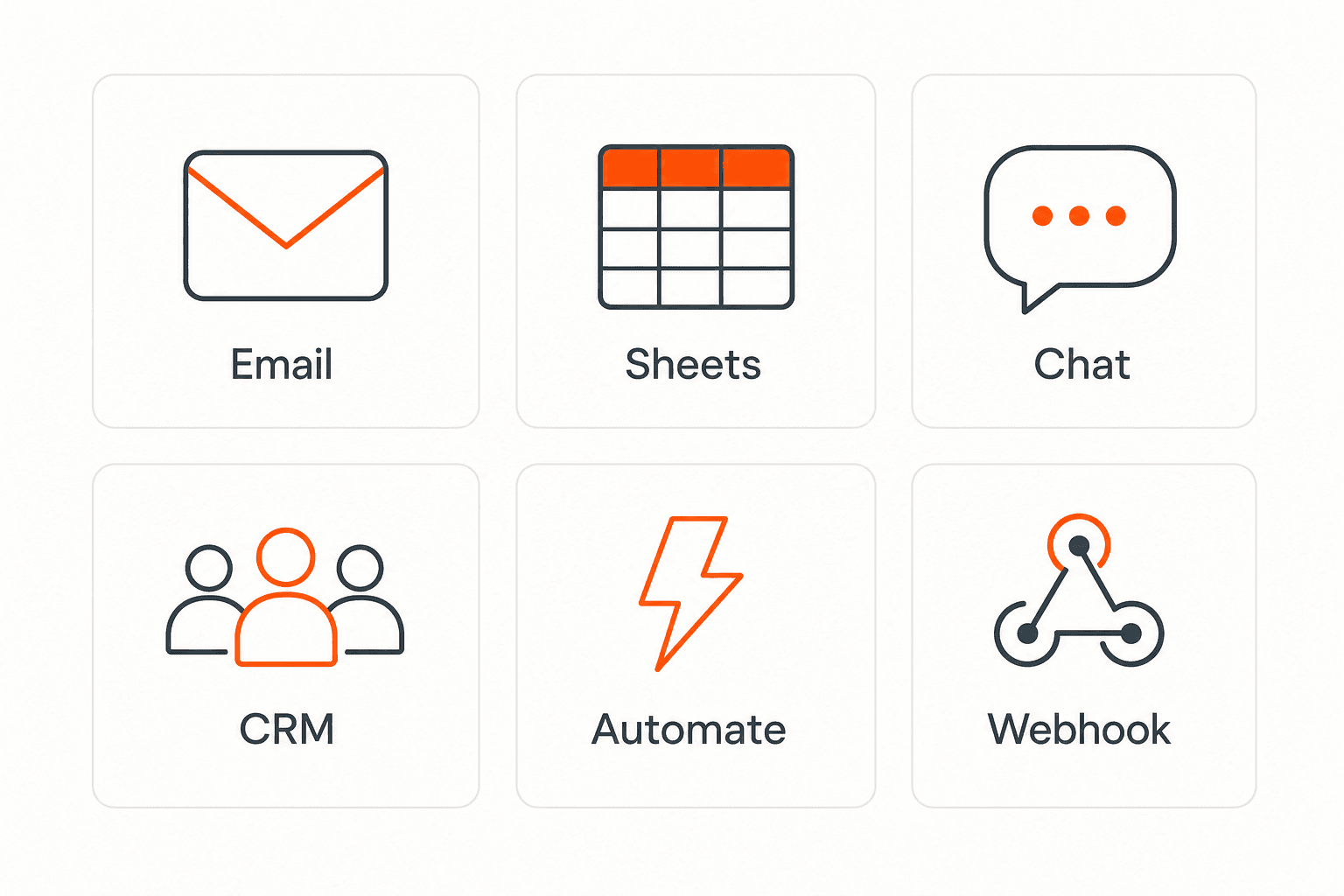
Send data to email, spreadsheets, CRMs, webhooks, and 7,000+ apps.
No credit card required. Set up in under 60 seconds.
Connect & automate
On paid plans, submissions can also go to Slack, Discord, Google Sheets, Notion, Airtable, Zapier or any signed webhook — and splitforms works on the platforms you build on, from WordPress and Shopify to Next.js. With Stripe connected, your forms can take payments too.
 NewTake payments on your formsDeposits, bookings, order forms — submitters check out through Stripe and the money goes straight to your Stripe account. Included on every paid plan.See plans →
Common questions
Yes. The form is plain HTML with a single POST endpoint, so it runs on any Astro site without server-side code, plugins, or SDKs. Drop the snippet into a Astro page or component and submissions land in your splitforms dashboard.
Free for 500 submissions total — no credit card, no trial. Pro is $5/mo for 5,000 submissions, and there's a one-time $59 3-year plan (15,000 submissions/mo for 36 months). The same pricing applies regardless of which framework hosts the form.
Yes. The template ships with sensible defaults (full name, work email, phone, company…) — add, remove, or rename any of them. Splitforms accepts whatever fields you POST.
A hidden honeypot field catches dumb bots, and a tuned classifier scores the rest. You only see real submissions in your dashboard. No CAPTCHA, no friction for human users — and it works the same on Astro as on any other framework.
Yes. Webhooks are available on paid plans, with auto-formatted payloads for Slack, Discord, and WhatsApp (via CallMeBot). Or send raw signed JSON to any URL — Zapier, n8n, your own server. Configure in the splitforms dashboard.
Yes — the form posts directly to splitforms from the browser, so no server is involved. Works on Vercel, Netlify, GitHub Pages, Cloudflare Pages, S3, or any plain Apache host.
Yes — block free email domains (gmail / yahoo / hotmail) on the email field. Free-email demos are 80% tire-kickers; work email is a basic ICP filter. Use a regex pattern or a real-time validator like ZeroBounce / Hunter to enforce.
Yes — Chili Piper natively pulls form data and routes to the right AE based on territory / industry / company size. Calendly for Sales Teams supports round-robin routing too. Webhook the qualified lead to the booker; the unqualified ones bypass the calendar.
Auto-respond with self-serve resources — a recorded demo, free trial signup, pricing page link, customer case studies. Add to a long-term nurture sequence. Don't burn AE time but don't lose the lead either.
Simple pricing
Free is $0 for 500 submissions in total (a one-time allowance). Paid plans are metered monthly: Starter is $1/month for 1,000, Pro is $5/month for 5,000, and the 3-Year plan is $59 for the first three years, then $59/year, for 15,000 a month.
For side projects and indie devs.
For builders who want every paid feature for $1/month.
For agencies and growing products.
Pay $59. 3 years sorted.
No credit card required on Free • Cancel anytime


