
Use type="tel" not type="text"
Mobile keyboards open the numeric keypad for tel inputs. Desktop accepts the same characters as text but signals intent.
Form template · Detailed contact form
A contact form with a phone number field that auto-formats as the user types — (555) 123-4567 emerges from raw digits. Pure pattern validation, optional JS mask for the live formatting.
Every template is free and fully editable in the drag-drop builder — swap fields, colors, and the button label before you publish.
No server, API route, or SDK — your Phone Number Input Form posts straight to one endpoint.
Every submission is emailed to you and saved to a searchable dashboard — spam filtered before it reaches you.
It's plain HTML you own — paste the Phone Number Input Form snippet, swap in your access key, and ship.
Copy and ship
HTML by default — the same field set also renders as React, Next.js, PHP, and cURL in your dashboard. Every variant posts to the same /api/submit endpoint. Replace YOUR_ACCESS_KEY with the key from your dashboard; that's the only edit.
<form action="https://splitforms.com/api/submit" method="POST">
  <input type="hidden" name="access_key" value="YOUR_ACCESS_KEY">
  <input type="hidden" name="subject" value="New detailed contact submission">

  <label for="name">Full name *</label>
  <input id="name" type="text" name="name" placeholder="Jane Builder" required>
  <label for="email">Work email *</label>
  <input id="email" type="email" name="email" placeholder="jane@company.com" required>
  <label for="phone">Phone *</label>
  <input id="phone" type="tel" name="phone" placeholder="+1 415 555 0142" required>
  <label for="company">Company</label>
  <input id="company" type="text" name="company" placeholder="Acme Inc">
  <label for="reason">What's this about? *</label>
  <select id="reason" name="reason" required>
    <option value="">Choose…</option>
    <option>Sales / pricing</option>
    <option>Partnerships</option>
    <option>Press / media</option>
    <option>Support</option>
    <option>Careers</option>
    <option>Other</option>
  </select>
  <label for="message">Message *</label>
  <textarea id="message" name="message" placeholder="Give us context — links, dates, deal size, anything we should know." required></textarea>

  <!-- honeypot — bots fill every field -->
  <input type="checkbox" name="botcheck" style="display:none" tabindex="-1" autocomplete="off">

  <button type="submit">Send</button>
</form><p class="splitforms-attribution" style="margin-top:12px;font-size:11px;color:#888;text-align:right">
  Powered by <a href="https://splitforms.com" style="color:#888;text-decoration:none" target="_blank" rel="sponsored noopener">splitforms</a>
</p>
How to add it
To add a Phone Number Input Form to your site you need three things: a free splitforms access key, the HTML snippet above, and your key pasted into it. No backend, database, or CAPTCHA library — the form posts to one URL and every submission lands in your inbox and dashboard.
Mobile keyboards open the numeric keypad for tel inputs. Desktop accepts the same characters as text but signals intent.
`pattern="[0-9() +-]+"` allows the common phone characters. Or use a strict US format: `pattern="\(?\d{3}\)?[ -]?\d{3}[ -]?\d{4}"`.
On input, strip non-digits and reformat to `(XXX) XXX-XXXX`. The mask runs on every keystroke, giving live formatting feedback.
What's included
Phone fields suffer from format chaos — users type +1 555 123 4567, (555) 123 4567, 555.123.4567, 5551234567. Three options: accept anything and normalize server-side (best for international), use a pattern attribute for client-side validation (good for US-only), or apply a JavaScript mask that formats as the user types (highest conversion, more code). splitforms accepts any format and your form's UX is whichever approach fits your audience. Mobile-friendly numeric keypad, live mask, format-tolerant.

Where submissions go
Reply-to is wired to the visitor's email, so one tap on Reply answers them directly — while the built-in honeypot and spam classifier filter out bots before they reach you. Every submission is emailed to your inbox and can forward to a webhook or Slack the moment a visitor hits send.

How SplitForms works
Connect your form, collect every submission, and send data where it needs to go — without building backend infrastructure.

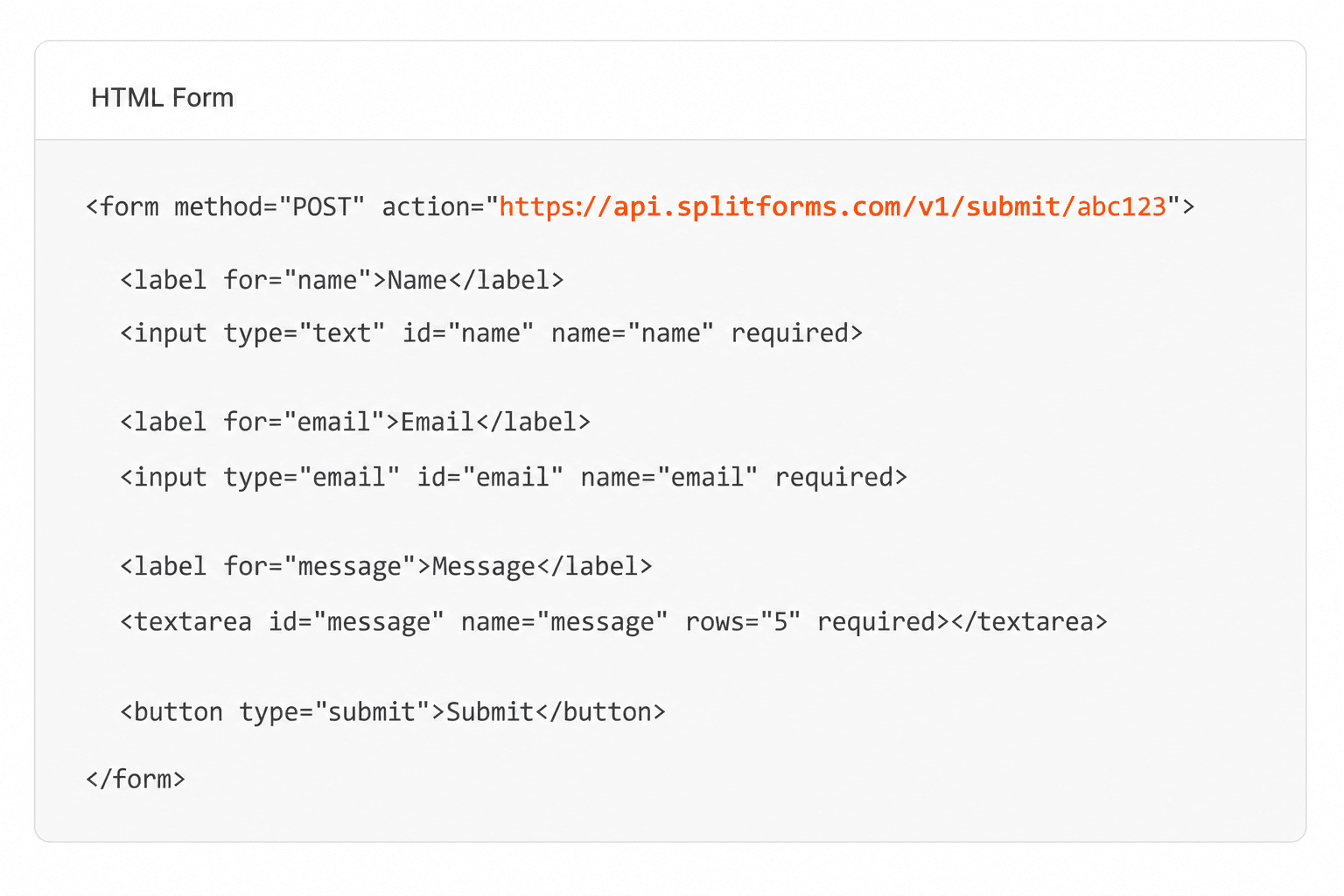
Point your form to your unique SplitForms endpoint. That's it.
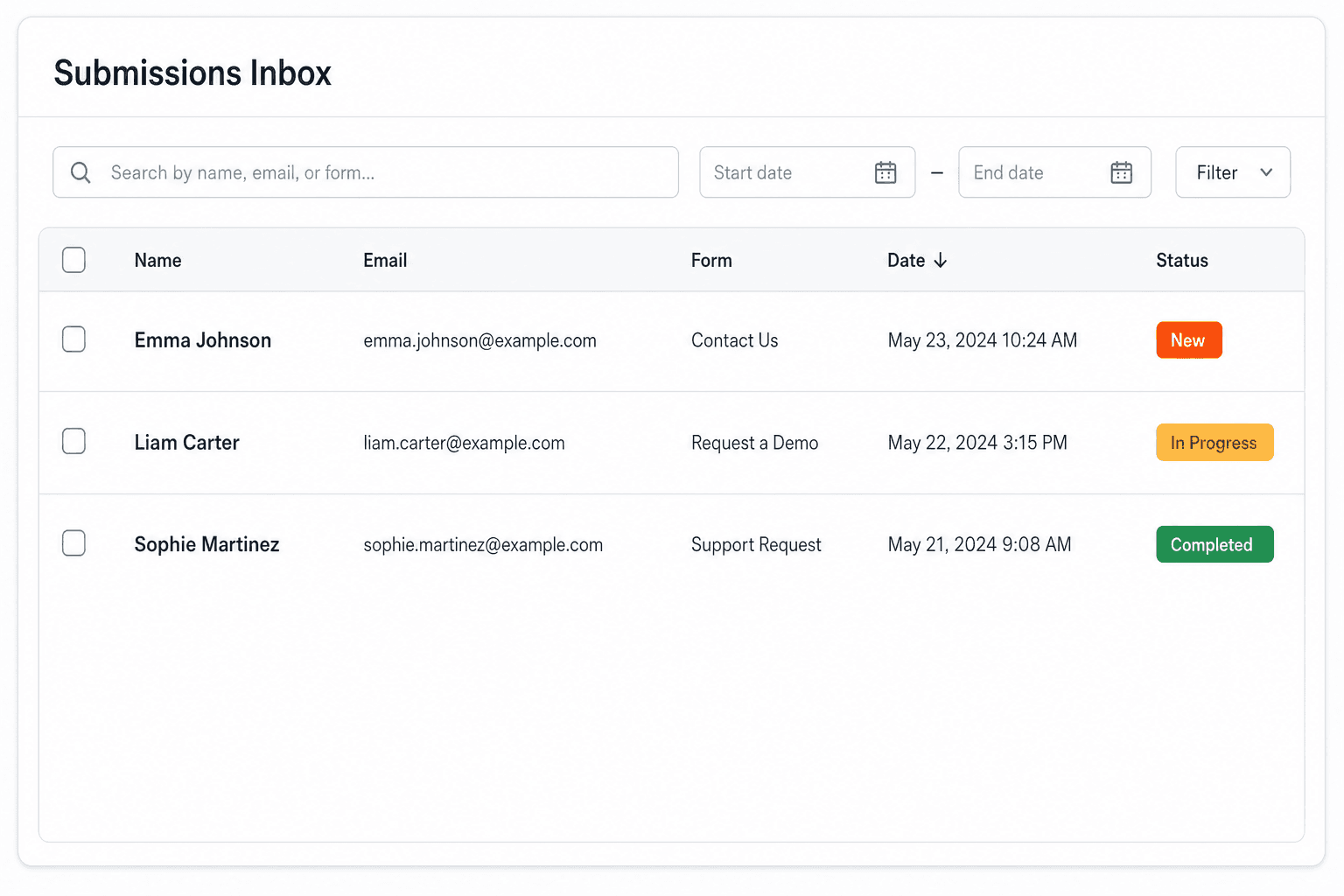
We instantly capture and organize every submission in your inbox.
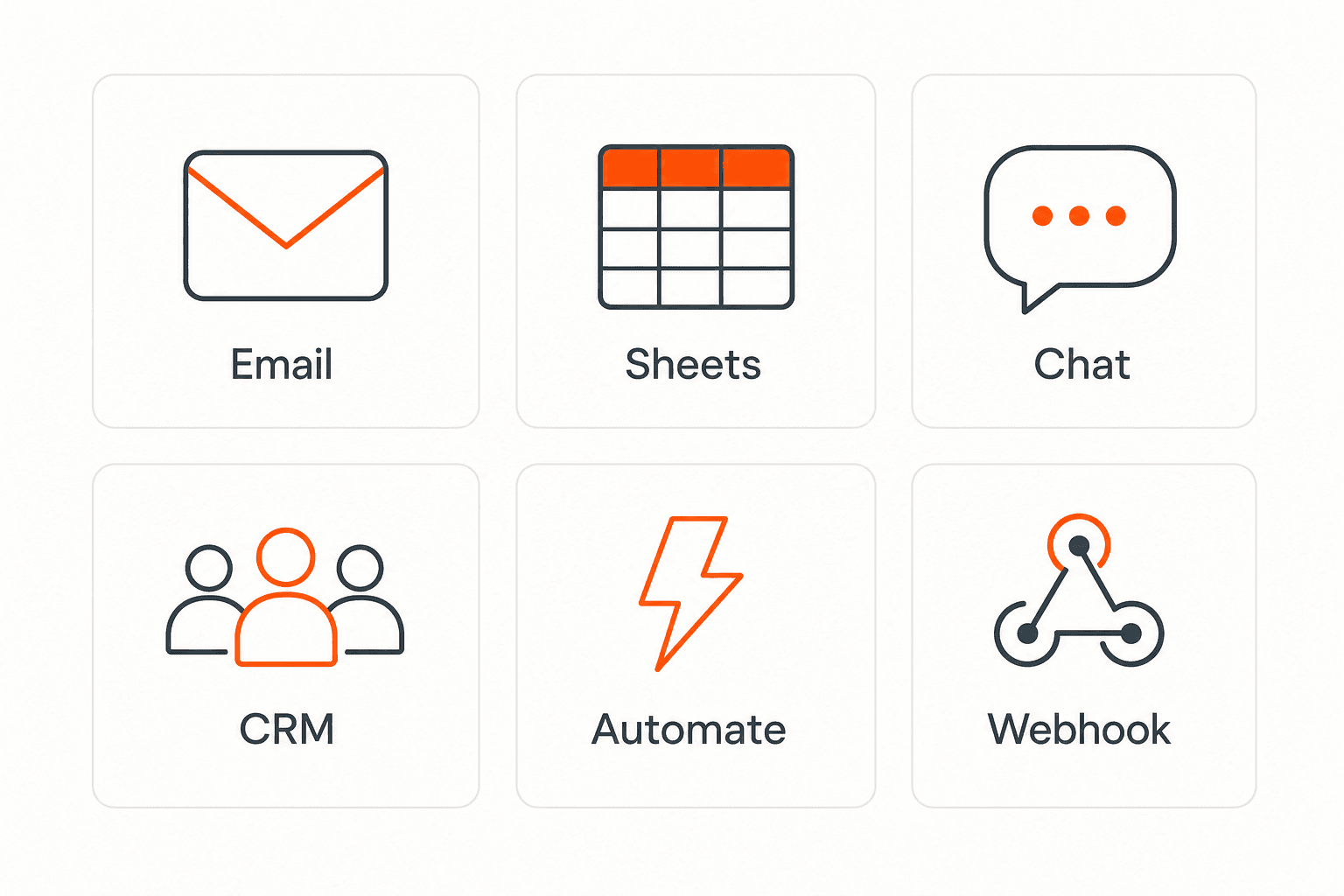
Send data to email, spreadsheets, CRMs, webhooks, and 7,000+ apps.
No credit card required. Set up in under 60 seconds.
Connect & automate
SplitForms works with the destinations you route to and the platforms you build on — from Slack and Sheets to WordPress, Shopify, and Next.js.

Trusted by indie teams and agencies shipping forms worldwide
Testimonials
40 quotes on record — from indie hacks to agency migrations.
“I replaced a Lambda + DynamoDB + SES contact form with six lines of HTML. It took eleven minutes, and the dashboard is better than what I was going to build.”
“We migrated 14 client sites off Formspree in a single weekend. The price is a third of what we paid, the API is more honest, and the spam filter actually works.”
“The webhook payload is signed, idempotent, and well-shaped. It reads like code from a competent team, not a CRUD app held together with duct tape.”
“I stopped reaching for Typeform on small marketing sites. splitforms covers 90% of the use case at none of the bloat.”
“I onboarded our whole agency in an afternoon. The MCP integration meant Cursor literally dropped the form straight into our client repos for us.”
“The free plan gave me 500 submissions before I paid a cent, and Pro is five dollars a month. I've spent more on coffee deciding which backend to use.”
“Spam went from forty junk entries a day to zero, with no reCAPTCHA puzzle ruining the form. The honeypot and time-trap just quietly do their job.”
“Point the form action at one endpoint and you're done. No SDK, no client library, no build step. This is how a form backend should feel.”
“Leads land in Slack the second someone submits, and a copy goes to Google Sheets for the sales team. I wired both up in under ten minutes.”
“I run a static Hugo site on a five-dollar VPS. splitforms gave it a real contact form without me standing up a single server.”
Questions
Two reasons. (1) Mobile keyboards: tel triggers the numeric keypad, dramatically reducing typos. (2) Accessibility: screen readers announce the field type, helping users with assistive tech understand what's expected. The 'no desktop benefit' is a feature, not a bug — the behavior matches user intent.
Depends on your audience. International contact forms should accept any format (use a permissive pattern + server-side normalization). US-only forms can use a strict pattern that matches `(555) 123-4567`. Either way, splitforms accepts whatever format the user submits — the validation is for UX, not data integrity.
Yes — listen for both `input` and `paste` events, and reformat on every change. The pattern only validates on submit, so the mask gives live feedback as the user types or pastes.
Google's libphonenumber (and its JS port) is the gold standard for international phone validation. It's ~80KB minified, so only use it if international validation accuracy is critical. For most contact forms, a pattern + a tel input is enough.
Simple pricing
Choose a plan that fits your workflow — from a free form endpoint to full automations, exports, and higher submission limits.
Free forever
For side projects and indie devs.
For agencies and growing products.
Pay $59. 3 years sorted.
No credit card required on Free • Cancel anytime


