
Generate a free splitforms key
Sign in at splitforms.com — your access key is created instantly. No credit card, no setup wizard, no SDK to install.
Demo Request · Next.js
B2B SaaS lead capture — qualifies company size, role, use case before the call. Free for 500 submissions per month — no backend, no SDK, no plugin.

Copy-paste code
Replace YOUR_ACCESS_KEY with your splitforms key, paste into a Next.js page, and ship. No build-time integration required.
'use client';
import { useState, type FormEvent } from 'react';
export default function DemoRequestForm() {
const [status, setStatus] = useState<'idle' | 'sending' | 'sent' | 'error'>('idle');
async function onSubmit(e: FormEvent<HTMLFormElement>) {
e.preventDefault();
setStatus('sending');
const data = new FormData(e.currentTarget);
data.set('access_key', 'YOUR_ACCESS_KEY');
data.set('subject', 'New demo request');
const res = await fetch('https://splitforms.com/api/submit', {
method: 'POST',
body: data,
headers: { Accept: 'application/json' },
});
const json = await res.json();
if (json.success && json.payment_url) {
// Payment form: finish the payment on the secure Stripe page.
window.location.href = json.payment_url;
return;
}
setStatus(json.success ? 'sent' : 'error');
if (json.success) e.currentTarget.reset();
}
if (status === 'sent') return <p>Thanks — we’ll be in touch.</p>;
return (
<form onSubmit={onSubmit}>
<label htmlFor="name">Full name *</label>
<input id="name" type="text" name="name" placeholder="Hans Becker" required />
<label htmlFor="work_email">Work email *</label>
<input id="work_email" type="email" name="work_email" placeholder="hans@company.com" required />
<label htmlFor="phone">Phone</label>
<input id="phone" type="tel" name="phone" placeholder="+1 415 555 0142" />
<label htmlFor="company">Company *</label>
<input id="company" type="text" name="company" placeholder="Kraft GmbH" required />
<label htmlFor="role">Your role *</label>
<select id="role" name="role" required>
<option value="">Choose…</option>
<option>Founder / CEO</option>
<option>Engineering</option>
<option>Product</option>
<option>Marketing</option>
<option>Sales</option>
<option>Operations</option>
<option>Other</option>
</select>
<label htmlFor="team_size">Team size *</label>
<select id="team_size" name="team_size" required>
<option value="">Choose…</option>
<option>1–10</option>
<option>11–50</option>
<option>51–250</option>
<option>250+</option>
</select>
<label htmlFor="use_case">What are you trying to solve? *</label>
<textarea id="use_case" name="use_case" placeholder="Replacing Formspree across 14 client sites." required />
<button type="submit" disabled={status === 'sending'}>
{status === 'sending' ? 'Sending…' : 'Send'}
</button>
{status === 'error' && <p>Something went wrong. Try again.</p>}
</form>
);
}Next.js + Demo Request
Next.js Server Actions handle the submit side but still leave you wiring SMTP, spam filtering, file uploads, and a dashboard. splitforms replaces all of that with one fetch('/api/submit') call. The demo request works identically in App Router and Pages Router — it's just a FormData POST, no router-specific magic. Because Next.js pre-renders pages, the form HTML is in the DOM before any JavaScript executes, meaning instant Time-to-Interactive. The honeypot field is invisible to users but catches bots that scrape rendered HTML — especially important for Next.js sites where the form HTML is statically generated and predictable.
Demo Request fields
The posted payload contains full name, work email, phone, company, your role, team size, what are you trying to solve?. Required fields are full name, work email, company, your role, team size and what are you trying to solve?. Rename, remove, or add your own — splitforms accepts any name you POST.

Template playbook
Demo requests cost the SaaS team real money — an AE spends 30-45 minutes on each call. Unqualified demos burn money. The form qualifies on company size, role, use case, current tools, and timeline. ICP-fit leads (right company size, right industry, right pain point) get the AE calendar slot; off-ICP get nurtured via email. The qualifying data also pre-loads the CRM so the AE walks in knowing the prospect's stack and use case — demo close rates climb 30-50% on prepared calls vs cold ones. Most B2B SaaS uses Calendly / Chili Piper for the booking step; the form is the gating layer in front of the calendar.
Setup
Three actions stand between you and your first demo request submission — no backend, no database, no CAPTCHA library.
Sign in at splitforms.com — your access key is created instantly. No credit card, no setup wizard, no SDK to install.
Drop the form snippet into a Next.js page, component, or layout. Replace YOUR_ACCESS_KEY with the key from your dashboard. The form action is a hard-coded URL — no env vars or build-time wiring needed.
Dashboard updates live on Free. Free includes owner email delivery; Starter adds signed webhooks, CSV export, Slack/Discord forwarding, and BCC to your team.
How SplitForms works
Connect your form, collect every submission, and send data where it needs to go — without building backend infrastructure.

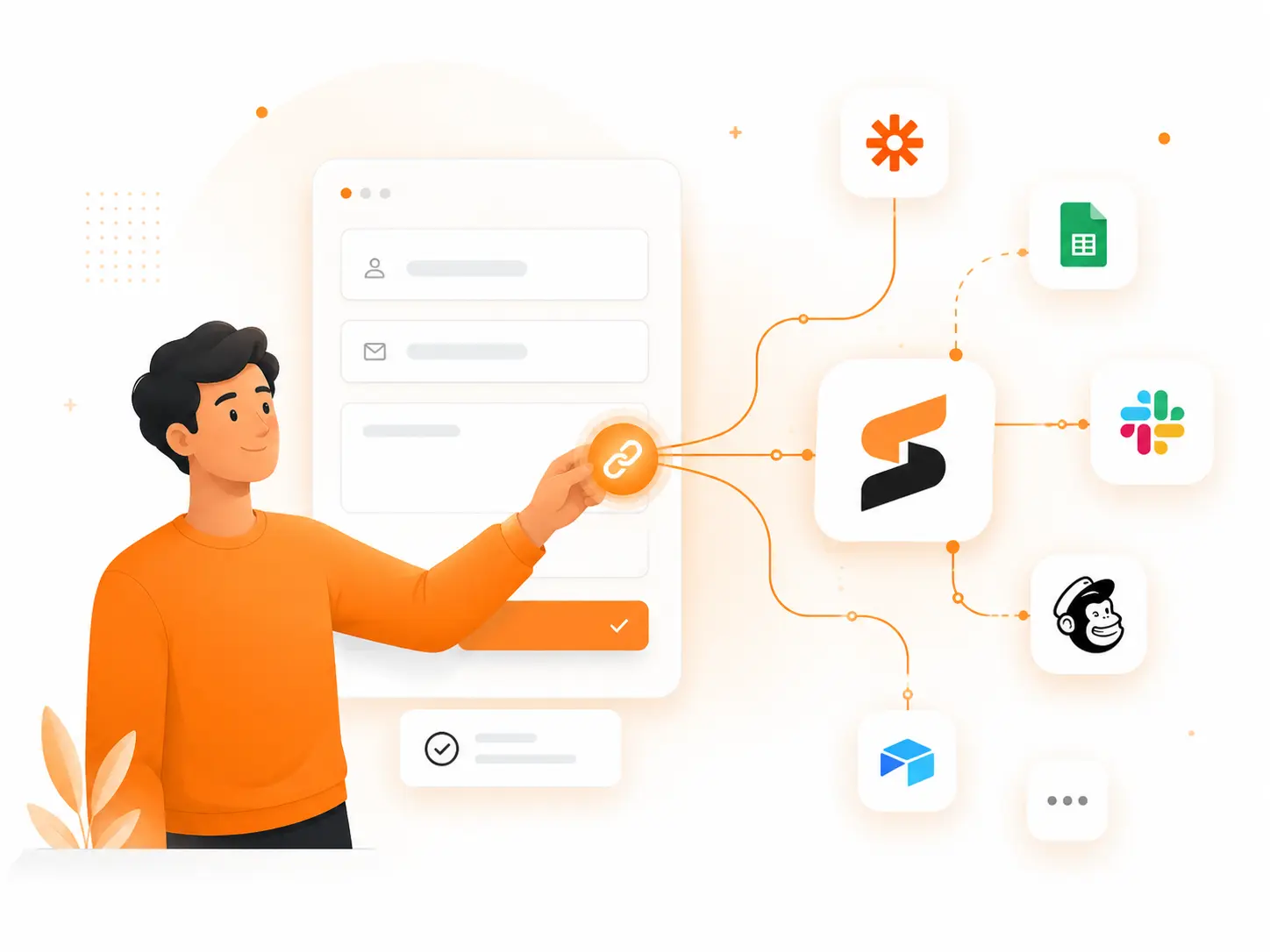
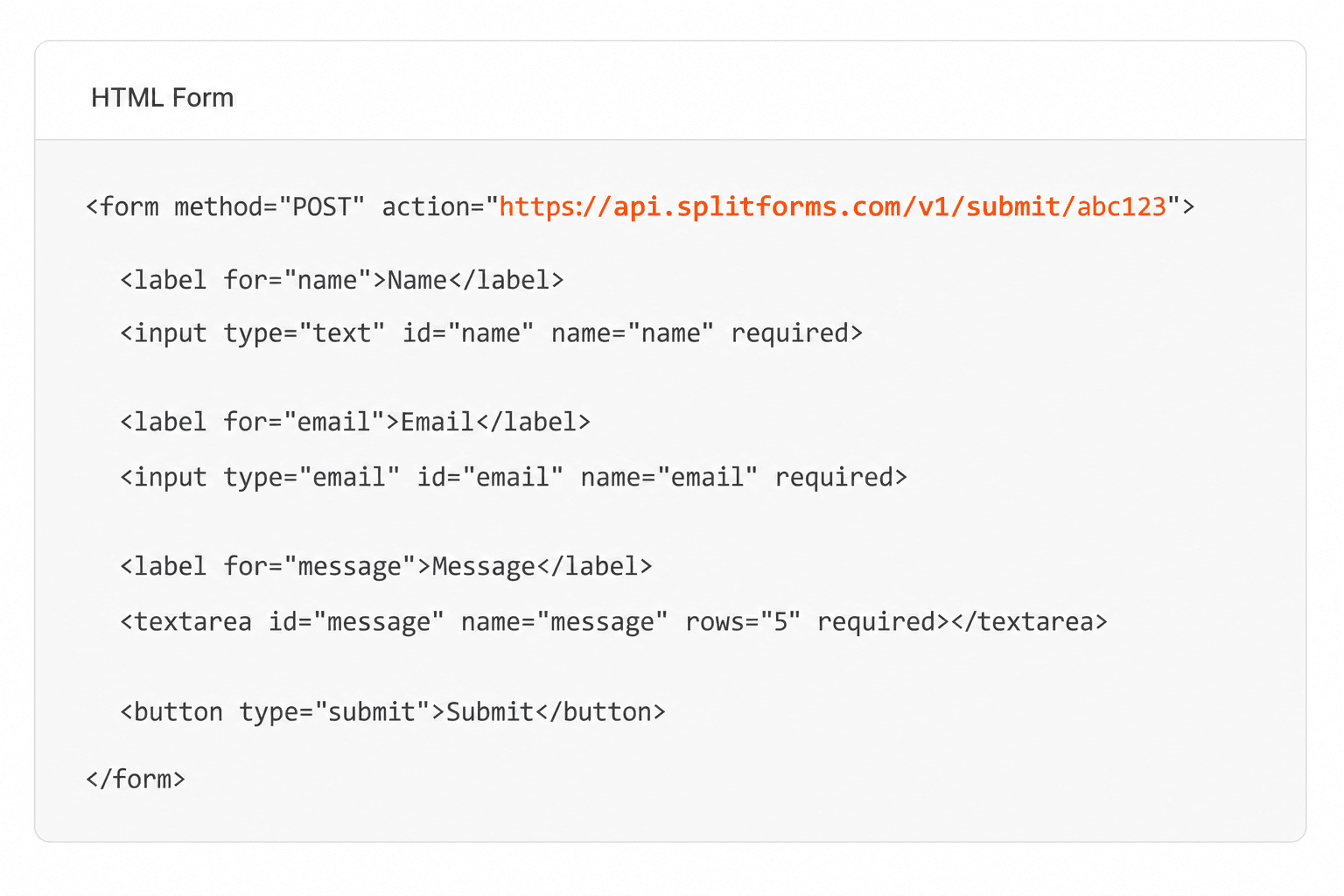
Point your form to your unique SplitForms endpoint. That's it.
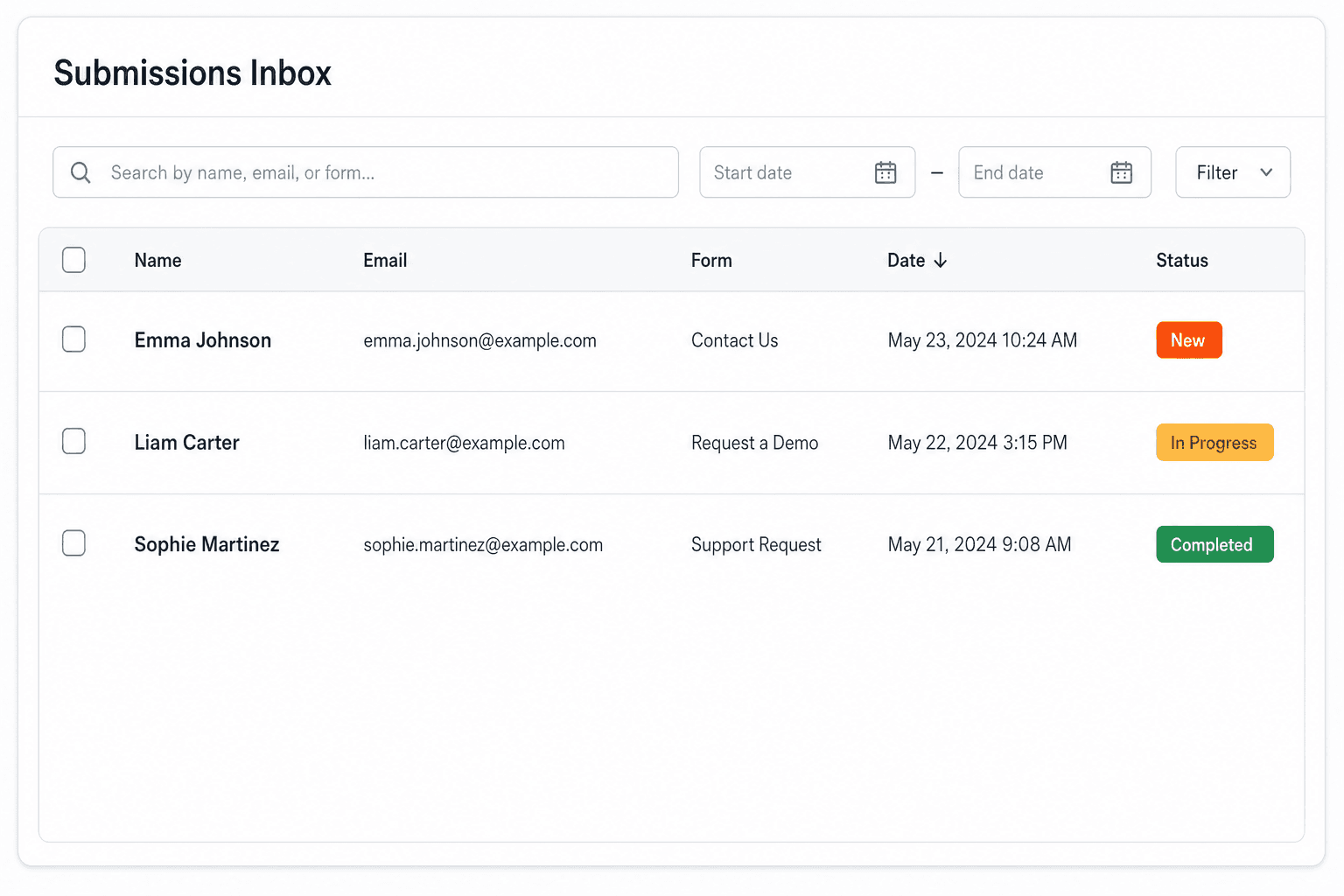
We instantly capture and organize every submission in your inbox.
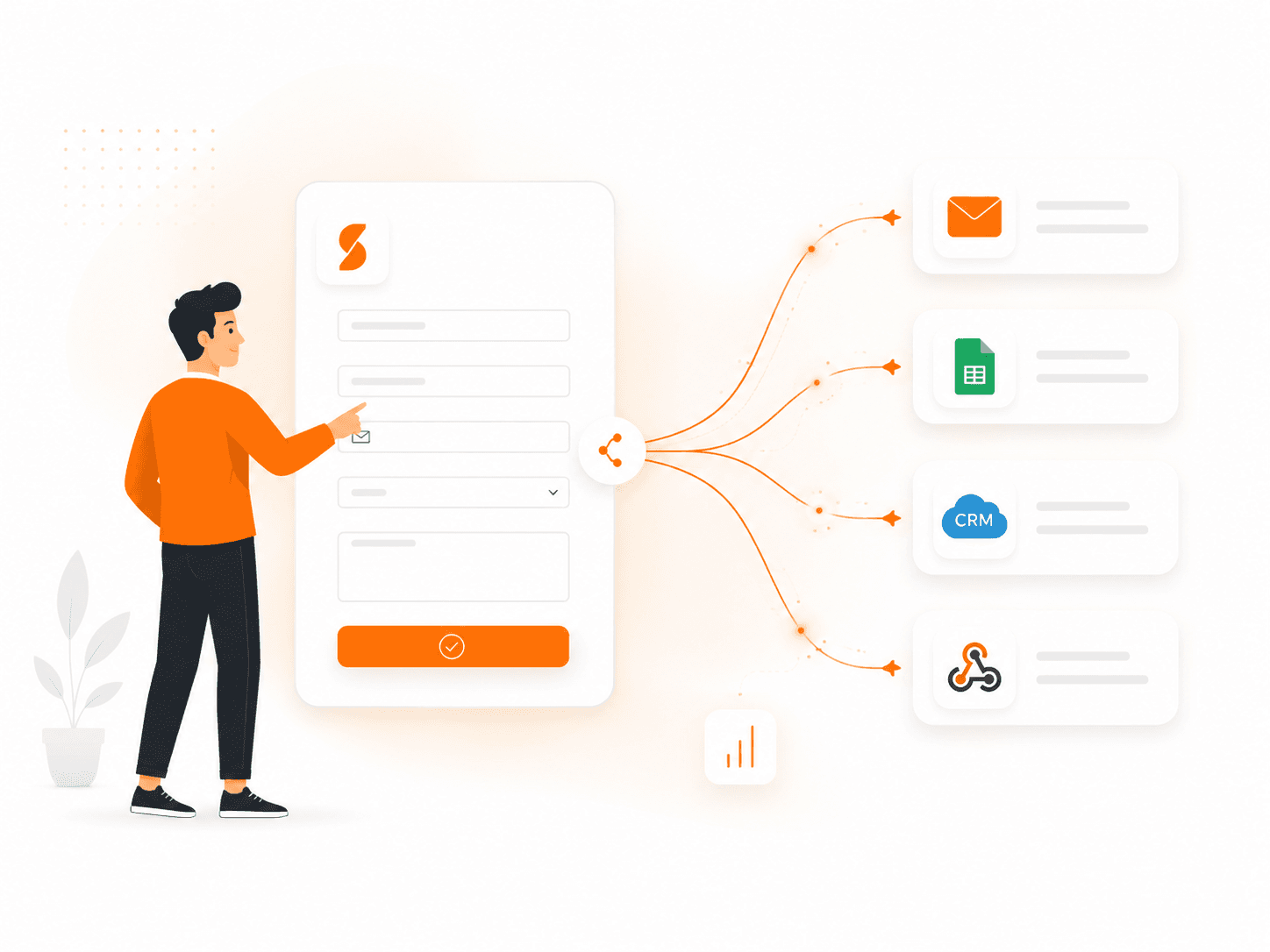
Send data to email, spreadsheets, CRMs, webhooks, and 7,000+ apps.
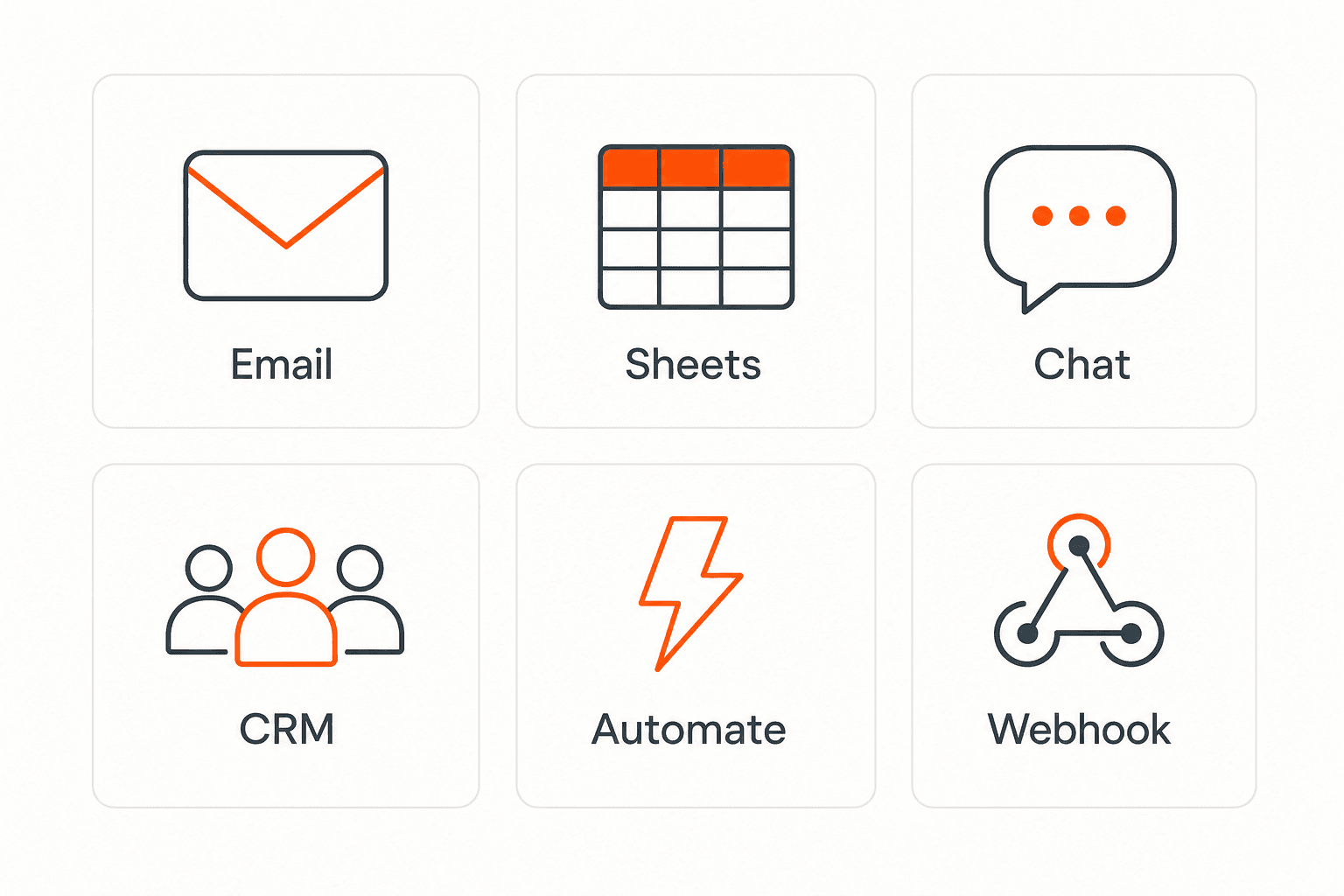
No credit card required. Set up in under 60 seconds.
Connect & automate
SplitForms works with the destinations you route to and the platforms you build on — from Slack and Sheets to WordPress, Shopify, and Next.js.
Trusted by indie teams and agencies shipping forms worldwide
Testimonials
40 quotes on record — from indie hacks to agency migrations.
“I replaced a Lambda + DynamoDB + SES contact form with six lines of HTML. It took eleven minutes, and the dashboard is better than what I was going to build.”
“We migrated 14 client sites off Formspree in a single weekend. The price is a third of what we paid, the API is more honest, and the spam filter actually works.”
“The webhook payload is signed, idempotent, and well-shaped. It reads like code from a competent team, not a CRUD app held together with duct tape.”
“I stopped reaching for Typeform on small marketing sites. splitforms covers 90% of the use case at none of the bloat.”
“I onboarded our whole agency in an afternoon. The MCP integration meant Cursor literally dropped the form straight into our client repos for us.”
“The free plan gave me 500 submissions before I paid a cent, and Pro is five dollars a month. I've spent more on coffee deciding which backend to use.”
“Spam went from forty junk entries a day to zero, with no reCAPTCHA puzzle ruining the form. The honeypot and time-trap just quietly do their job.”
“Point the form action at one endpoint and you're done. No SDK, no client library, no build step. This is how a form backend should feel.”
“Leads land in Slack the second someone submits, and a copy goes to Google Sheets for the sales team. I wired both up in under ten minutes.”
“I run a static Hugo site on a five-dollar VPS. splitforms gave it a real contact form without me standing up a single server.”
Common questions
Yes. The form is plain HTML with a single POST endpoint, so it runs on any Next.js site without server-side code, plugins, or SDKs. Drop the snippet into a Next.js page or component and submissions land in your splitforms dashboard.
Free for 500 submissions per month — no credit card, no trial. Pro is $5/mo for 5,000 submissions, and there's a one-time $59 3-year plan (15,000 submissions/mo for 36 months). The same pricing applies regardless of which framework hosts the form.
Yes. The template ships with sensible defaults (full name, work email, phone, company…) — add, remove, or rename any of them. Splitforms accepts whatever fields you POST.
A hidden honeypot field catches dumb bots, and a tuned classifier scores the rest. You only see real submissions in your dashboard. No CAPTCHA, no friction for human users — and it works the same on Next.js as on any other framework.
Yes. Webhooks are available on paid plans, with auto-formatted payloads for Slack, Discord, and WhatsApp (via CallMeBot). Or send raw signed JSON to any URL — Zapier, n8n, your own server. Configure in the splitforms dashboard.
Yes — the form posts directly to splitforms from the browser, so no server is involved. Works on Vercel, Netlify, GitHub Pages, Cloudflare Pages, S3, or any plain Apache host.
Yes — block free email domains (gmail / yahoo / hotmail) on the email field. Free-email demos are 80% tire-kickers; work email is a basic ICP filter. Use a regex pattern or a real-time validator like ZeroBounce / Hunter to enforce.
Yes — Chili Piper natively pulls form data and routes to the right AE based on territory / industry / company size. Calendly for Sales Teams supports round-robin routing too. Webhook the qualified lead to the booker; the unqualified ones bypass the calendar.
Auto-respond with self-serve resources — a recorded demo, free trial signup, pricing page link, customer case studies. Add to a long-term nurture sequence. Don't burn AE time but don't lose the lead either.
Simple pricing
Choose a plan that fits your workflow — from a free form endpoint to full automations, exports, and higher submission limits.
Free forever
For side projects and indie devs.
For agencies and growing products.
Pay $59. 3 years sorted.
No credit card required on Free • Cancel anytime


