splitforms.com
BUG REPORT · NEXT.JS

Bug Report for Next.js

Bug reports with severity, environment, and reproduction steps. Free for 500 submissions per month — no backend, no SDK, no plugin.

500/mo free·no card·drop-in for Next.js
Form.tsxtsx57 lines
01'use client';
02
03import { useState, type FormEvent } from 'react';
04
05export default function BugForm() {
06 const [status, setStatus] = useState<'idle' | 'sending' | 'sent' | 'error'>('idle');
07
08 async function onSubmit(e: FormEvent<HTMLFormElement>) {
09 e.preventDefault();
10 setStatus('sending');
11
12 const data = new FormData(e.currentTarget);
13 data.set('access_key', 'YOUR_ACCESS_KEY');
14 data.set('subject', 'New bug report');
15
16 const res = await fetch('https://splitforms.com/api/submit', {
17 method: 'POST',
18 body: data,
19 headers: { Accept: 'application/json' },
20 });
21
22 const json = await res.json();
23 setStatus(json.success ? 'sent' : 'error');
24 if (json.success) e.currentTarget.reset();
25 }
26
27 if (status === 'sent') return <p>Thanks — we&rsquo;ll be in touch.</p>;
28
29 return (
30 <form onSubmit={onSubmit}>
31 <label htmlFor="title">Short summary *</label>
32 <input id="title" type="text" name="title" placeholder="What went wrong?" required />
33 <label htmlFor="severity">Severity *</label>
34 <select id="severity" name="severity" required>
35 <option value="">Choose…</option>
36 <option>Critical</option>
37 <option>High</option>
38 <option>Medium</option>
39 <option>Low</option>
40 </select>
41 <label htmlFor="browser">Browser &amp; OS</label>
42 <input id="browser" type="text" name="browser" placeholder="Chrome 120 / macOS" />
43 <label htmlFor="steps">Steps to reproduce *</label>
44 <textarea id="steps" name="steps" placeholder="1. Go to…
452. Click…
463. See error" required />
47 <label htmlFor="email">Your email (so we can follow up) *</label>
48 <input id="email" type="email" name="email" placeholder="you@example.com" required />
49
50 <button type="submit" disabled={status === 'sending'}>
51 {status === 'sending' ? 'Sending…' : 'Send'}
52 </button>
53
54 {status === 'error' && <p>Something went wrong. Try again.</p>}
55 </form>
56 );
57}
500
submissions / mo, free
5
fields, ready to ship
5
code outputs
60s
from copy to inbox
§ 00Next.js + Bug Reportplatform-specific integration guide

Why Next.js developers choose splitforms for bug report

Next.js Server Actions handle the submit side but still leave you wiring SMTP, spam filtering, file uploads, and a dashboard. splitforms replaces all of that with one <code>fetch('/api/submit')</code> call. The bug report works identically in App Router and Pages Router — it's just a <code>FormData</code> POST, no router-specific magic. Because Next.js pre-renders pages, the form HTML is in the DOM before any JavaScript executes, meaning instant Time-to-Interactive. The honeypot field is invisible to users but catches bots that scrape rendered HTML — especially important for Next.js sites where the form HTML is statically generated and predictable.

§ 00Quick answerReact / Next.js · support

Yes — this is the shortest safe path for Next.js.

Use the React / Next.js snippet on this page, keep the bug report fields visible in your Next.js UI, and let splitforms handle delivery, spam filtering, storage, and webhooks.

best implementation

Paste the React / Next.js version, then replace YOUR_ACCESS_KEY.

The posted payload contains short summary, severity, browser & os, steps to reproduce, your email (so we can follow up). Required fields are short summary, severity, steps to reproduce and your email (so we can follow up).

native next.js reality

Without splitforms, you'd write a route handler at app/api/contact/route.ts, parse the FormData, configure SMTP via nodemailer or Resend (~10 minutes of secrets wrangling), add a Postgres or SQLite store for submissions, and then bolt on rate limiting, a honeypot check, an email-classifier or reCAPTCHA, and webhook fan-out.

use case fit

User-reported bugs are signal — but only if the report has steps-to-reproduce and a screenshot. The form forces the structure, then files the issue automatically.

§ 01Bug Report × Next.jswhy this combination, in 80 words

Built for Next.js developers who hate operating a backend.

Splitforms is the form backend for Next.js sites. One POST endpoint, no SDK, no plugin — drop the bug report into a page and ship.

Splitforms is the form backend for Next.js sites. One POST endpoint, spam filtering, and a real dashboard — drop-in, no server, no PHP. Free for 500 dashboard submissions per month; Starter adds email, signed webhooks, exports, and retained uploads; Pro is $5/mo for 5,000.

✦ what you get on the free plan
  • 500 form submissions per month
  • 2 forms on Free; unlimited forms on Pro
  • Spam protection (honeypot + classifier)
  • Webhooks: Slack, Discord, WhatsApp, custom
  • CSV export of all submissions
  • Email notifications (CC and BCC on Pro)
§ 02Copy-paste codeReact / Next.js · 57 lines

Drop into any Next.js project.

Replace YOUR_ACCESS_KEY with your splitforms key, paste into a Next.js page, and ship. No build-time integration required.

Form.tsxtsx57 lines
01'use client';
02
03import { useState, type FormEvent } from 'react';
04
05export default function BugForm() {
06 const [status, setStatus] = useState<'idle' | 'sending' | 'sent' | 'error'>('idle');
07
08 async function onSubmit(e: FormEvent<HTMLFormElement>) {
09 e.preventDefault();
10 setStatus('sending');
11
12 const data = new FormData(e.currentTarget);
13 data.set('access_key', 'YOUR_ACCESS_KEY');
14 data.set('subject', 'New bug report');
15
16 const res = await fetch('https://splitforms.com/api/submit', {
17 method: 'POST',
18 body: data,
19 headers: { Accept: 'application/json' },
20 });
21
22 const json = await res.json();
23 setStatus(json.success ? 'sent' : 'error');
24 if (json.success) e.currentTarget.reset();
25 }
26
27 if (status === 'sent') return <p>Thanks — we&rsquo;ll be in touch.</p>;
28
29 return (
30 <form onSubmit={onSubmit}>
31 <label htmlFor="title">Short summary *</label>
32 <input id="title" type="text" name="title" placeholder="What went wrong?" required />
33 <label htmlFor="severity">Severity *</label>
34 <select id="severity" name="severity" required>
35 <option value="">Choose…</option>
36 <option>Critical</option>
37 <option>High</option>
38 <option>Medium</option>
39 <option>Low</option>
40 </select>
41 <label htmlFor="browser">Browser &amp; OS</label>
42 <input id="browser" type="text" name="browser" placeholder="Chrome 120 / macOS" />
43 <label htmlFor="steps">Steps to reproduce *</label>
44 <textarea id="steps" name="steps" placeholder="1. Go to…
452. Click…
463. See error" required />
47 <label htmlFor="email">Your email (so we can follow up) *</label>
48 <input id="email" type="email" name="email" placeholder="you@example.com" required />
49
50 <button type="submit" disabled={status === 'sending'}>
51 {status === 'sending' ? 'Sending…' : 'Send'}
52 </button>
53
54 {status === 'error' && <p>Something went wrong. Try again.</p>}
55 </form>
56 );
57}
ALTPrefer plain HTML? View the universal bug report HTML snippet28 lines
form.htmlHTML
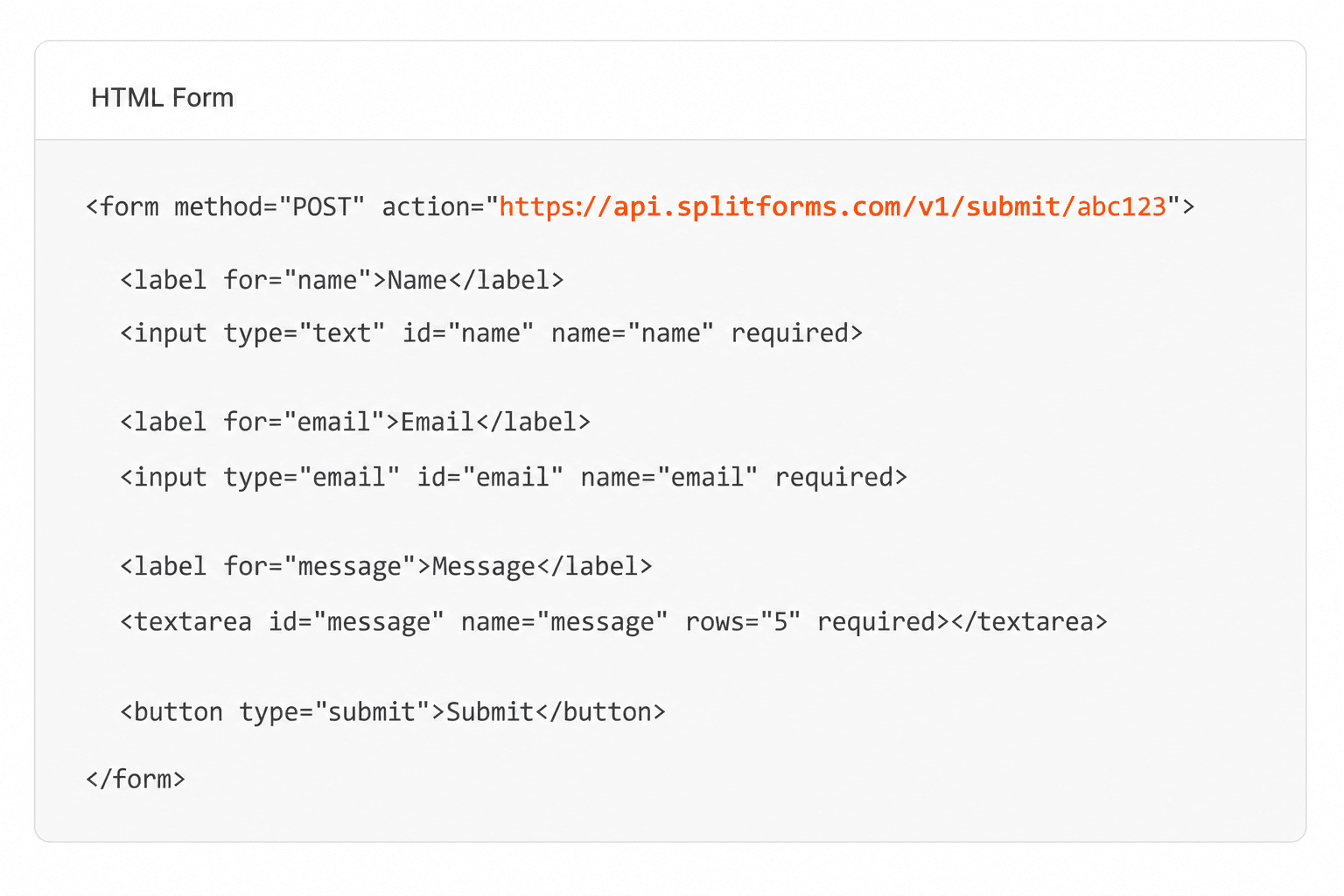
<form action="https://splitforms.com/api/submit" method="POST">
  <input type="hidden" name="access_key" value="YOUR_ACCESS_KEY">
  <input type="hidden" name="subject" value="New bug report">

  <label for="title">Short summary *</label>
  <input id="title" type="text" name="title" placeholder="What went wrong?" required>
  <label for="severity">Severity *</label>
  <select id="severity" name="severity" required>
    <option value="">Choose…</option>
    <option>Critical</option>
    <option>High</option>
    <option>Medium</option>
    <option>Low</option>
  </select>
  <label for="browser">Browser &amp; OS</label>
  <input id="browser" type="text" name="browser" placeholder="Chrome 120 / macOS">
  <label for="steps">Steps to reproduce *</label>
  <textarea id="steps" name="steps" placeholder="1. Go to…
2. Click…
3. See error" required></textarea>
  <label for="email">Your email (so we can follow up) *</label>
  <input id="email" type="email" name="email" placeholder="you@example.com" required>

  <!-- honeypot — bots fill every field -->
  <input type="checkbox" name="botcheck" style="display:none" tabindex="-1" autocomplete="off">

  <button type="submit">Send</button>
</form>
§ 03Setup3 steps · 60 seconds · zero config

Generate, embed, receive.

Three actions stand between you and your first bug report submission. None of them require a backend, a database, or a CAPTCHA library.

STEP 01GENERATE

Generate a free splitforms key

Sign in at splitforms.com — your access key is created instantly. No credit card, no setup wizard, no SDK to install.

Create your form
key=sk_live_••••••••
STEP 02EMBED

Paste the bug report into your Next.js project

Drop the form snippet into a Next.js page, component, or layout. Replace YOUR_ACCESS_KEY with the key from your dashboard. The form action is a hard-coded URL — no env vars or build-time wiring needed.

snippettsx
'use client';
  …
</form>
STEP 03RECEIVE

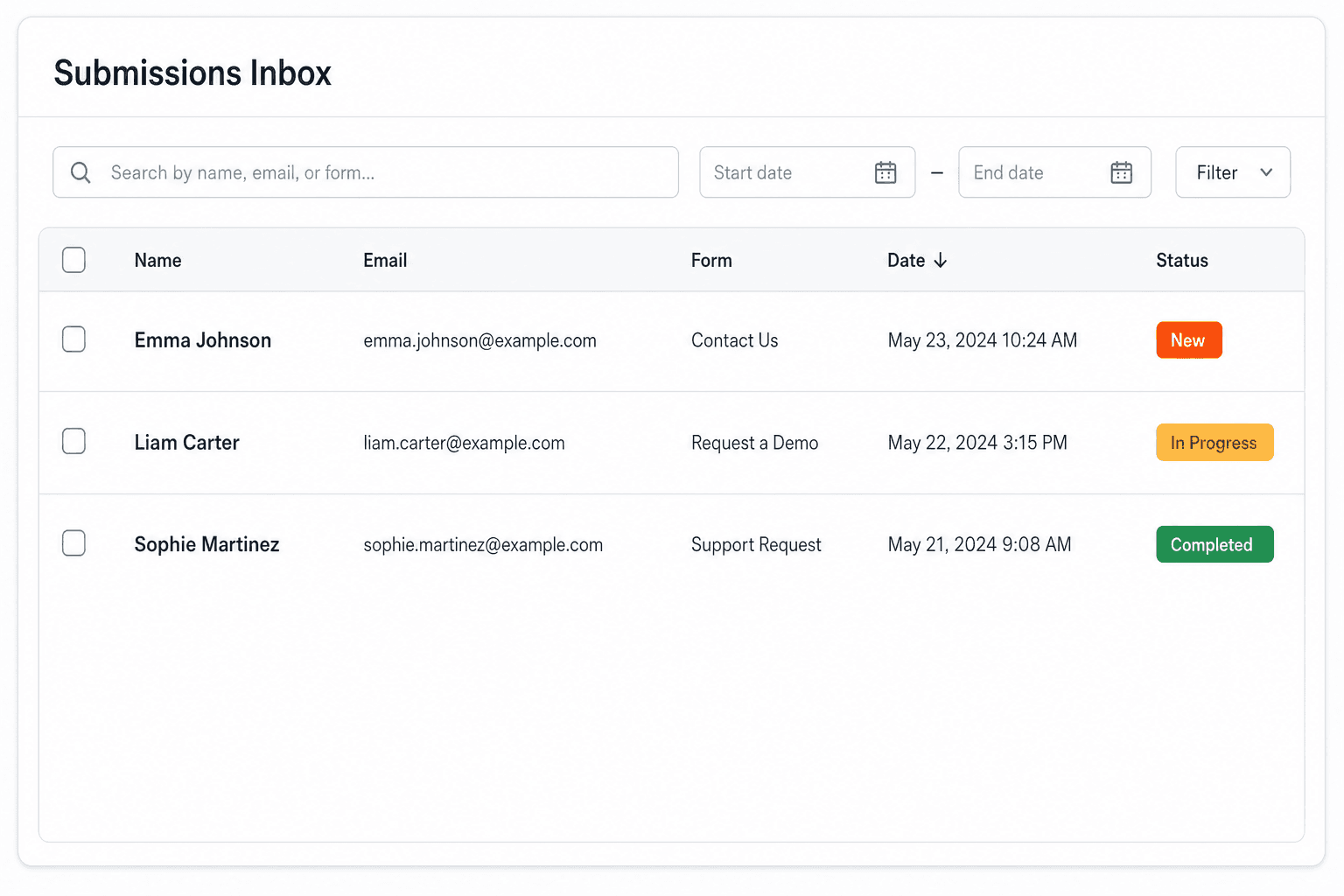
Receive submissions

Dashboard updates live on Free. Starter adds email delivery, signed webhooks, CSV export, Slack/Discord forwarding, and BCC to your team.

inbox · 1 newjust now
FROM contact@yoursite.com
New bug report
Maya Iyer maya@studio71.co
Loved the demo — quick question about pricing on the 3-year plan. Are usage limits per project or account-wide?
§ 03bBug Report Form (Issue Submission)template-specific playbook

The reason this bug report exists.

Screenshot upload (Pro) · webhooks into Linear / GitHub Issues / Slack.

why it matters

Bug reports without reproduction steps waste hours of triage. The form structures the report — what happened, what was expected, steps to reproduce, browser / OS / device, screenshot. Screenshot upload is critical: 'the page broke' tells you nothing; a screenshot of the broken state tells you everything. Webhook the structured report into Linear or GitHub Issues so it lands as a triageable ticket, not a Slack message that scrolls away. For SaaS teams the time saved is huge — instead of a 4-message back-and-forth gathering basic context, the engineer opens the issue and starts debugging.

route the submission
01

Structure the report

Required: what happened, what you expected, steps to reproduce. Optional: browser, OS, device, URL where it occurred. Most templates auto-detect browser/OS via JS so the user doesn't have to fill them.

02

Screenshot upload

Pro file upload — drag-and-drop a screenshot or screen recording. Multi-file accepted. Image attachments arrive on the email and via webhook with signed URLs.

03

Webhook into Linear / GitHub

Lands as a Linear issue or GitHub issue with the structured report as the body and the screenshot embedded. Engineer opens, reproduces, fixes — no triage thread needed.

§ 03cNext.js production notesnative path · deploy · gotchas

What changes when this bug report lives in Next.js.

These notes come from the Next.js platform registry and are rendered on this template page so crawlers see the framework-specific answer without opening a separate guide.

without splitforms

Without splitforms, you'd write a route handler at app/api/contact/route.ts, parse the FormData, configure SMTP via nodemailer or Resend (~10 minutes of secrets wrangling), add a Postgres or SQLite store for submissions, and then bolt on rate limiting, a honeypot check, an email-classifier or reCAPTCHA, and webhook fan-out. Server actions made the wiring slightly tidier in Next 14+, but the operational cost stays the same: a function with a runtime, a database, an outbound email provider, an inbox to monitor, and your name on the spam-filter incident report. Splitforms collapses all of that into a POST to a single URL.

deploy notes

On Vercel, the form works on every plan tier — server actions and client components both run inside the same edge/serverless function. Don't put the splitforms fetch inside a Vercel cron or background function (it's user-facing, latency matters). On Netlify with the Next runtime, server actions need the latest @netlify/plugin-nextjs (≥5.6). For self-hosted / Docker: configure output: 'standalone' in next.config.ts and pass SPLITFORMS_KEY as a runtime env var — never bake it into the image. For static export (output: 'export'), use the client-component path only — server actions aren't supported in static mode.

Next.js gotcha

Don't expose your access key client-side without domain locking

Inlining access_key in a "use client" component makes the key visible to anyone who views source. That's fine if you've enabled allowed-domains in your Splitforms dashboard (Settings → Security) — anyone copying the key from your bundle can't use it from a different origin. If you haven't, use a server action so the key stays on the server.

Next.js gotcha

Server actions need `'use server'` and a real form, not fetch

If you submit to a server action via <form action={myAction}>, Next handles the FormData serialization for you. If you call the action manually with fetch, you have to set the right Content-Type and stringify yourself. Pick one path and stick with it — mixing causes 'Server Action invalid' errors.

Next.js gotcha

App Router + Suspense + useSearchParams = static-prerender bailout

If your form reads ?next=/something to support post-submit redirects, useSearchParams forces the page out of static generation. Either wrap the inner component in a <Suspense fallback={<Skeleton/>}> so the wrapper still prerenders, or accept dynamic rendering for the form route only.

Next.js gotcha

Vercel Edge runtime can't read FormData from `multipart/form-data`

If your route handler uses export const runtime = 'edge' and the form posts as multipart (file inputs), it'll silently miss fields. Use application/x-www-form-urlencoded or remove the edge runtime declaration.

PATTERN A

Pattern A — server action (no client JS, key stays server-side)

Form posts to a server action; the action appends the access key from process.env.SPLITFORMS_KEY and proxies to splitforms. Works without JavaScript, key never reaches the bundle. Use the same wiring for the bug report fields on this page.

pattern-a.tsxtsx10 lines
01// app/actions/contact.ts
02"use server";
03import { redirect } from "next/navigation";
04
05export async function submitContact(formData: FormData) {
06 formData.append("access_key", process.env.SPLITFORMS_KEY!);
07 const res = await fetch("https://splitforms.com/api/submit", { method: "POST", body: formData });
08 if (!(await res.json()).success) throw new Error("Submission failed");
09 redirect("/thanks");
10}
PATTERN B

Pattern B — client component with fetch and inline status

'use client' component using useState for a 4-state status machine. Lets you show a spinner, inline errors, optimistic resets — at the cost of a hydration boundary. Use NEXT_PUBLIC_SPLITFORMS_KEY and rely on splitforms' domain-locking for safety. Use the same wiring for the bug report fields on this page.

pattern-b.tsxtsx17 lines
01"use client";
02import { useState } from "react";
03export default function ContactForm() {
04 const [s, setS] = useState<"idle" | "loading" | "ok" | "err">("idle");
05 return (
06 <form onSubmit={async (e) => {
07 e.preventDefault(); setS("loading");
08 const fd = new FormData(e.currentTarget);
09 fd.append("access_key", process.env.NEXT_PUBLIC_SPLITFORMS_KEY!);
10 const r = await fetch("https://splitforms.com/api/submit", { method: "POST", body: fd });
11 setS((await r.json()).success ? "ok" : "err");
12 }}>
13 <input name="email" type="email" required />
14 <button disabled={s === "loading"}>{s === "loading" ? "…" : "Send"}</button>
15 </form>
16 );
17}
§ 04Field-by-field rundown5 fields · names you POST

What every field actually does.

Each field below ships in the bug report template — rename, remove, or add your own. Splitforms accepts any name you POST.

titleREQUIRED
TEXT

Short summary

Buyer-persona signal — IC vs decision-maker changes the follow-up cadence.

placeholder · What went wrong?
severityREQUIRED
SELECT

Severity

Triage signal — drives whether this pages on-call or waits till Monday.

CriticalHighMediumLow
browser
TEXT

Browser & OS

Repro context for engineering — saves a back-and-forth.

placeholder · Chrome 120 / macOS
stepsREQUIRED
TEXTAREA

Steps to reproduce

Free-text input — no character limit, expands as the visitor types.

placeholder · 1. Go to… 2. Click… 3. See error
emailREQUIRED
EMAIL

Your email (so we can follow up)

Reply-to address — splitforms wires this so hitting reply goes back to the sender.

placeholder · you@example.com
§ 06Questions9 answered

Bug Report on Next.jsFAQ.

Direct answers, no marketing fluff. Missing one? Email hello@splitforms.com.

01Does this bug report work on Next.js?
Yes. The form is plain HTML with a single POST endpoint, so it runs on any Next.js site without server-side code, plugins, or SDKs. Drop the snippet into a Next.js page or component and submissions land in your splitforms dashboard.
02How much does the bug report cost on Next.js?
Free for 500 submissions per month — no credit card, no trial. Pro is $5/mo for 5,000 submissions, and there's a one-time $59 3-year plan (15,000 submissions/mo for 36 months). The same pricing applies regardless of which framework hosts the form.
03Can I customize the fields?
Yes. The template ships with sensible defaults (short summary, severity, browser & os, steps to reproduce…) — add, remove, or rename any of them. Splitforms accepts whatever fields you POST.
04How does spam protection work on the bug report?
A hidden honeypot field catches dumb bots, and a tuned classifier scores the rest. You only see real submissions in your dashboard. No CAPTCHA, no friction for human users — and it works the same on Next.js as on any other framework.
05Can I send the bug report submissions to Slack or Discord?
Yes. Webhooks are available on Starter and above, with auto-formatted payloads for Slack, Discord, and WhatsApp (via CallMeBot). Or send raw signed JSON to any URL — Zapier, n8n, your own server. Configure in the splitforms dashboard.
06Will it work on a static Next.js site?
Yes — the form posts directly to splitforms from the browser, so no server is involved. Works on Vercel, Netlify, GitHub Pages, Cloudflare Pages, S3, or any plain Apache host.
07Should I auto-detect browser / OS?
Yes — JavaScript can read navigator.userAgent and pre-fill hidden fields with browser name, version, OS, and screen size. The user doesn't see them; the engineer gets them. Saves 90% of 'what browser are you on?' replies.
08Can I integrate with Linear / GitHub / Sentry?
Yes — webhook the JSON. Linear and GitHub both accept inbound issue creation via API or Zapier. Sentry doesn't accept user-reported bugs as events but you can webhook to a Slack channel where the on-call engineer triages and creates the Sentry issue manually.
09How do I prevent abuse / spam in bug reports?
Public bug-report forms attract spam — hidden honeypot plus splitforms' classifier catches most. Require an email field; bots filling random emails get filtered by the classifier. For severe abuse, gate the form behind a logged-in user session.
§ 07Comparisonvs Web3Forms · vs Formspree

splitforms vs everything else.

Same drop-in API. More free submissions, Starter signed webhooks, MCP support no other backend has.

FeatureWeb3FormsFormspreesplitforms
Free monthly submissions25050500
Custom fields beyond contactYesPro tierFree
Webhooks (Slack / Discord)Pro tierPro tierFree, signed
AI / MCP submission inboxNoNoYes
Long-term plan (3-year flat)$59 every 3 years
✻ ✻ ✻

Ship a bug report on Next.js in 60 seconds.

500 submissions per month, free forever. No credit card. Copy the snippet above and paste it into your Next.js project.

Get free access key →Read the docs
founders pricing locked in · early access open