
Get your free splitforms access key
Sign up at splitforms.com, verify your email, and copy your access key from the dashboard. No credit card required.
Contact form · AJAX (vanilla JS)
No framework? No problem. Submit a form via the native fetch() API and show inline success/error messages — pure browser JavaScript, zero dependencies, no jQuery, no axios. Works in every modern browser back to Edge 18.

No server, API route, or SDK. Your AJAX (vanilla JS) form posts straight to one endpoint.
Every submission is emailed to you and saved to a searchable dashboard — spam filtered before it reaches you.
It's your own AJAX (vanilla JS) markup and styles. Splitforms is only the backend, so nothing constrains how the form looks.
Copy-paste ready
Replace YOUR_ACCESS_KEY with the key from your dashboard — that's the whole integration. No SDK to install, no build step, just the html you already write.
<form id="contact" autocomplete="off">
  <input type="text"  name="name"    placeholder="Name"    required />
  <input type="email" name="email"   placeholder="Email"   required />
  <textarea           name="message" placeholder="Message" required></textarea>
  <input type="checkbox" name="botcheck" style="display:none" tabindex="-1" />
  <button type="submit">Send</button>
  <p id="msg"></p>
</form>

<script>
  const form = document.getElementById("contact");
  const msg  = document.getElementById("msg");

  form.addEventListener("submit", async (e) => {
    e.preventDefault();
    msg.textContent = "Sending…";

    const formData = new FormData(form);
    formData.append("access_key", "YOUR_ACCESS_KEY");

    try {
      const res  = await fetch("https://splitforms.com/api/submit", {
        method: "POST",
        body: formData,
      });
      const data = await res.json();
      if (data.success) {
        msg.textContent = "Thanks! We'll be in touch.";
        form.reset();
      } else {
        msg.textContent = "Something went wrong: " + (data.message || "Try again");
      }
    } catch (err) {
      msg.textContent = "Network error. Try again.";
    }
  });
</script>
How to add it
To add a contact form to a AJAX (vanilla JS) website you need three things: a free splitforms access key, the html snippet above, and your key pasted into it. No backend, server, or SDK — the form posts to one URL and every submission lands in your inbox and dashboard.
Sign up at splitforms.com, verify your email, and copy your access key from the dashboard. No credit card required.
Copy the AJAX (vanilla JS) code example into your project and replace YOUR_ACCESS_KEY with the key from step 1.
Submissions arrive in the splitforms dashboard within seconds. Free includes inbox delivery; Pro adds Slack, Discord, Sheets, or any signed webhook URL.
Where submissions go
Every submission is emailed to you and saved to a searchable dashboard — spam filtered before it ever reaches you. Search, export to CSV, or forward it to a webhook or Slack on Pro.

No backend needed
Your AJAX (vanilla JS) form posts standard FormData to one URL. Splitforms validates the access key, runs the spam classifier, and forwards it to your email — so there's no server, API route, or database for you to build or maintain.

Best practices
The difference between a form that works in the demo and one that survives launch traffic — the production-tested defaults, in priority order.

How SplitForms works
Connect your form, collect every submission, and send data where it needs to go — without building backend infrastructure.

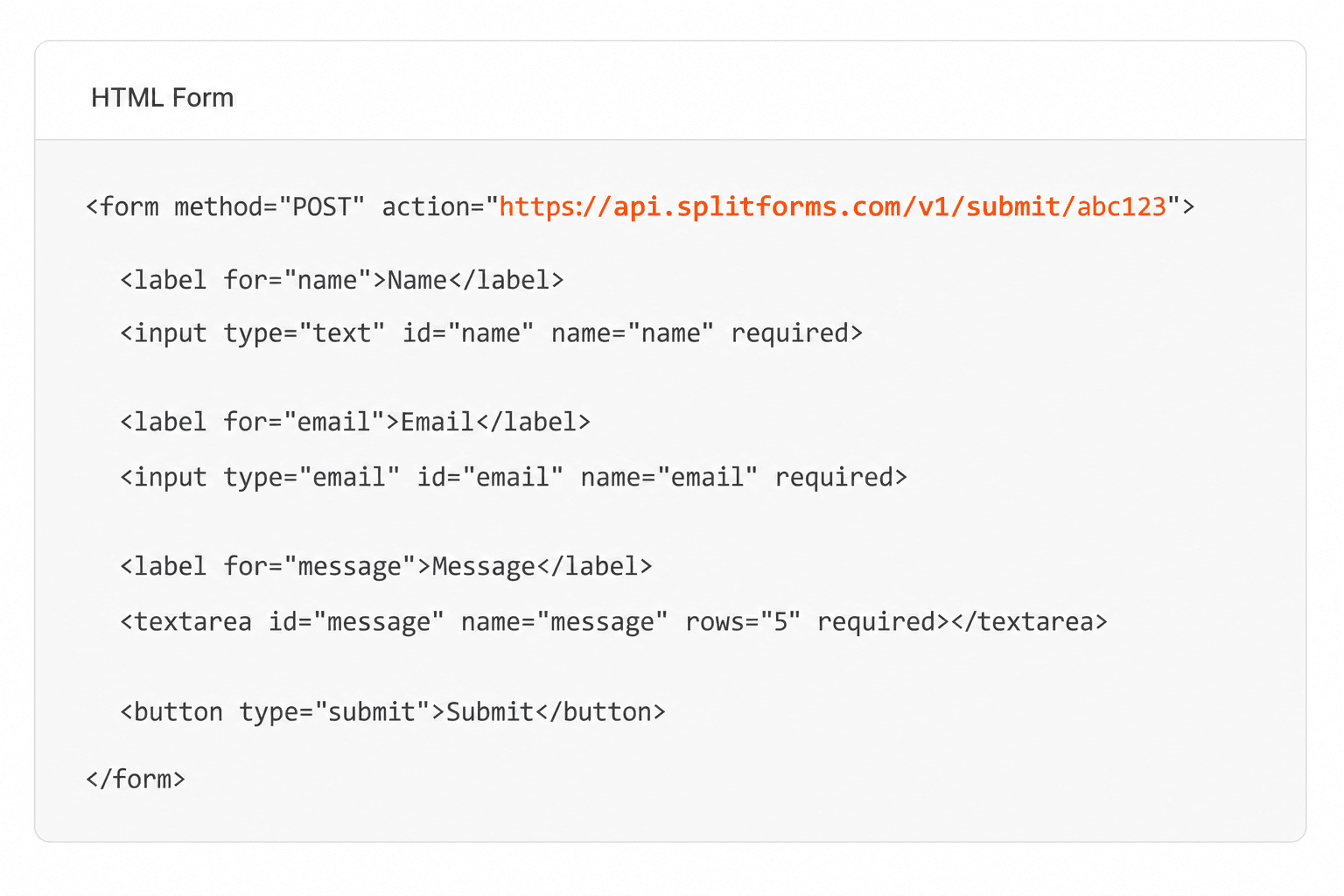
Point your form to your unique SplitForms endpoint. That's it.
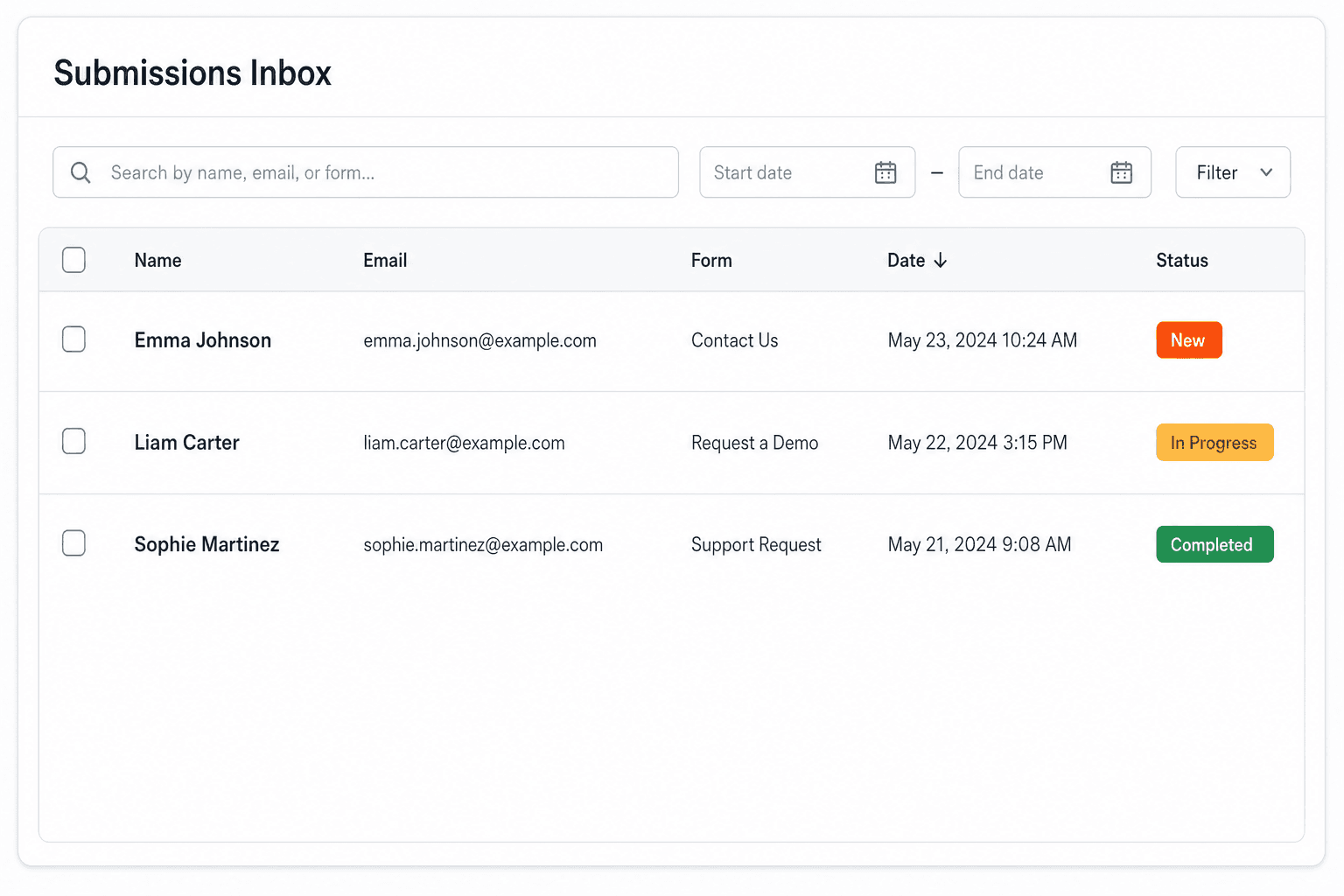
We instantly capture and organize every submission in your inbox.
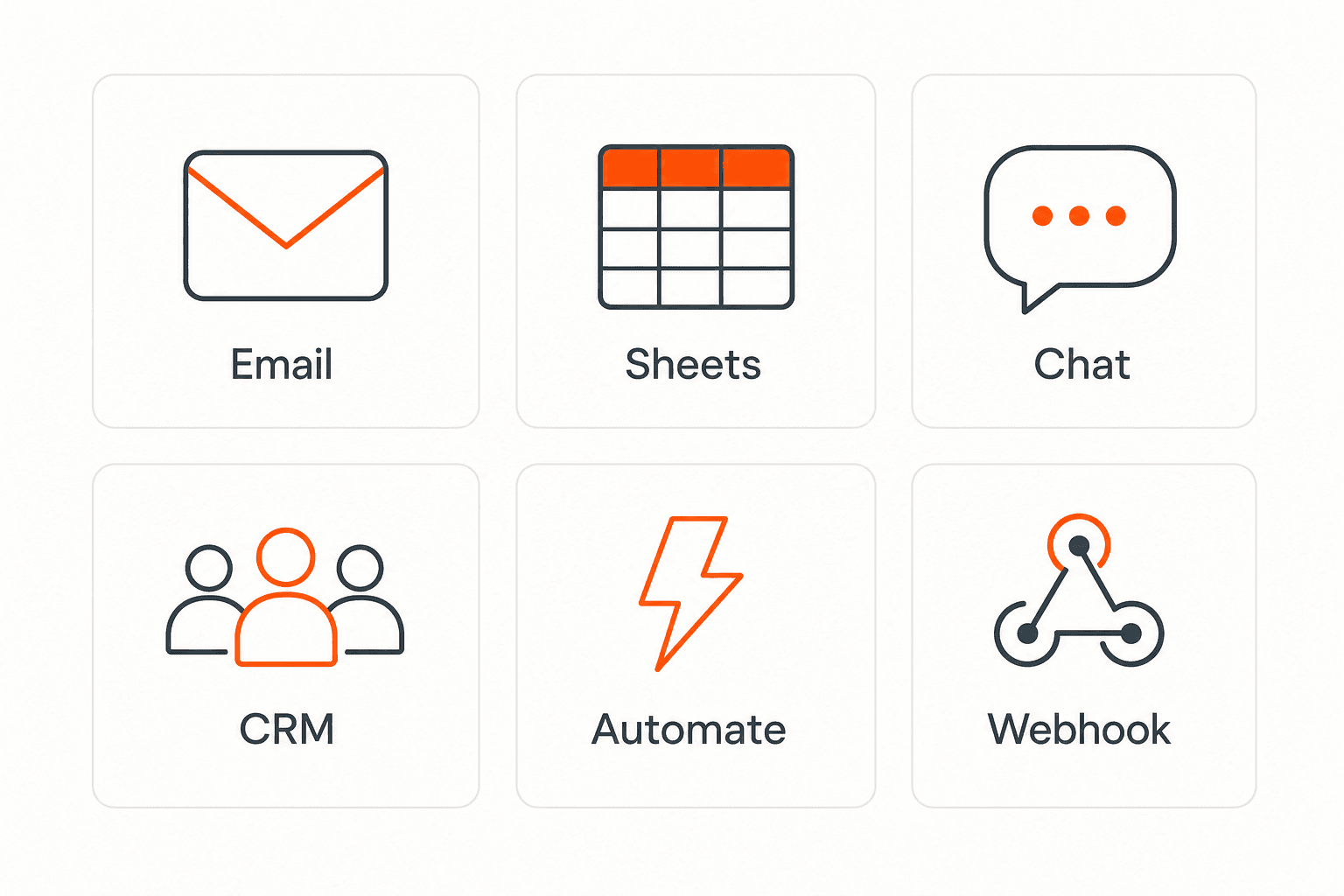
Send data to email, spreadsheets, CRMs, webhooks, and 7,000+ apps.
No credit card required. Set up in under 60 seconds.
Connect & automate
SplitForms works with the destinations you route to and the platforms you build on — from Slack and Sheets to WordPress, Shopify, and Next.js.
Trusted by indie teams and agencies shipping forms worldwide
Testimonials
40 quotes on record — from indie hacks to agency migrations.
“I replaced a Lambda + DynamoDB + SES contact form with six lines of HTML. It took eleven minutes, and the dashboard is better than what I was going to build.”
“We migrated 14 client sites off Formspree in a single weekend. The price is a third of what we paid, the API is more honest, and the spam filter actually works.”
“The webhook payload is signed, idempotent, and well-shaped. It reads like code from a competent team, not a CRUD app held together with duct tape.”
“I stopped reaching for Typeform on small marketing sites. splitforms covers 90% of the use case at none of the bloat.”
“I onboarded our whole agency in an afternoon. The MCP integration meant Cursor literally dropped the form straight into our client repos for us.”
“The free plan gave me 500 submissions before I paid a cent, and Pro is five dollars a month. I've spent more on coffee deciding which backend to use.”
“Spam went from forty junk entries a day to zero, with no reCAPTCHA puzzle ruining the form. The honeypot and time-trap just quietly do their job.”
“Point the form action at one endpoint and you're done. No SDK, no client library, no build step. This is how a form backend should feel.”
“Leads land in Slack the second someone submits, and a copy goes to Google Sheets for the sales team. I wired both up in under ten minutes.”
“I run a static Hugo site on a five-dollar VPS. splitforms gave it a real contact form without me standing up a single server.”
Questions
Copy the HTML + script snippet above into any page. Replace YOUR_ACCESS_KEY with your splitforms key. The script attaches a submit listener, builds FormData, posts to splitforms.com, and renders the response inline. No build step, no npm install.
Yes. Use jQuery's $.post or $.ajax with processData: false, contentType: false so it doesn't double-encode the FormData. Modern browsers don't need jQuery for this — but the splitforms endpoint accepts requests from any HTTP client.
Check data.success after parsing the JSON response. If false, render data.message into your status element. Wrap the fetch in try/catch for network errors, and check res.ok for HTTP-level errors — they're three separate failure modes.
Yes — anything that POSTs FormData to a URL works. The splitforms endpoint doesn't care about the client library, only about the request body and the access_key field.
Two options. (1) Inline success: render a styled <p> with aria-live after a 2xx response (default in our snippet). (2) Configure a URL in Dashboard → Form settings → Redirect and let the browser submit natively for a server-side 302.
The AJAX version requires JS. For a no-JS fallback, add action="https://splitforms.com/api/submit" method="POST" to the form tag and configure any thank-you URL in the splitforms dashboard. With JS, your handler intercepts; without JS, the browser performs a native form POST.
Without preventDefault, the browser does its own form submission to wherever the form's action attribute points (or the current page) AND your fetch runs. You see a flash, the page reloads, and your handler's effects are lost.
new FormData(form) skips inputs without a name attribute, skips disabled inputs, skips unchecked checkboxes/radios. If a field doesn't show up in your splitforms inbox, check whether it's disabled at submit time.
If splitforms returns a 401 (bad key) or 429 (rate limit), fetch resolves successfully. You have to check res.ok or data.success yourself. Wrapping in try/catch only catches network failures, not HTTP errors.
Without disabling the button on the first click, a quick double-click sends two POSTs. Both succeed; the user sees one success message; you see two submissions. Always set button.disabled = true at the start of the handler.
If your site has a Content-Security-Policy header with connect-src 'self', fetch to splitforms.com is blocked. Add it explicitly: connect-src 'self' https://splitforms.com.
Common mistake: writing fetch(url, { method: 'POST', headers: { 'Content-Type': 'multipart/form-data' }, body: formData }). The browser silently fails to append the boundary parameter (; boundary=---WebKitFormBoundary…) because you've overridden its automatic header — splitforms's parser then sees a malformed body and returns 400. Fix: omit the headers object entirely. The browser sets Content-Type correctly when you pass a FormData instance as the body. Same trap when copying example code from old jQuery tutorials that hardcode the header.
Vanilla JS / AJAX forms have been the no-framework default since jQuery's heyday. Without splitforms, the 'AJAX' part is one fetch line; the operational part is everything else: a backend route, an SMTP provider, a database for submissions, a honeypot or reCAPTCHA, a thank-you page, error handling for HTTP 4xx/5xx, retry logic. For 'JS-only on a static host' setups (Cloudflare Pages, GitHub Pages, S3), there's literally no server to run the route on — historically that meant Formspree, Formspark, Web3Forms, Basin. Splitforms is the modern entry: same shape, better free tier, better spam filtering, and signed webhooks from Pro.
Vanilla JS deploys to any static host — the snippet is HTML + inline <script>, no build step. CSP: if your site sets connect-src 'self', add https://splitforms.com to the directive or fetch is blocked. Browser support: native fetch is in every browser back to Edge 18 — the snippet runs without polyfills on every market-share-relevant browser. The progressive-enhancement variant (Pattern B) keeps the form working when JS fails to load — useful on flaky networks, ad-blocked clients, or for accessibility tools that disable JS.
Simple pricing
Choose a plan that fits your workflow — from a free form endpoint to full automations, exports, and higher submission limits.
Free forever
For side projects and indie devs.
For agencies and growing products.
Pay $59. 3 years sorted.
No credit card required on Free • Cancel anytime


